
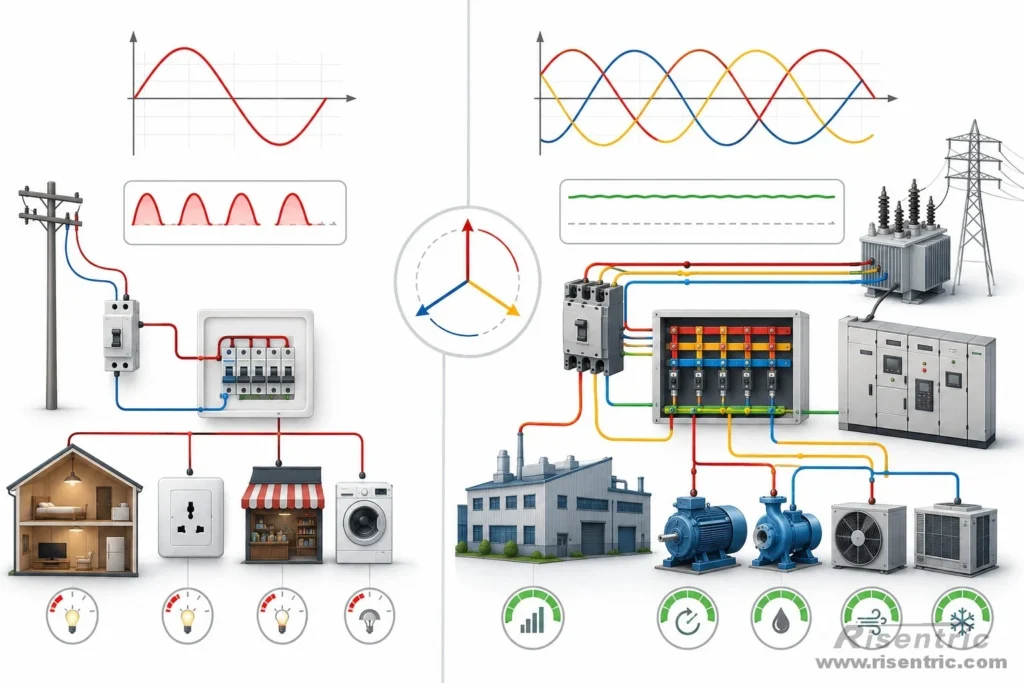
Note: This article is Part I of our Three-Phase Power series. We will start from the beginner level and gradually move toward a deeper, eventually academic-level understanding of three-phase power.
Single phase and three phase power are two of the most important basic concepts in electrical systems.
For small loads such as lighting, sockets, and home appliances, single phase power is often enough. For larger loads such as motors, pumps, HVAC systems, transformers, and switchgear, three phase power is usually more suitable.
The difference is not simply “three” versus “one”. This article explains the difference in a practical way.
- Single Phase vs Three Phase: Simple Comparison
- The Main Difference: Power Capacity and Stability
- Why Three Phase Is Common in Industry
- Does Three Phase Always Mean Higher Voltage?
- Three Phase Does Not Mean Every Load Is Three Phase
- How to Identify Single Phase or Three Phase in a Project
- Which One Should You Choose?
- Single Phase and Three Phase in Switchgear
- Common Mistakes
- Quick Summary
What Is a Phase in Electrical Power?
In AC power, voltage and current are not constant. They rise, fall, cross zero, and rise again in a repeating wave.
A phase means the position of one AC wave in this repeating cycle.
What is single-phase power
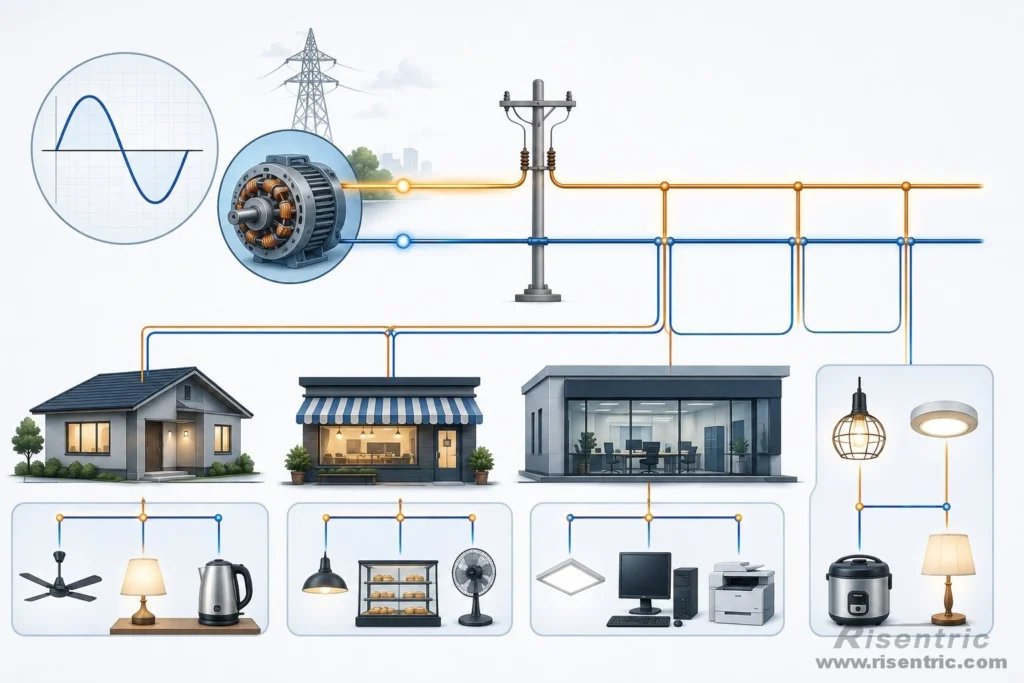
In single-phase power, there is one main AC voltage waveform supplying the load. In many common systems, this is supplied through a live conductor and a neutral conductor. Single-phase power is commonly used for homes, small shops, offices, lighting circuits, small appliances, and low-power equipment.
What is three-phase power
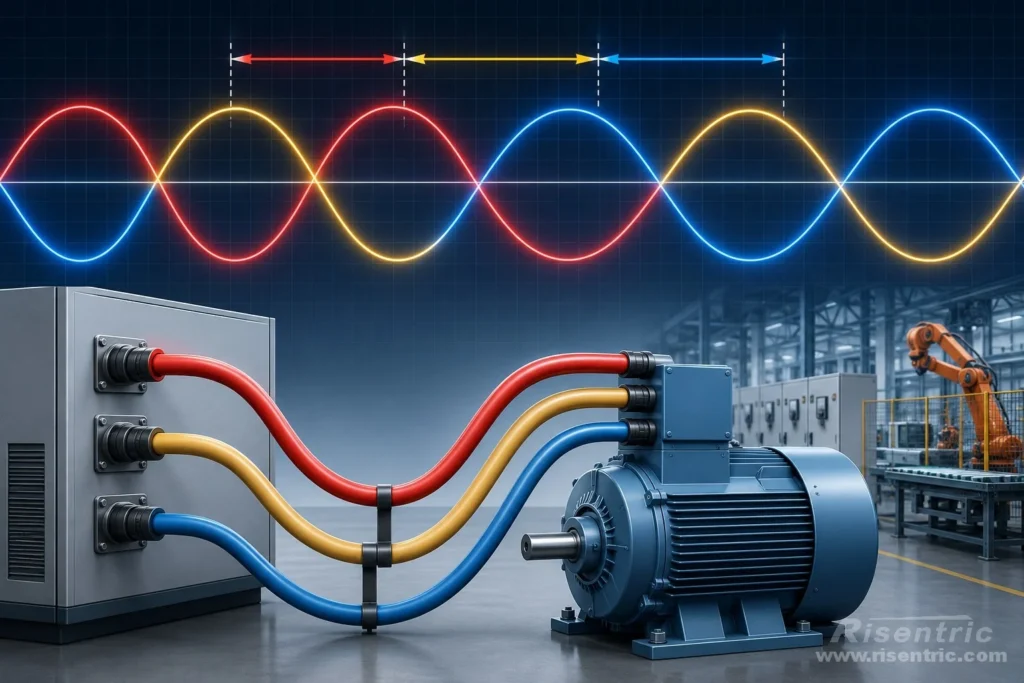
In three-phase power, there are three AC voltage waveforms. These three waves follow the same repeating cycle, but they do not reach their peaks at the same time. They are separated by 120 electrical degrees.
Because the three waves are spread across the cycle, three-phase power delivers energy more smoothly than single-phase power. This is especially useful for motors, pumps, fans, HVAC systems, elevators, transformers, LV switchgear, ATS panels, voltage regulators, and other industrial or commercial power systems.
In simple terms:
Single phase power uses one AC wave. Three phase power uses three AC waves working together.
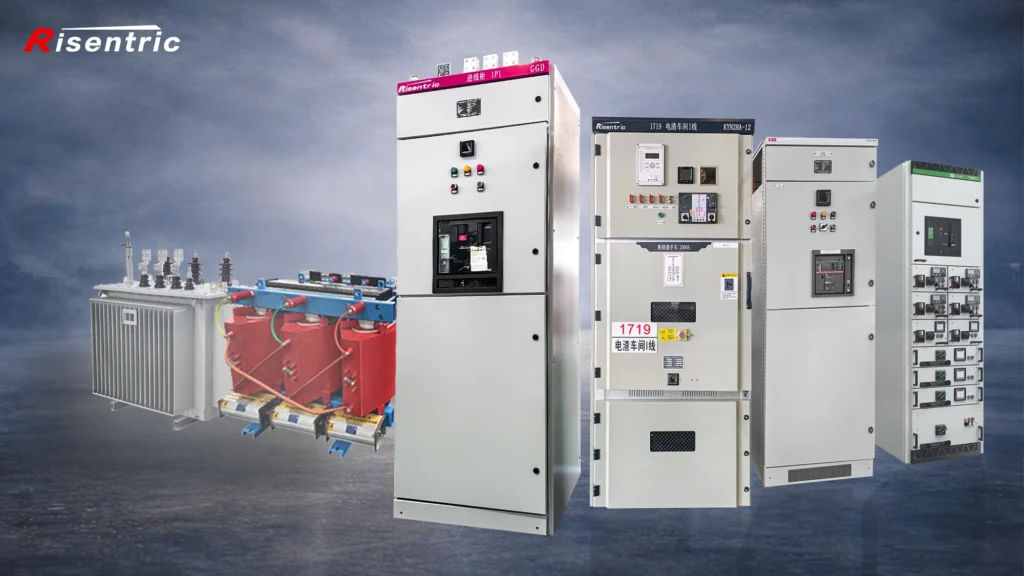
Looking for factory-tested 3-Phase switchgear & Panel boards for your project?
Single Phase vs Three Phase: Simple Comparison
| Item | Single Phase Power | Three Phase Power |
|---|---|---|
| Number of AC waveforms | One | Three |
| Phase angle | One waveform | Three waveforms, 120° apart |
| Common use | Homes, small shops, small loads | Commercial, industrial, high-power systems |
| Motor performance | Less smooth for larger motors | Smoother and better for motors |
| Load capacity | Lower | Higher |
| Wiring | Usually live + neutral, depending on local system | 3 wires or 4 wires with neutral, depending on system |
| Power delivery | Pulsating | More constant under balanced load |
| Typical equipment | Lighting, sockets, small appliances | Switchgear, transformers, pumps, motors, HVAC |
The Main Difference: Power Capacity and Stability
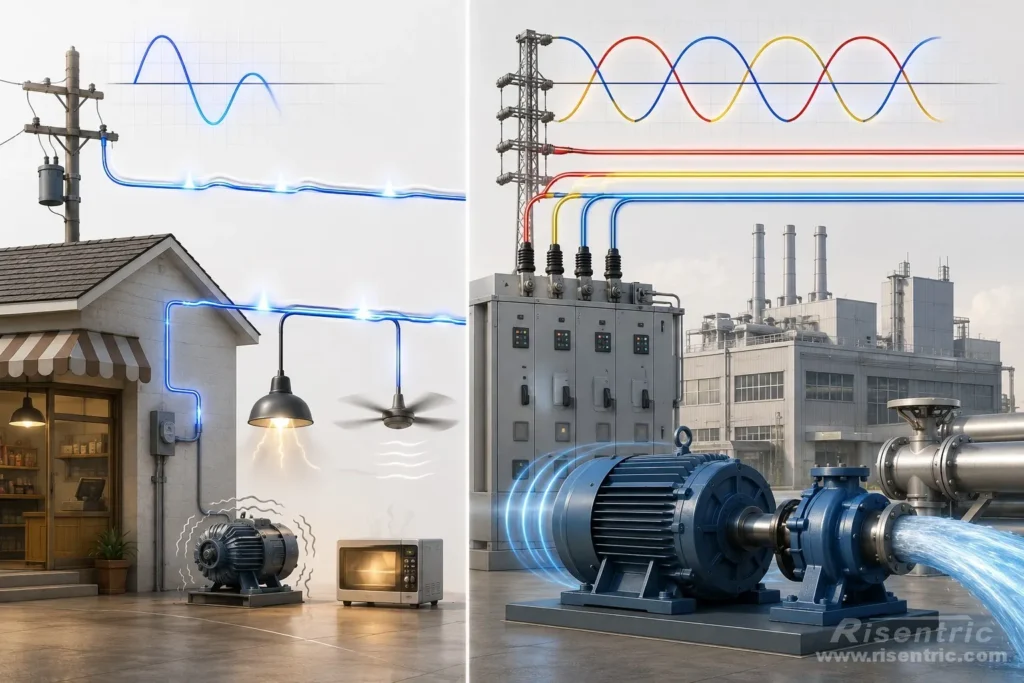
The biggest practical difference is not only the number of wires. It is the way power is delivered.
Single phase power rises and falls once per cycle. For small loads, this is usually acceptable. But for larger motors or industrial equipment, this can be less efficient and less stable.
Three phase power delivers energy through three separate phase waves. Because these waves are offset from each other, the total power is smoother. This is why three phase power is preferred for industrial loads, large motors, and distribution systems.
In simple words:
Single phase is suitable for smaller loads. Three phase is better for larger and more demanding loads.
Why Three Phase Is Common in Industry
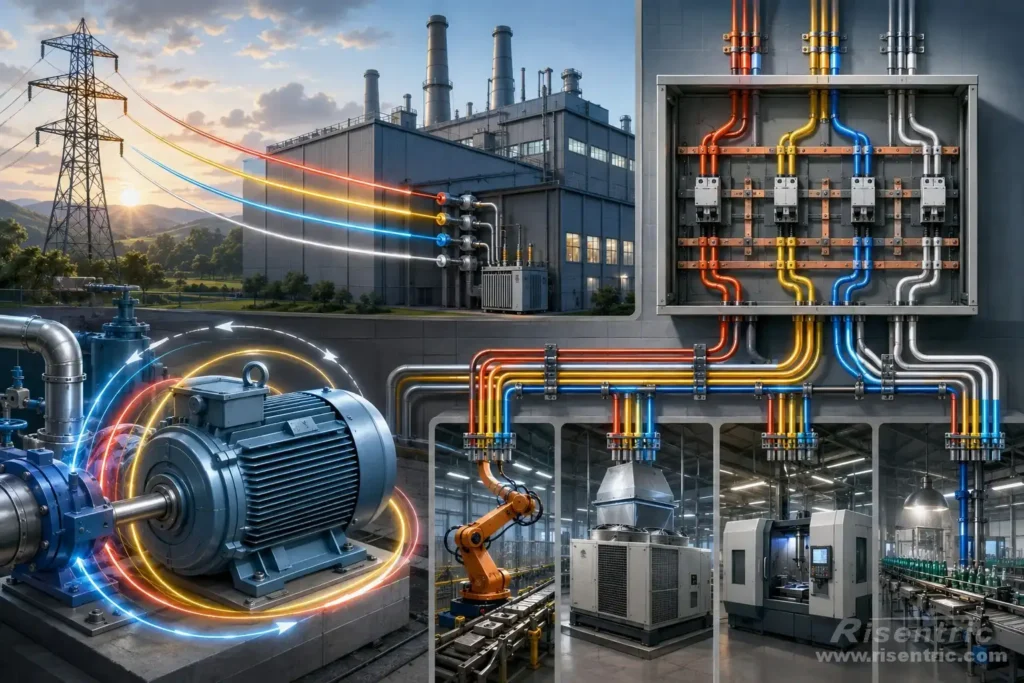
Three phase power has several practical advantages.
First, it can deliver more power efficiently. For the same current level, a three-phase system can transmit more power than a single-phase system. This is important for factories, commercial buildings, and large electrical systems.
Second, it is better for motors. A three-phase motor can start and run more smoothly because the three-phase supply naturally creates a rotating magnetic field. This improves motor performance and reduces vibration compared with many single-phase motor arrangements.
Third, three phase power is more suitable for balanced distribution. In a three-phase four-wire system, single-phase loads can be distributed across different phases to improve balance and avoid overloading one phase.
Does Three Phase Always Mean Higher Voltage?
Not always.
Three phase power is often associated with higher voltage, but “three phase” describes the number and timing of phase waveforms, not only the voltage level.
For example, many low-voltage distribution systems use three phase power. A common system in many regions is 400/230 V, where 400 V is the line-to-line voltage and 230 V is the line-to-neutral voltage. Other countries and projects may use different voltage systems.
So when reading an SLD, quotation request, or technical file, do not only check whether the system is single phase or three phase. Also check:
- Rated voltage
- Frequency
- Number of poles
- Neutral requirement
- Earthing system
- Load type
- Rated current
- Short-circuit level
Three Phase Does Not Mean Every Load Is Three Phase
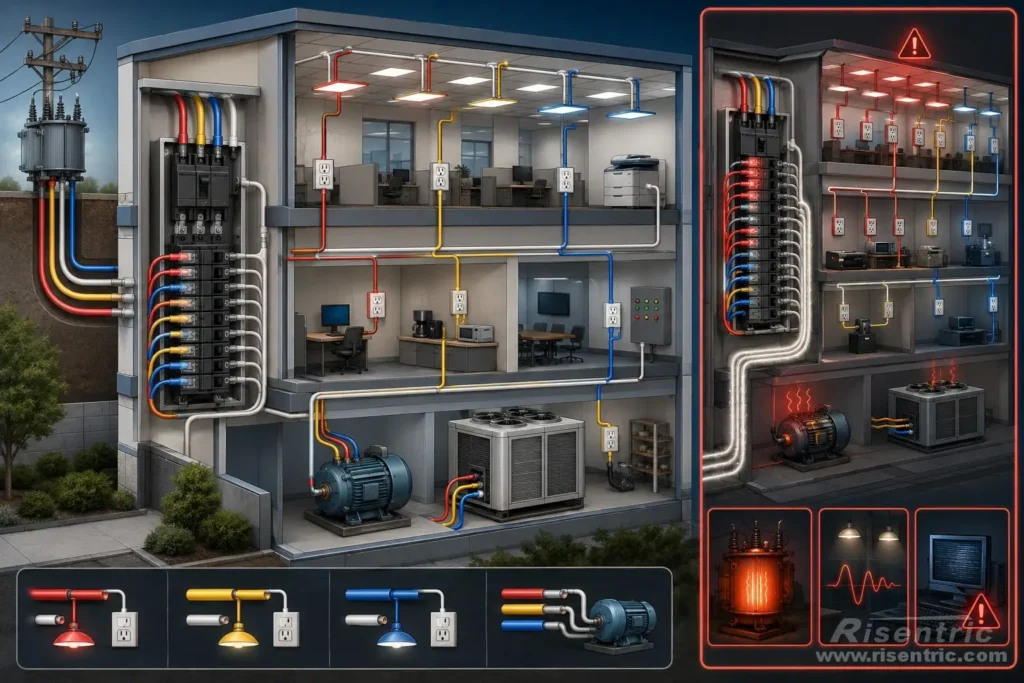
This is a very important point.
A building may receive three phase power, but many loads inside the building can still be single phase. For example, lighting, sockets, control power, and small appliances may use single-phase circuits taken from a three-phase distribution board.
In a three-phase four-wire system, single-phase loads can be connected between one phase and neutral. The important point is to distribute them properly across L1, L2, and L3 so the system is not badly unbalanced.
Poor phase balance can cause inefficient transformer use, higher neutral current, overheating, voltage problems, and unstable operation.
How to Identify Single Phase or Three Phase in a Project
In a real project, you can usually identify the power system from several clues.
If the technical file says 1P, 1P+N, or shows one live conductor and neutral, it is usually single phase.
If it says 3P, 3P+N, 3P+PE, or 3P+N+PE, it is three phase.
In switchgear and distribution board projects, three phase systems are also commonly shown as:
- L1, L2, L3
- R, S, T
- A, B, C
- U, V, W for motor terminals
- 400 V / 230 V
- 380 V / 220 V
- 415 V / 240 V
The exact naming depends on the country, standard, and drawing habit.
Looking for factory-tested 3-Phase switchgear & Panel boards for your project?
Which One Should You Choose?
For small residential or light commercial loads, single phase power is often enough. It is simpler and usually cheaper for small systems.
For industrial systems, large buildings, motors, pumps, elevators, workshops, HVAC systems, and electrical rooms, three phase power is usually preferred.
A simple rule is:
Use single phase for small and simple loads. Use three phase when the load is large, motor-based, industrial, or needs better power distribution.
However, the final choice should always follow the project design, local utility supply, electrical standards, and equipment requirements.
Single Phase and Three Phase in Switchgear
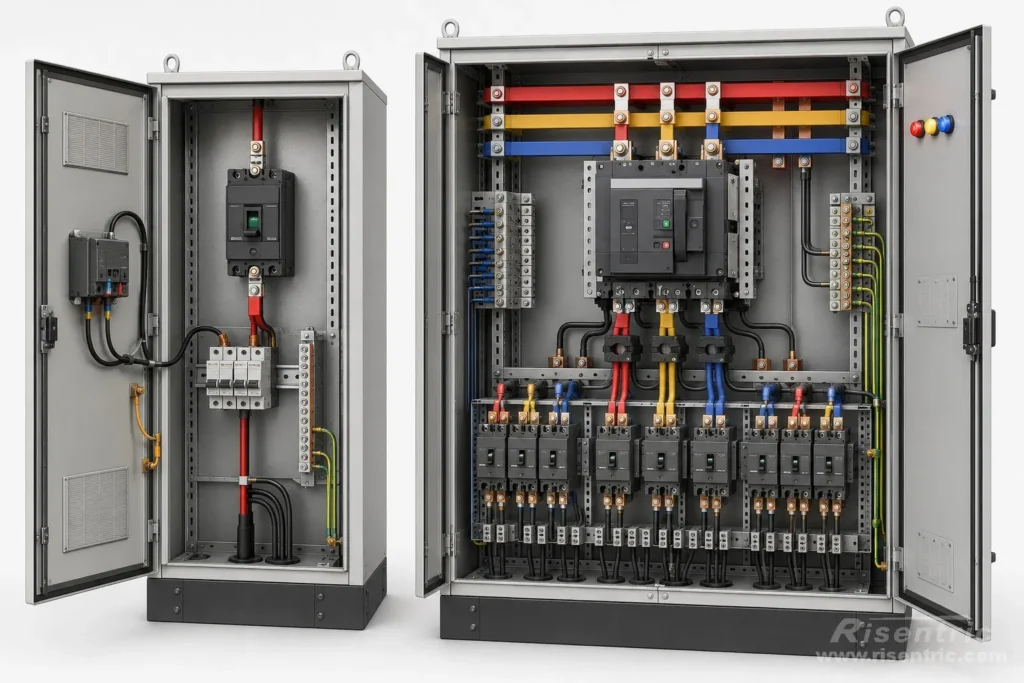
For switchgear manufacturers, the difference between single phase and three phase is not just theoretical. It affects the cabinet design.
For example, a three-phase LV switchgear panel may require:
- Three-phase busbars
- Larger rated current design
- ACB or MCCB selection
- Proper phase spacing
- Neutral busbar if required
- PE busbar
- CTs for metering or protection
- Three-phase voltage indication
- Phase sequence consideration
- Load balancing between outgoing circuits
For a single-phase panel, the structure is usually simpler, but the design still needs correct protection, cable sizing, earthing, and safety clearance.
This is why, when preparing a quotation, the supplier needs to confirm whether the system is single phase or three phase at the beginning.
Common Mistakes
- One common mistake is thinking that three phase is always better. It is not. If the load is small, single phase may be enough and more economical.
- Another mistake is thinking that a three-phase system only supplies three-phase loads. In reality, many three-phase distribution systems also supply many single-phase loads.
- A third mistake is ignoring phase balance. Even if the incoming supply is three phase, the outgoing single-phase loads should be arranged carefully to avoid overloading one phase.
- A fourth mistake is only checking voltage and ignoring the number of poles. For example, a breaker may be 1P, 2P, 3P, or 4P depending on the system and protection requirement.
Quick Summary
Single phase power uses one AC waveform and is common for homes, small shops, lighting, sockets, and small equipment.
Three phase power uses three AC waveforms separated by 120 degrees. It is common in commercial and industrial power systems because it can deliver higher power more smoothly and efficiently.
If you are reading an SLD or preparing a switchgear quotation, always confirm the phase system first. It is one of the most basic but most important project conditions.
FAQ
Is three phase power more powerful than single phase power?
Usually, yes. Three phase power is better suited for higher loads and industrial equipment. But the actual capacity still depends on voltage, current, transformer capacity, cable size, and protection design.
Can single-phase equipment run on three-phase power?
Yes, in many systems, single-phase loads can be supplied from a three-phase system by connecting to one phase and neutral, or sometimes between two phases depending on the voltage and equipment design. The loads should be distributed properly to keep the phases balanced.
Can three-phase equipment run on single-phase power?
Usually not directly. Some equipment may use a phase converter or VFD, but this depends on the equipment and application. For motors and industrial machines, the power supply requirement should always be checked carefully.
Is three phase only used in factories?
No. Three phase is common in factories, but it is also used in commercial buildings, apartments, shopping centers, hospitals, data centers, EV charging systems, and many larger electrical installations.
Why do three-phase systems use 120 degrees?
Three phases are separated by 120 degrees because one full AC cycle is 360 degrees, and 360 divided by 3 equals 120. This arrangement allows the three phase waves to work together smoothly and efficiently.


