
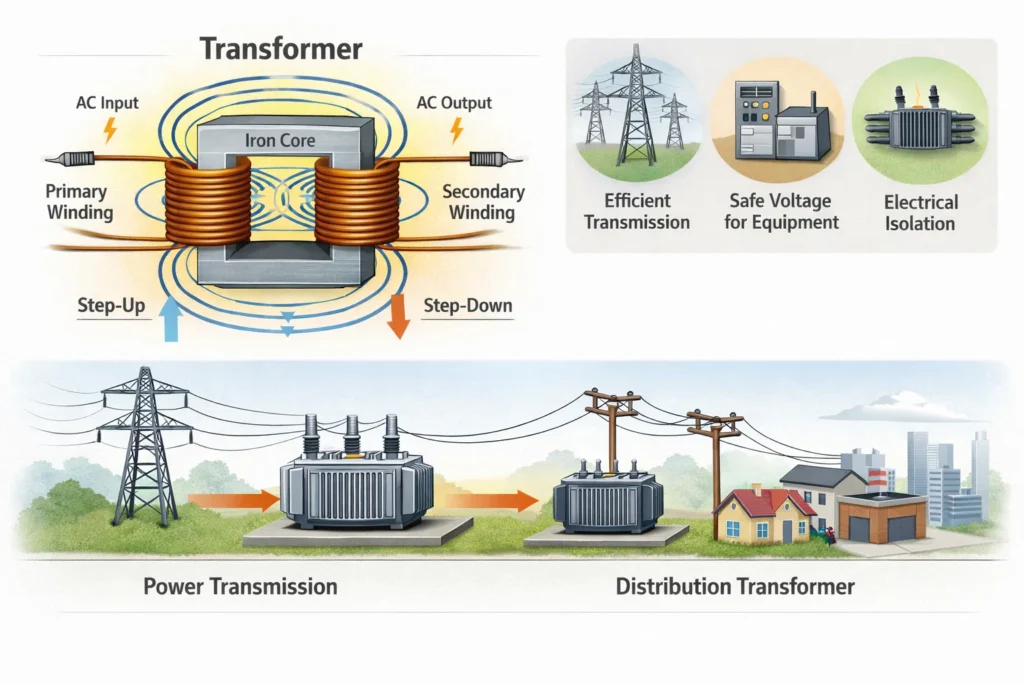
So what is a Transformer?
A transformer is an electrical device that transfers AC (alternating current) power from one circuit to another using electromagnetic induction. Its main job is to change voltage levels (step up or step down) while keeping the same frequency—so electricity can be transmitted efficiently and used safely by different loads.
In power distribution systems, transformers are essential because the voltage that is best for long-distance transmission is not the same voltage that is safest and most practical for industrial plants, buildings, and equipment.
What is the purpose of a transformer?
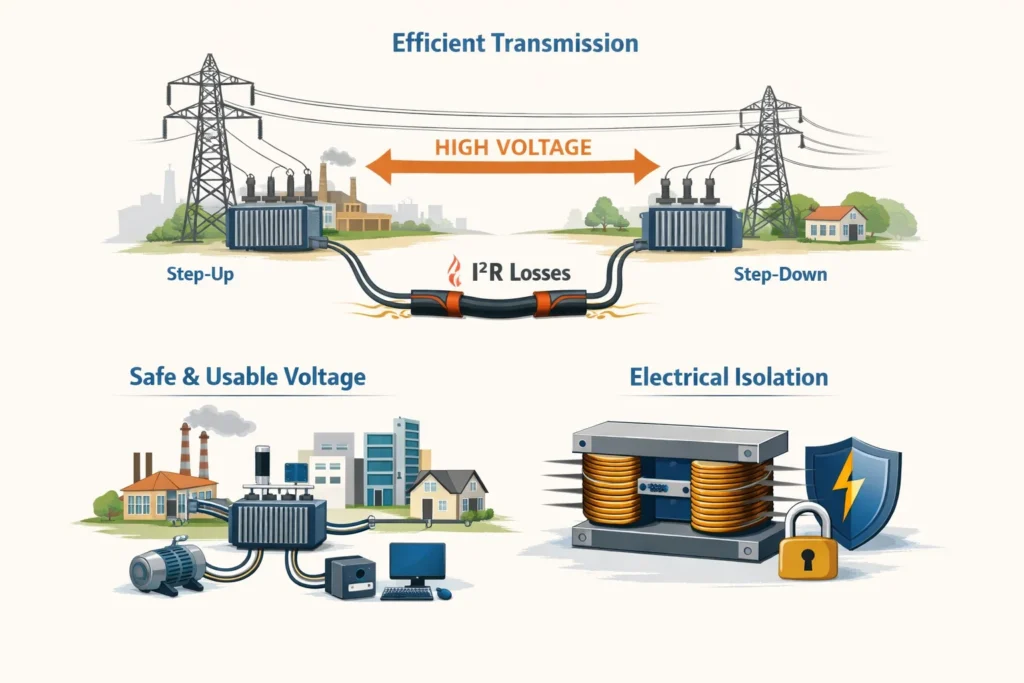
Transformers solve three practical problems in electrical systems:
- Efficient transmission
Higher voltage means lower current for the same power, which reduces I²R losses in cables. Utilities step up voltage for transmission, then step down voltage close to where it is used. - Safe and usable voltage for equipment
Most industrial and commercial equipment requires standardized voltages (for example, common low-voltage distribution levels). Transformers enable the system to deliver the correct voltage at each stage. - Electrical isolation (in many designs)
Many transformers provide galvanic isolation between primary and secondary circuits, which can improve safety and help reduce interference.
How a Transformer Works (Simple Explanation)
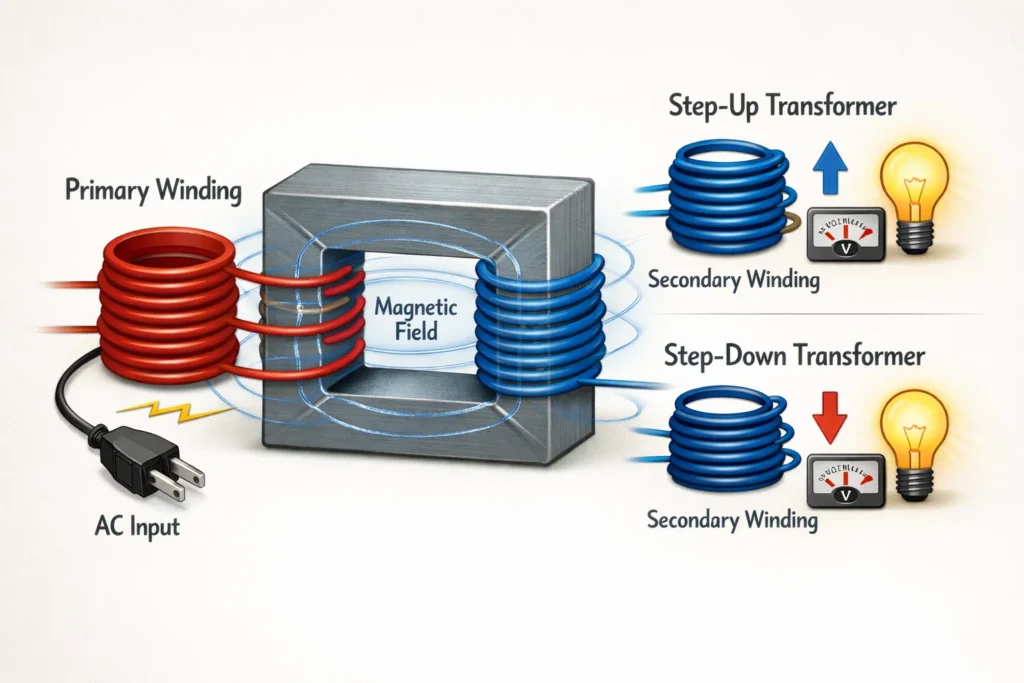
A typical transformer has two windings:
- Primary winding: connected to the incoming AC supply
- Secondary winding: provides output AC power at a different voltage
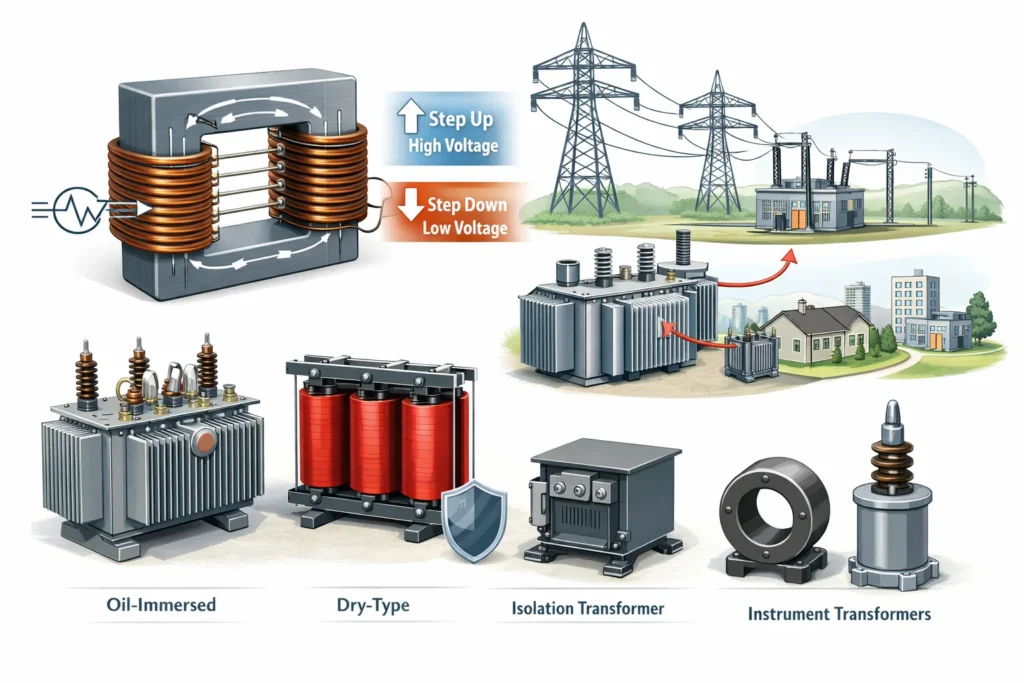
When AC flows through the primary winding, it creates a changing magnetic field in the transformer core. This changing magnetic field induces a voltage in the secondary winding.
The voltage ratio is determined by the turns ratio:
- Step-up transformer: secondary has more turns → higher output voltage
- Step-down transformer: secondary has fewer turns → lower output voltage
Where Transformers Fit in a Distribution System
In a typical power distribution architecture:
- The grid transmits power at high voltage
- A substation transformer reduces it to medium voltage
- A distribution transformer reduces it further to low voltage for switchgear, panels, and final loads
Transformers are commonly installed upstream of LV switchgear, MDBs, and other distribution assemblies to ensure loads receive the correct rated voltage.
Common Types of Transformers
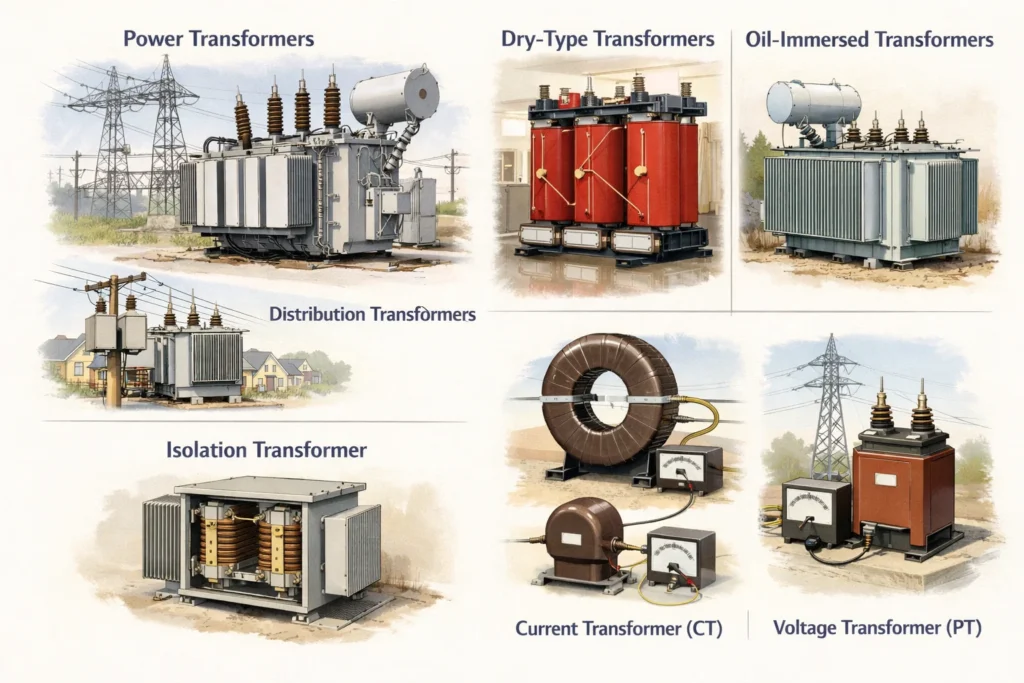
1) Power Transformers vs Distribution Transformers
- Power transformers are typically used in transmission/substations and optimized for high efficiency at higher loads.
- Distribution transformers are used closer to end users and optimized for efficiency across varying load conditions.
2) Dry-Type vs Oil-Immersed
- Dry-type transformers (air-cooled or cast resin): often used indoors where fire safety and cleanliness matter.
- Oil-immersed transformers: common outdoors and in substations; oil improves cooling and insulation performance.
3) Isolation Transformers
Used when you want electrical separation between supply and load for safety, noise reduction, or grounding control.
4) Instrument Transformers (CT/PT)
- CT (Current Transformer): steps current down for metering/protection
- PT/VT (Potential/Voltage Transformer): steps voltage down for metering/protection
These are used for measurement and protection rather than power delivery.
Key Transformer Ratings and Specifications
When specifying a transformer for a project, the most common parameters include:
- Rated power (kVA or MVA)
- Primary and secondary voltage (e.g., 11kV/0.4kV)
- Frequency (50Hz / 60Hz)
- Phase (single-phase or three-phase)
- Vector group (important for phase relationship and paralleling)
- Impedance (%) (affects short-circuit current and voltage drop)
- Cooling method (e.g., ONAN, ONAF for oil units; air/cast resin options for dry-type)
- Insulation class and temperature rise
- Standards compliance (IEC/IEEE depending on project requirements)
For switchgear and distribution box projects, matching transformer ratings to your load profile and protection scheme is critical to avoid overheating, nuisance trips, or poor voltage regulation.
Practical Notes on Transformer Installation and Maintenance
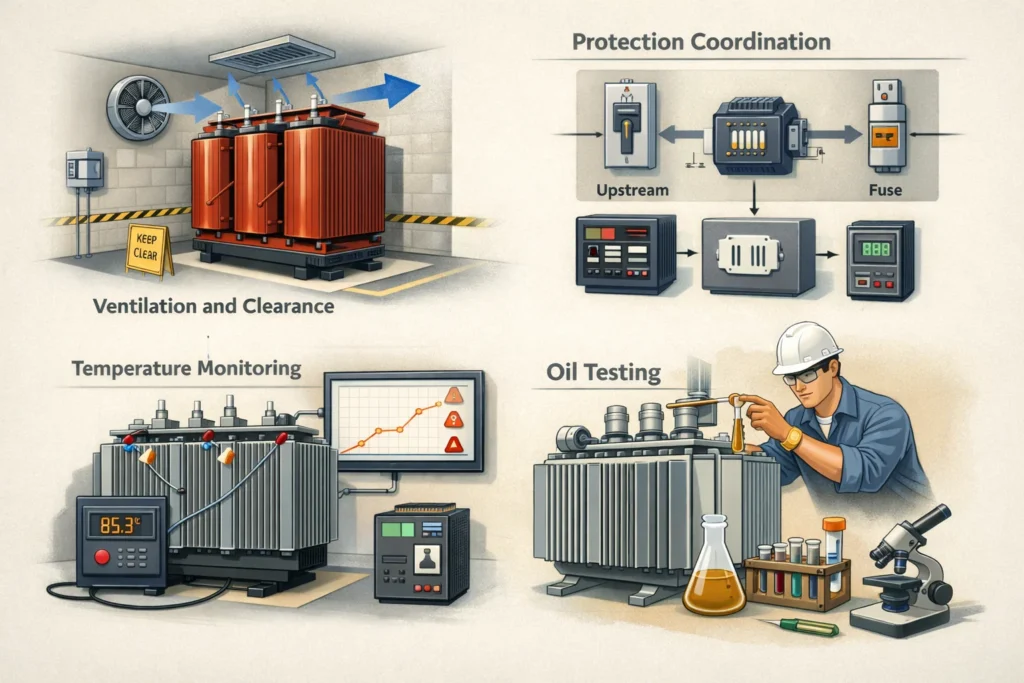
- Ventilation and clearance matter (especially for dry-type units).
- Protection coordination: upstream/downstream breakers, fuses, and relays must be selected based on transformer inrush and fault levels.
- Temperature monitoring: often used on larger units.
- Oil testing (oil transformers): periodic checks help detect insulation degradation early.
FAQ
What is a transformer?
A transformer is an electrical device that transfers AC power between circuits using electromagnetic induction. It is mainly used to step up or step down voltage while keeping the same frequency, so electricity can be transmitted efficiently and supplied safely to different loads.
Do transformers work with DC power?
Standard transformers require AC. DC does not create the changing magnetic field needed for induction (unless special high-frequency switching designs are used, like in SMPS).
What is the difference between a transformer and a UPS?
A transformer changes voltage and provides isolation. A UPS provides backup power and power conditioning (it may include transformers inside, depending on design).
Reference: What is a transformer


