
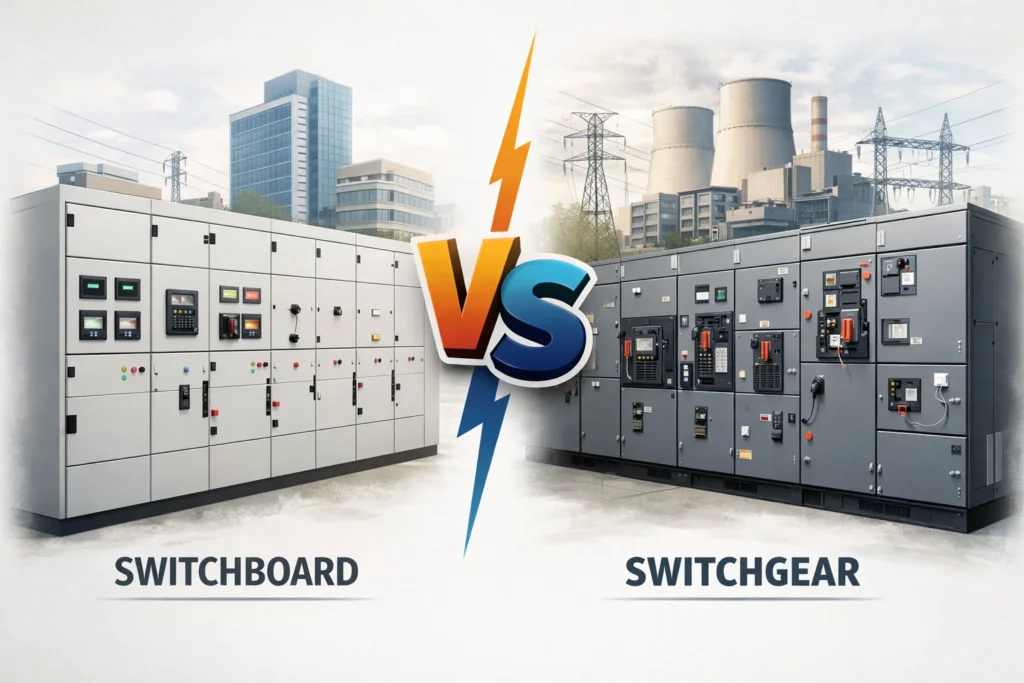
In electrical power distribution, the terms switchgear and switchboard are often used as if they mean the same thing. In practice, they are closely related, but they are not identical, and neither one is simply a broader version of the other.
This distinction matters in real projects. If the terminology is misunderstood, it can lead to the wrong expectations in specification, quotation, maintenance planning, or system design.
This article explains the difference between switchgear vs switchboard in a practical way, with a focus on real engineering use rather than vague naming habits.
- Short answer
- Why the terms are often confused
- What is a switchboard?
- What is switchgear?
- Switchgear vs switchboard: the real distinction
- Switchgear vs switchboard comparison table
- Is switchgear an advanced switchboard?
- Can a switchboard include switchgear components?
- When is a switchboard usually used?
- When is switchgear usually used?
- What about low-voltage switchgear?
- Practical conclusion – Switchgear vs Switchboard
Short answer
A switchboard is mainly a power distribution assembly. Its main role is to receive incoming power and distribute it to multiple outgoing circuits.
Switchgear is mainly a switching, protection, control, and isolation assembly. Its main role is to protect equipment, interrupt faults, and allow safe operation and maintenance of the electrical system.
So:
- A switchboard is not simply a broader term than switchgear
- Switchgear is not just an advanced switchboard
- They are different categories with overlapping functions
Why the terms are often confused
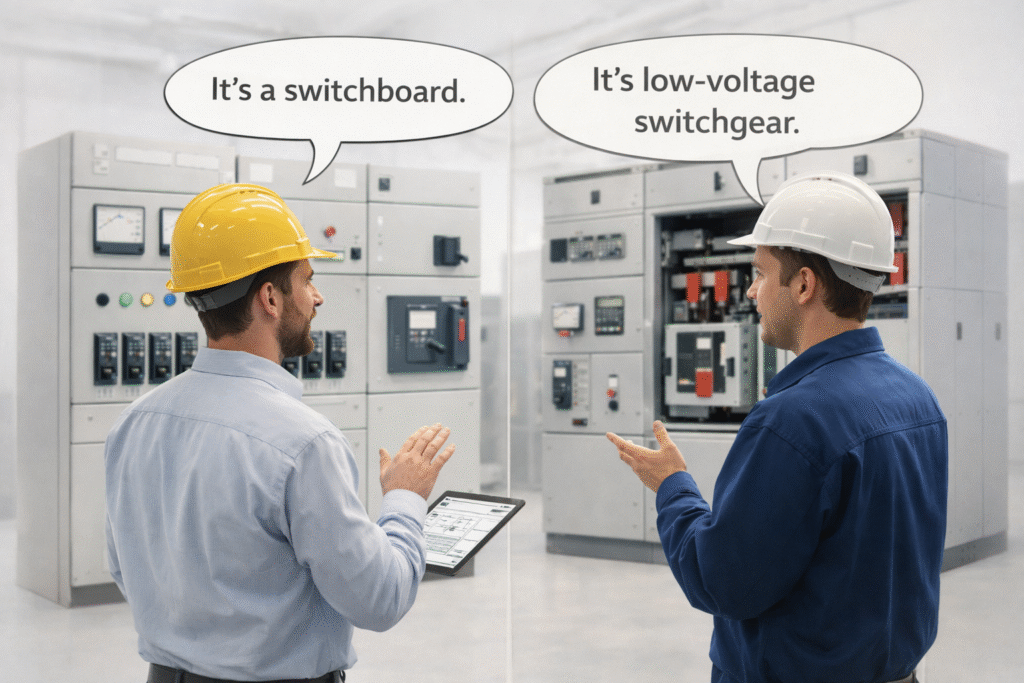
In actual projects, the naming is not always strict.
For example, one engineer may call the main low-voltage distribution assembly a switchboard, while another may call a similar lineup low-voltage switchgear. This happens especially across different countries, standards, and manufacturer product lines.
Switchgear vs switchboard – the real difference should not be judged only by the name. It should be judged by:
- overall function
- voltage level
- internal structure
- breaker type
- maintainability
- protection duty
- project standard
That is why, in engineering practice, the safer question is not “What is this called?” but rather:
What is this assembly designed to do?
What is a switchboard?
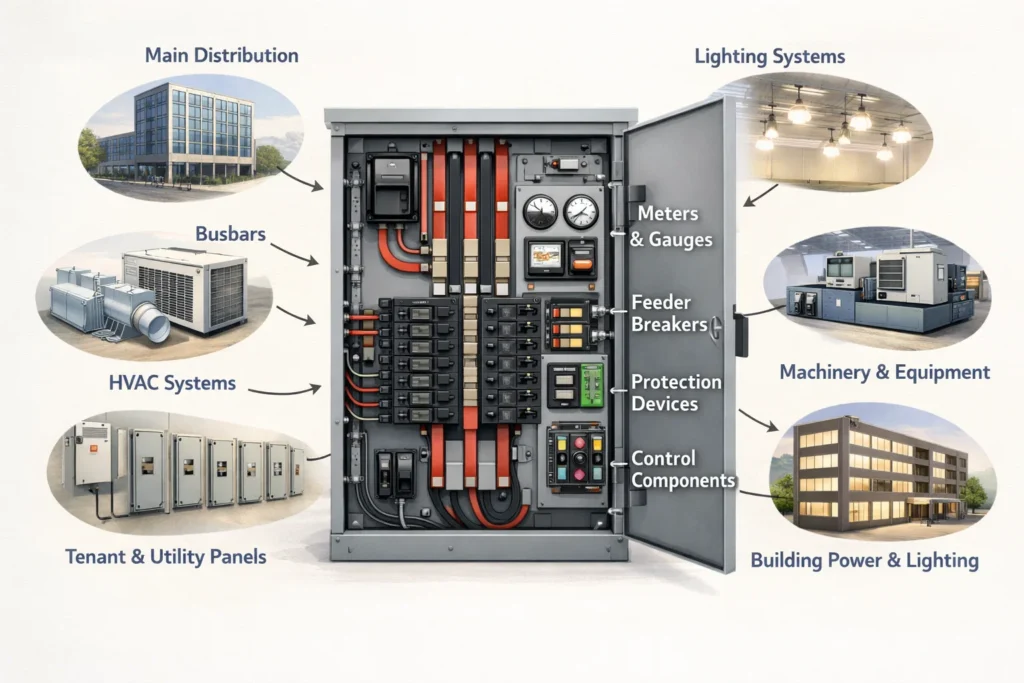
A switchboard is an electrical assembly used mainly to distribute power from one or more incoming sources to multiple outgoing feeders.
A typical switchboard may include:
- incoming main breaker or switch
- busbars
- outgoing feeder breakers
- metering instruments
- protection devices
- control components
Its central purpose is distribution.
In low-voltage commercial and industrial systems, switchboards are commonly used for:
- main distribution
- sub-distribution
- lighting and power feeders
- HVAC feeders
- building electrical systems
- tenant and utility distribution
In simple terms, a switchboard is usually the distribution hub of a low-voltage system.
What is switchgear?
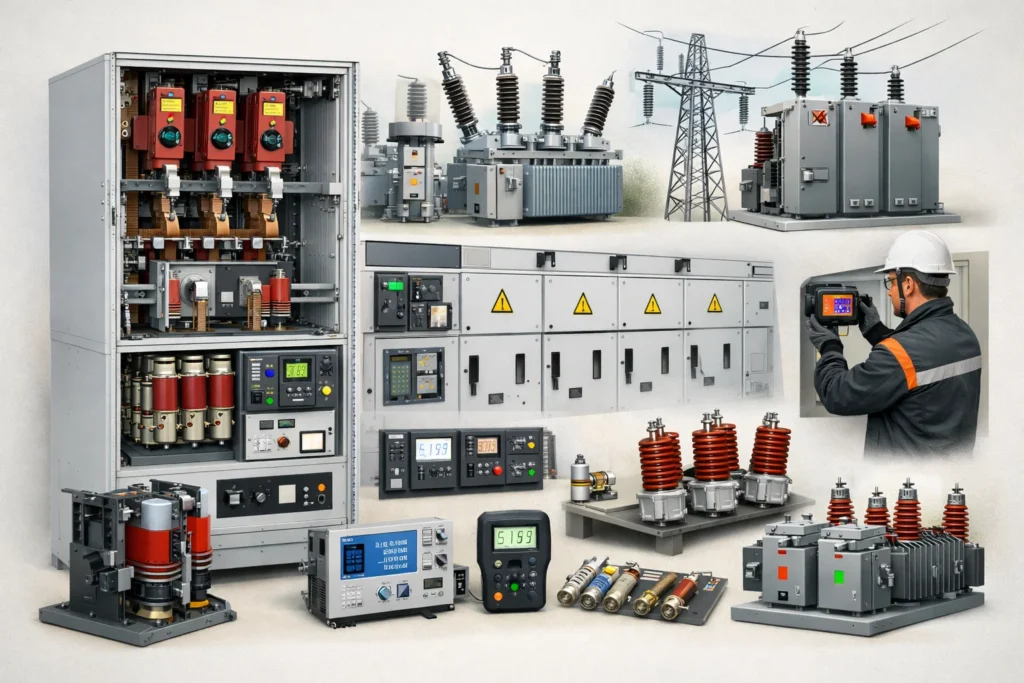
Switchgear refers to equipment primarily intended for switching, fault interruption, protection, control, and safe isolation of electrical circuits and equipment.
A switchgear assembly may include:
- circuit breakers
- disconnectors
- contact systems
- protection relays
- fuses
- metering and monitoring devices
- control compartments
- isolation sections
Its central purpose is protection and controlled switching, not just distribution.
Switchgear is commonly used where the system requires:
- fault interruption
- protection coordination
- high operational reliability
- safe isolation for maintenance
- higher short-circuit performance
- more structured compartmentalization
Switchgear can exist in low-voltage, medium-voltage, and high-voltage systems, although in practical conversation many people especially associate the word with medium-voltage and higher-duty assemblies.
Switchgear vs switchboard: the real distinction
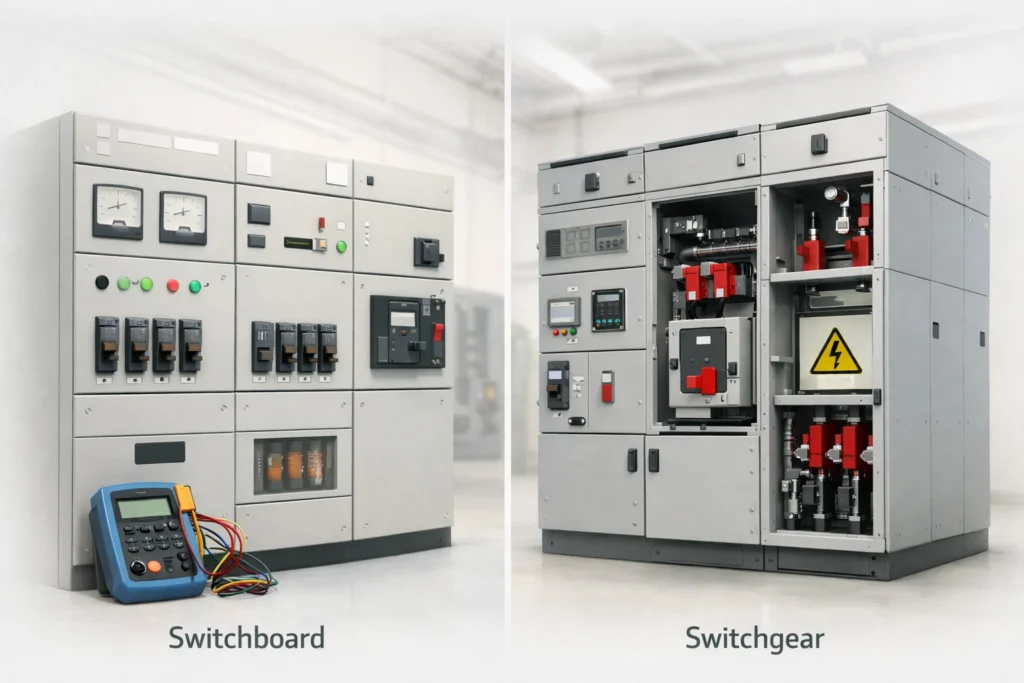
The most useful way to distinguish them is this:
- Switchboard = distribution-centered
- Switchgear = protection-centered
Both may contain breakers, busbars, meters, and control devices.
Both may appear in the same electrical room.
Both may serve as important parts of the distribution system.
But their design emphasis is different.
A switchboard is usually optimized around power distribution to multiple circuits.
Switchgear is usually optimized around safe switching, fault protection, isolation, and maintainability.
Switchgear vs switchboard comparison table
| Aspect | Switchboard | Switchgear |
| Main purpose | Power distribution | Protection, switching, control, isolation |
| Design emphasis | Feeding multiple outgoing circuits | Interrupting faults and ensuring safe operation |
| Typical voltage use | Mostly low voltage | Low, medium, or high voltage |
| Typical application | Commercial and industrial distribution | Utility, industrial, critical power, MV/HV systems |
| Internal structure | Usually more compact | Usually more robust and more separated |
| Maintenance focus | Functional distribution access | Safer isolation and maintainability |
| Protection duty | Moderate to high, depending on design | Usually higher-duty and protection-focused |
| Common perception | Distribution board lineup | More advanced protective switching lineup |
Is switchgear an advanced switchboard?
This is a common idea, but it is not the best technical definition.
It is true that, in many cases, switchgear feels like the more advanced or heavier-duty solution because it often offers:
- stronger fault-handling capability
- better compartmentalization
- improved isolation
- higher maintainability
- more protection-oriented design
So from a practical project perspective, people may feel that switchgear is a “higher-end” solution.
But conceptually, it is better to say:
Switchgear is not an advanced version of a switchboard.
Instead, switchgear and switchboard are different types of assemblies with different design priorities.
A switchgear lineup may be more advanced in protection and safety design, but that does not make switchboard a subset of switchgear, or switchgear a simple upgrade path from switchboard.
Can a switchboard include switchgear components?
Yes.
A switchboard can include devices such as:
- MCCBs
- ACBs
- disconnect switches
- fuses
- metering units
- protection accessories
That does not mean the entire assembly becomes “switchgear” in the strict sense.
key point:
having switchgear components inside a switchboard does not make switchboard and switchgear identical terms.
The classification depends on the overall function and construction of the assembly, not just on whether it contains protective devices.
When is a switchboard usually used?
A switchboard is usually preferred when the project mainly needs organized low-voltage power distribution with a relatively compact and practical arrangement.
Typical cases include:
- commercial buildings
- office buildings
- hotels
- shopping centers
- residential complexes
- standard industrial low-voltage distribution
- building main distribution boards
- sub-distribution systems
In these applications, the main goal is efficient and reliable feeder distribution.
When is switchgear usually used?
Switchgear is usually preferred when the project requires stronger emphasis on:
- system protection
- operational safety
- isolation
- fault interruption
- reliability
- maintainability
- medium-voltage distribution
- higher criticality
Typical cases include:
- utility substations
- industrial plants
- heavy industry
- petrochemical systems
- data centers
- hospitals
- critical infrastructure
- medium-voltage incoming and feeder systems
In these applications, the electrical assembly must do more than simply distribute power. It must also protect the system at a higher level.
What about low-voltage switchgear?
This is where confusion becomes even more common.
At low voltage, there can be a gray area in everyday speech because both switchboards and low-voltage switchgear may use breakers, busbars, feeder units, metering, and similar enclosure forms.
The difference is usually in the construction philosophy and duty level, such as:
- degree of separation
- type of breakers used
- fault withstand capability
- accessibility
- maintainability
- standard classification
- intended level of service continuity
So in low-voltage systems, the term cannot always be judged from appearance alone.
How to choose between switchgear and switchboard
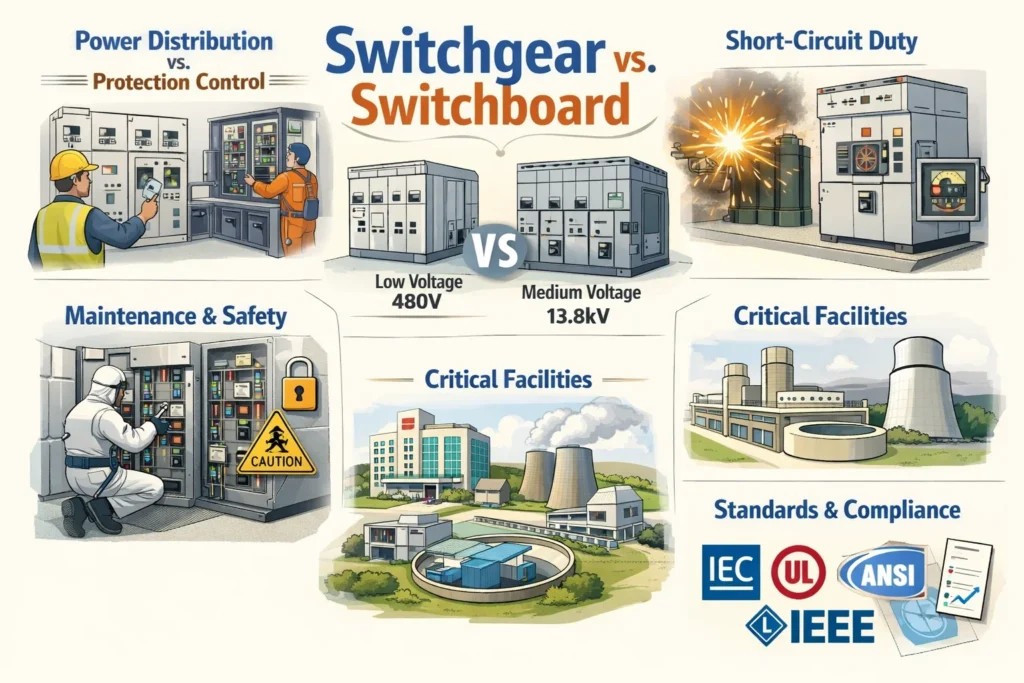
When deciding between switchgear vs switchboard, ask these questions:
1. What is the main task of the assembly?
Is it mainly distributing power to many feeders, or mainly protecting and controlling a critical part of the system?
2. What is the voltage level?
Low-voltage systems often use switchboards, while medium-voltage systems much more commonly use switchgear.
3. What short-circuit duty is required?
Higher fault levels usually push the design toward more protection-focused equipment.
4. How important is maintainability?
If isolation, section separation, and safer maintenance are major priorities, switchgear may be the better fit.
5. How critical is the load?
Hospitals, plants, utilities, and high-reliability systems often justify switchgear more easily than standard building distribution does.
6. Which standard is the project following?
Always check whether the project is based on IEC, UL, ANSI, IEEE, or customer-specific requirements.
Practical conclusion – Switchgear vs Switchboard
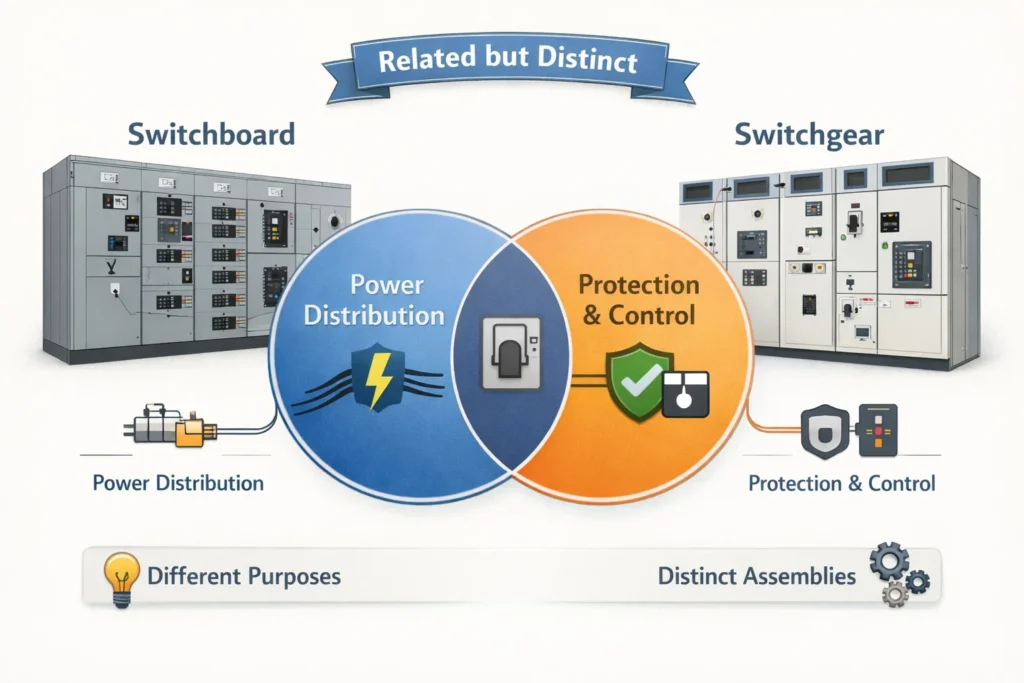
If you want one simple takeaway, use this:
A switchboard is mainly for distributing electrical power.
Switchgear is mainly for switching, protection, control, and safe isolation.
They overlap, but they are not in a simple parent-child relationship.
So the safest wording is not:
- “switchgear is just an advanced switchboard”
Instead, say:
Switchboard and switchgear are related but distinct assemblies, with different primary design purposes.
That wording is much more accurate for engineering communication.
FAQ
What is the difference between switchgear vs switchboard?
A switchboard mainly distributes electrical power to outgoing feeders, while switchgear mainly focuses on switching, protection, fault interruption, control, and isolation.
Is switchgear better than switchboard?
Not automatically. Switchgear is not simply “better.” It is better suited for applications that need stronger protection, isolation, and maintainability. A switchboard may be the better choice for standard low-voltage power distribution.
Is switchgear more advanced than switchboard?
In some projects, switchgear may be more advanced in safety, fault-handling, and maintainability. But technically, it is better described as a different type of assembly, not just an advanced switchboard.
Can a switchboard contain circuit breakers and protection devices?
Yes. A switchboard often contains breakers, disconnectors, meters, and other protective devices. That does not make switchboard and switchgear the same term.
Is switchgear only used in medium voltage?
No. Switchgear can be used in low-, medium-, and high-voltage systems. However, the term is very commonly associated with medium-voltage and higher-duty applications.
Which is used in commercial buildings?
Commercial buildings often use switchboards for low-voltage power distribution. More critical or specialized facilities may also use switchgear, depending on the system requirements.
For any further questions about switchgear vs switchboard, please feel free to contact us. Our team is ready to provide professional support based on your project requirements.
Reference:
https://community.se.com/t5/Power-Distribution-and-Digital/What-is-the-difference-between-switchgear-and-switchboard/td-p/530451?utm_source=chatgpt.com
https://www.eaton.com/us/en-us/products/low-voltage-power-distribution-control-systems/switchgear-lv/switchboard-vs-switchgear-application-considerations.html


