
Please note: this article is academically oriented and intended for readers who want a deeper technical explanation.
Level: Advanced
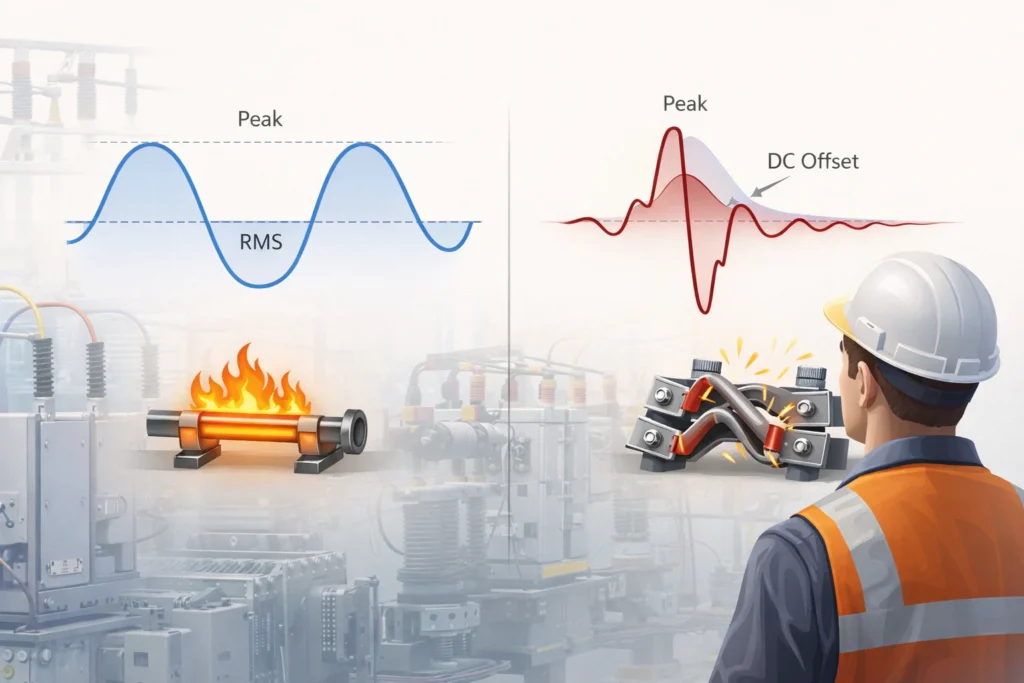
In the first article, we explained the basic difference between RMS and peak. In this second article, we go one level deeper and focus on RMS vs peak in short-circuit current, because this is where the distinction becomes truly important in power engineering.
The core idea is simple: a fault current does not damage equipment in only one way. It creates thermal stress over time and mechanical stress at the worst instant, so engineers need more than one current quantity to describe the event properly. We can describe fault current in this dual way: an early peak in the asymmetrical state, and an RMS current that governs the later effective duty.
- Why do we even have both RMS and peak?
- Why short-circuit current is more complicated than a normal sine wave
- What is the DC offset physically?
- Why the first peak can be much larger than 1.414 × RMS
- Then what exactly is peak current?
- Why the first peak matters so much mechanically
- What does "available fault current" mean?
- The simplest mental model
- Why this matters in real engineering conversations
- Conclusion
Why do we even have both RMS and peak?
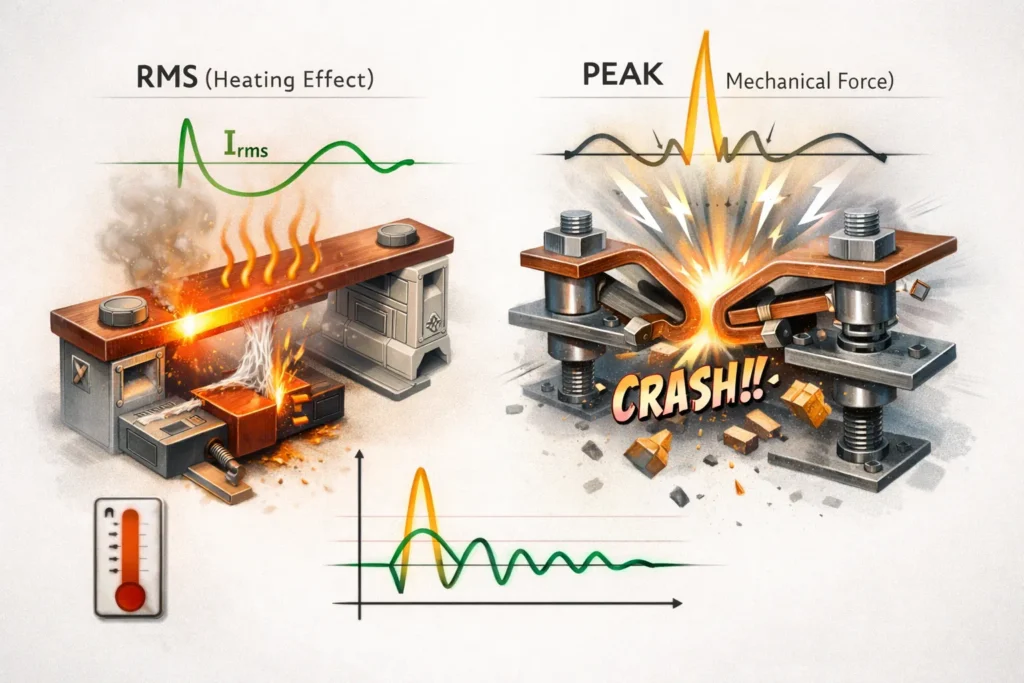
The root reason is that a short-circuit current has two different destructive effects.
One is heating. Conductors, contacts, and busbars experience Joule heating, which depends on current over time in a square-law sense. The other is mechanical force. During the first fault loop, very high current produces very strong electrodynamic stress on conductors and supports. ABB’s IEC 61439 material treats short-circuit capability in terms of the mechanical, electrical, and thermal strength of the busbar system, while CMP notes that the peak fault occurs first and is the maximum instantaneous value of the short-circuit current.
That is why these two questions are different:
- RMS asks: how severe is the fault in an effective, heating sense?
- Peak asks: what is the maximum instantaneous punch delivered by the waveform?
That distinction is the real reason both values exist.
What exactly is RMS?
RMS means root mean square. In practical electrical engineering, RMS is the value of a varying current or voltage that produces the same heating effect as an equivalent DC value.
For a time-varying current i(t), the RMS value is:
I_{\mathrm{RMS}} = \sqrt{\frac{1}{T}\int_{0}^{T} i^{2}(t)\,dt}Why RMS is not just the average
RMS is not the same as the ordinary average.
A pure AC sine wave has positive and negative halves, so its ordinary average over a full cycle is zero. But the conductor still heats up, which means simple averaging cannot represent the real electrical effect.
Why not use absolute average then?
The reason RMS uses squaring, averaging, and then square root is physical rather than arbitrary: resistive heating follows
P=I^2R
So the current must be treated through its square if we want a value that reflects its true thermal effect.
The physical meaning of the RMS formula is straightforward: it is the heating-equivalent current of a varying waveform.
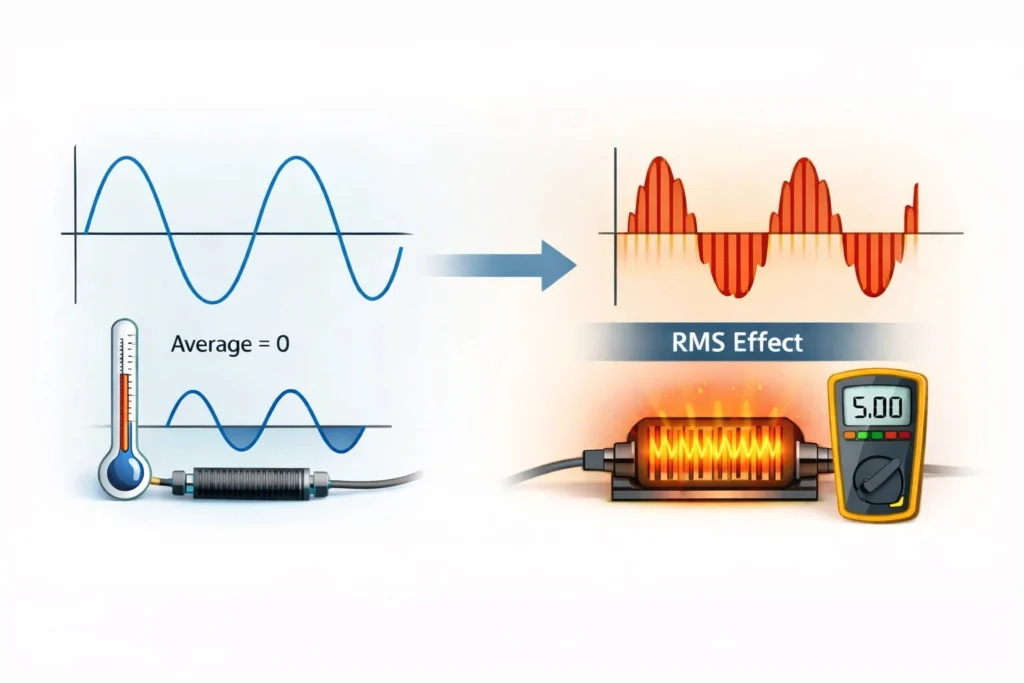
So RMS is not a “mere average.” It is a value built to match the physical effect that current actually produces.
RMS and peak for a pure sinusoid
For a clean sinusoidal current,
i(t) = I_{\mathrm{peak}}\sin(\omega t)the relationship is:
I_{\mathrm{RMS}} = \frac{I_{\mathrm{peak}}}{\sqrt{2}} or equivalently:
I_{\mathrm{peak}} = \sqrt{2}\,I_{\mathrm{RMS}} \approx 1.414\,I_{\mathrm{RMS}}The derivation:
Start from the RMS definition
I_{\mathrm{RMS}}=\sqrt{\frac{1}{T}\int_{0}^{T} i^{2}(t)\,dt}For a pure sinusoidal current
i(t)=I_{\mathrm{peak}}\sin(\omega t)Substitute into the RMS formula
\begin{aligned}
I_{\mathrm{RMS}}&=\sqrt{\frac{1}{T}\int_{0}^{T}\left(I_{\mathrm{peak}}\sin(\omega t)\right)^{2}dt}
\\\\&=\sqrt{\frac{I_{\mathrm{peak}}^{2}}{T}\int_{0}^{T}\sin^{2}(\omega t)\,dt}
\\\\&=I_{\mathrm{peak}}\sqrt{\frac{1}{T}\int_{0}^{T}\sin^{2}(\omega t)\,dt}
\end{aligned}
Due to
\sin^{2}x=\frac{1-\cos(2x)}{2}\begin{aligned}
\frac{1}{T}\int_{0}^{T}\sin^{2}(\omega t)\,dt
&=
\frac{1}{T}\int_{0}^{T}\frac{1-\cos(2\omega t)}{2}\,dt
\\\\&=
\frac{1}{2T}\int_{0}^{T}1\,dt-
\frac{1}{2T}\int_{0}^{T}\cos(2\omega t)\,dt
\end{aligned}\text{For the 1st term,}
\\[2em]
\frac{1}{2T}\int_{0}^{T}1\,dt=\frac{1}{2T}\cdot T=\frac{1}{2}\text{For the 2nd term,}
\\[2em]
\int_{0}^{T}\cos(2\omega t)\,dt
=
\left[\frac{\sin(2\omega t)}{2\omega}\right]_{0}^{T}
=
\frac{\sin(2\omega T)-\sin(0)}{2\omega}\text{Since one period satisfies}
\\[2em] T=\frac{2\pi}{\omega}
\\ ({\omega}\text{ is the angular frequency})
\\[2em]
\to 2\omega T=2\omega\cdot\frac{2\pi}{\omega}=4\pi
\\
\to \sin(2\omega T)=\sin(4\pi)=0
\\[2em]
\to\int_{0}^{T}\cos(2\omega t)\,dt=0\text{Therefore the average of }sin^{2}(\omega t) \text{ over one period is: }
\\
\frac{1}{T}\int_{0}^{T}\sin^{2}(\omega t)\,dt=\frac{1}{2}
\\[2em]
\begin{aligned}
\to I_{\mathrm{RMS}}&=I_{\mathrm{peak}}\sqrt{\frac{1}{T}\int_{0}^{T}\sin^{2}(\omega t)\,dt}
\\
&=I_{\mathrm{peak}}\sqrt{\frac{1}{2}}
\\
&=\frac{I_{\mathrm{peak}}}{\sqrt{2}}
\end{aligned}
\\[2em]
\to I_{\mathrm{peak}}=\sqrt{2}\,I_{\mathrm{RMS}}\approx1.414\,I_{\mathrm{RMS}}Derivation ends
E.g. Texas Instruments uses the familiar AC example that 120 V RMS corresponds to about 170 V peak, which is exactly the same sine-wave relationship.
So if a sinusoidal fault current were 100 A RMS, its peak would be about 141.4 A. This is the relationship many engineers remember first. But it is only true for a clean symmetrical sine wave.
Why short-circuit current is more complicated than a normal sine wave
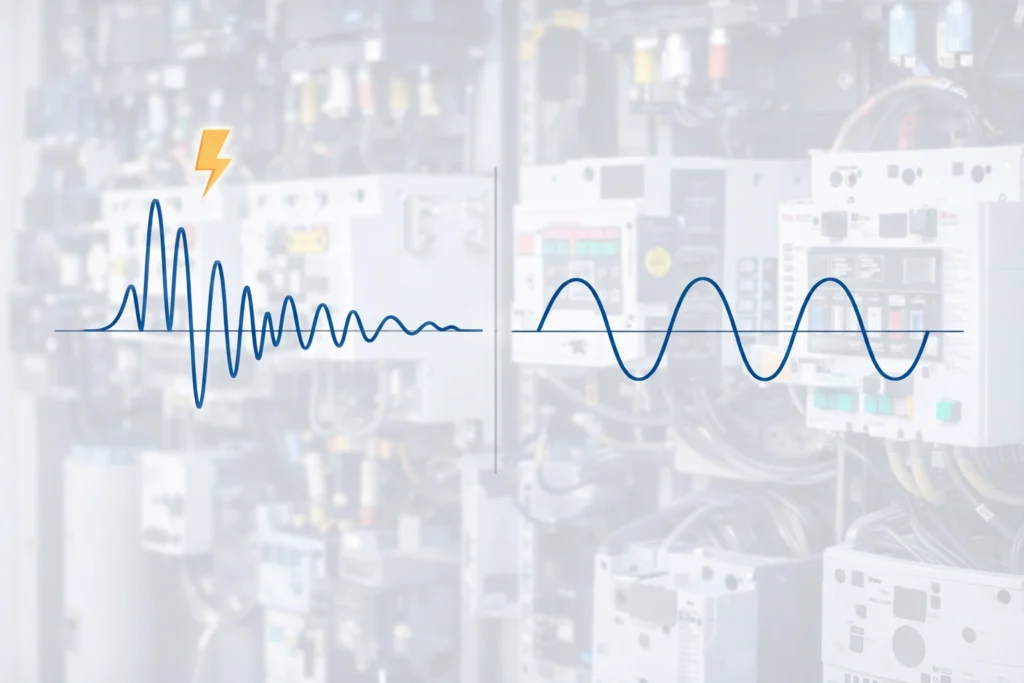
A real short-circuit current usually does not begin as a neat symmetrical sine wave.
CMP explains that a three-phase short-circuit fault can be split into an asymmetrical state and a later symmetrical state. Schneider similarly distinguishes symmetrical and asymmetrical short-circuit current, noting that the asymmetrical case includes a DC offset superimposed on the AC component.
That means the actual current waveform may initially look like a sine wave shifted upward or downward, not centered neatly around zero. In practice, this is one of the most important reasons engineers cannot stop at the simple 1.414 × RMS rule.
What is the DC offset physically?
The DC offset is a transient component that appears when the fault starts.
Schneider explains that the asymmetrical breaking current includes both AC and DC components, and that the DC offset decays over a few cycles.
Physically, this happens because the current does not always begin from the “ideal” place on the waveform, and because the system’s inductive behavior prevents the current from instantly jumping into its final symmetrical sinusoidal pattern. Early in the fault, the waveform is therefore asymmetrical; later, the transient component dies away and the waveform becomes more symmetrical.
Why the first peak can be much larger than 1.414 × RMS
This is one of the most important ideas in short-circuit analysis.
A real short-circuit current often does not start as a pure symmetrical sine wave. At the moment the fault begins, the current may include not only the AC component but also a decaying DC offset.
This DC offset shifts the waveform upward or downward during the first few cycles. As a result, the first half-cycle peak is no longer just the crest of a centered sine wave. It becomes the sum of:
- the AC sinusoidal component, and
- the temporary DC offset component
So in normal steady AC, peak ≈ 1.414 × RMS.
In an actual short-circuit, the first peak can be much higher, because the waveform is initially asymmetrical rather than perfectly centered around zero.
That is why the first fault peak deserves special attention in fault engineering.
Then what exactly is peak current?
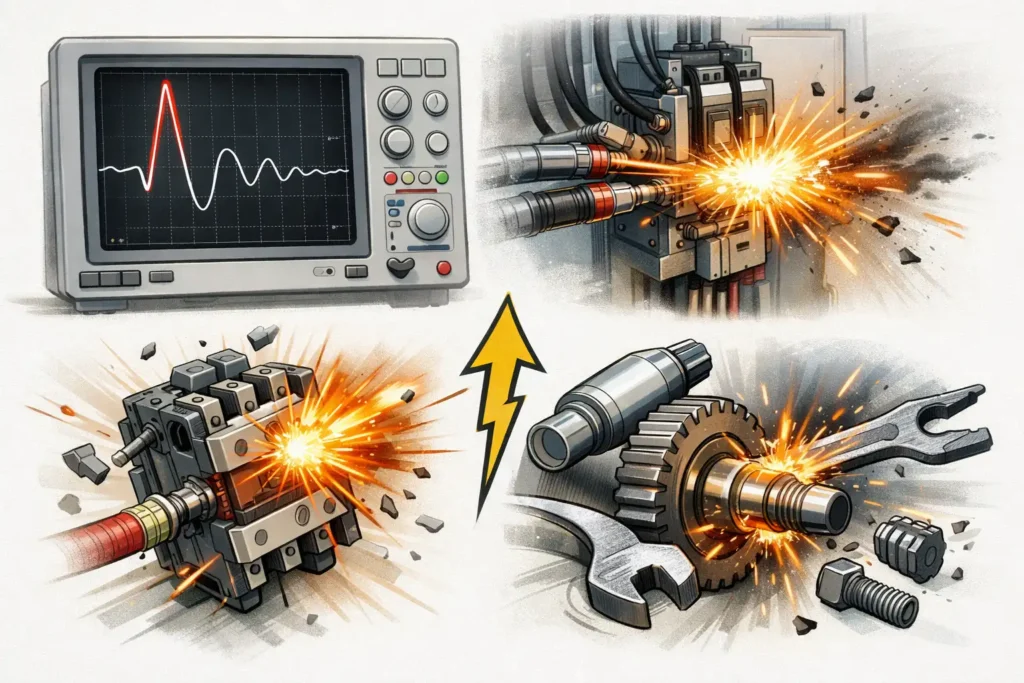
Peak current is the maximum instantaneous value reached by the current waveform.
Unlike RMS current, which represents an effective value over time, peak current refers to a single moment — the highest point of the waveform. In short-circuit conditions, this maximum often occurs during the early asymmetrical stage of the fault, when the AC component is superimposed with a decaying DC offset.
Because it is an instantaneous maximum rather than a time-based effective value, peak current is mainly relevant to mechanical stress and electrodynamic force, rather than to long-duration thermal heating.
Why the first peak matters so much mechanically
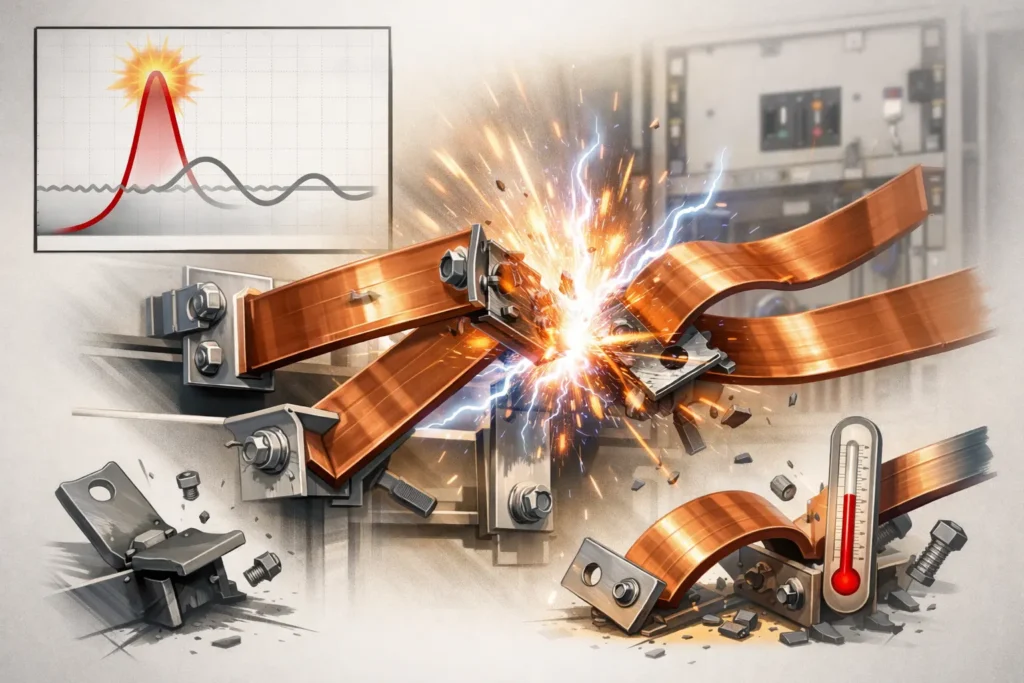
When fault current rises sharply, it produces a strong magnetic field around conductors. That magnetic field creates electrodynamic forces between busbars, conductors, supports, and connected parts. Because these forces increase very rapidly with current, the first peak of the fault current can produce the most severe mechanical stress of the entire event.
This is why the early part of a fault is so important. Even if the equipment can withstand the current thermally for a short duration, the first peak may still deliver a violent mechanical shock to the assembly.
In practical terms, this is why busbar supports, bracing, spacing, geometry, and overall structural integrity matter so much in switchgear and panel design. The first peak is often the moment when the assembly experiences its highest instantaneous force.
What does “available fault current” mean?
When engineers say something like “available fault current is 50 kA,” they often mean the symmetrical RMS short-circuit current, not the instantaneous peak current.
This matters because fault current can be expressed in more than one way. The RMS value describes the effective magnitude of the AC component, while the peak value describes the highest instantaneous current reached during the fault.
So if someone simply says “the fault current is 50 kA” without further clarification, an important question remains:
Is that 50 kA RMS, or 50 kA peak?
That is why fault-current discussions can become confusing when the current quantity is not stated explicitly.
The simplest mental model
- RMS tells you how hard the fault current works over time
- Peak tells you how hard the fault current hits at its worst instant
That is the cleanest mental separation. It is also the reason the same fault event needs more than one current description.
Why this matters in real engineering conversations
In ordinary AC discussions, people often use RMS casually and everything remains clear enough. But in fault engineering, that shortcut becomes risky.
Once short-circuit behavior enters the conversation, you need to ask a more precise question: are we talking about the symmetrical RMS value, or the instantaneous peak of the first asymmetrical loop? Note DC offset is exactly what makes the early waveform more severe than a clean sine wave.
Conclusion
For RMS vs peak in short-circuit current:
RMS describes the effective severity of current over time. Peak describes the maximum instantaneous shock.
For a pure sine wave, the relationship is simple. For a real short-circuit current, it is not. The waveform starts in an asymmetrical state, carries a decaying DC offset, and may deliver a first peak much more severe than the familiar sinusoidal rule suggests. CMP, Schneider, and ABB all separate these ideas because they correspond to different physical stresses inside the equipment.
That is why both RMS and peak matter in short-circuit engineering.
FAQ
Is RMS the same as average?
No. RMS is the effective heating-equivalent value, while a simple average can be zero for a pure AC waveform over a full cycle.
Is peak always 1.414 × RMS?
Only for a clean symmetrical sine wave. Real short-circuit current can be asymmetrical at inception, so the first peak can be higher than that simple relationship suggests.
What makes short-circuit current asymmetrical?
A decaying DC offset superimposed on the AC component. Schneider notes that this DC offset decays over a few cycles, after which the waveform becomes more symmetrical.
When engineers say “fault current,” do they usually mean RMS or peak?
Often they mean the symmetrical RMS short-circuit current, but not always. That is why it is important to clarify which current quantity is being discussed.
Reference:
https://www.cmp-products.com/cable-cleats/technical-cable-cleats/what-is-a-short-circuit/peak-fault-rms/
https://www.se.com/za/en/faqs/FAQ000219931/?utm_source=chatgpt.com
https://search.abb.com/library/Download.aspx?DocumentID=9AKK108466A8513


