
Please note: this article is academically oriented and intended for readers who want a deeper technical explanation.
Level: Intermediate
For a deeper look into RMS vs Peak, please refer to Part II: RMS vs Peak in Short-Circuit Current.
When engineers talk about AC voltage or current, two numbers appear again and again: RMS vs peak. They are related, but they are not interchangeable.
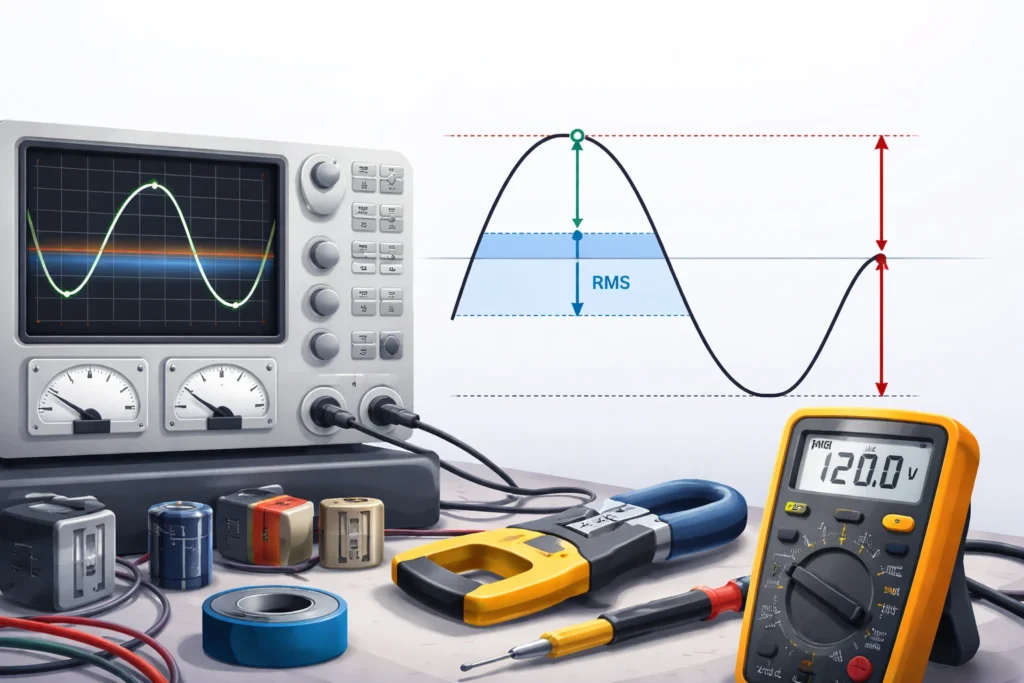
Peak tells you the highest instantaneous value a waveform reaches. RMS tells you the effective value of that waveform, meaning the AC value that produces the same heating effect in a resistive load as an equivalent DC value. For a pure sine wave, the relationship is straightforward:
- Peak = RMS × 1.414
- RMS = Peak × 0.707
- Peak-to-peak = 2 × Peak
That is why a standard 120 V AC supply actually reaches about 170 V peak, and a 230 V AC supply reaches about 325 V peak.
What does peak mean?
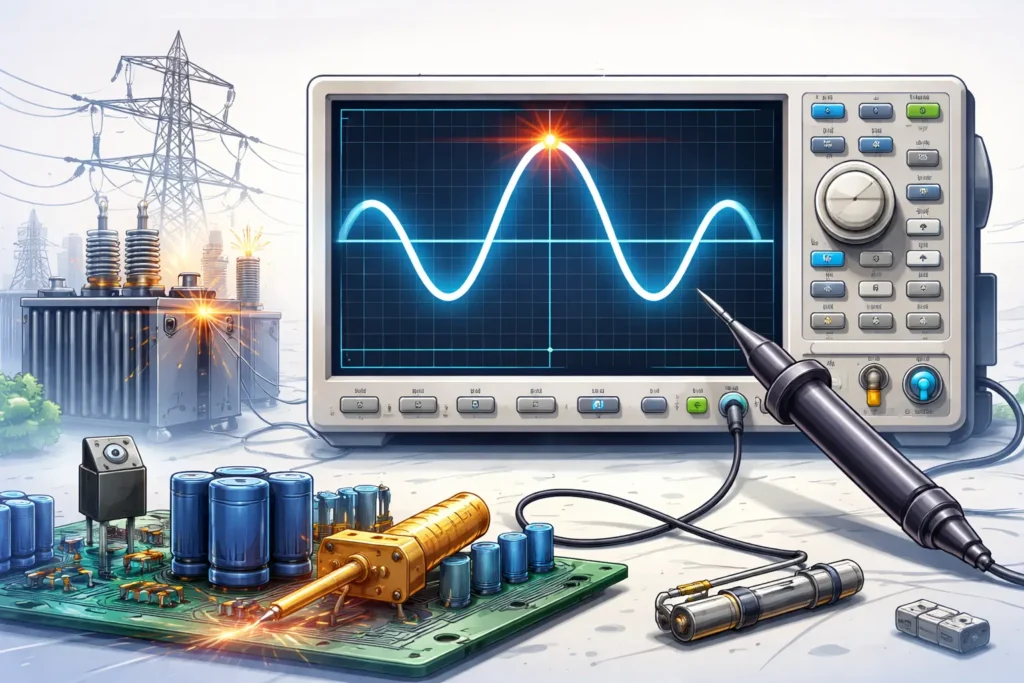
The peak value is the maximum instantaneous voltage or current reached during a cycle. If you look at a sine wave on an oscilloscope, the peak is the top of the crest.
Peak matters because equipment does not experience only the “average feeling” of a waveform. Components also see the highest instantaneous stress. That affects insulation coordination, semiconductor limits, surge tolerance, and short-duration fault or transient behavior. In short, peak is often the number that tells you whether something survives the worst moment.
What does RMS mean?
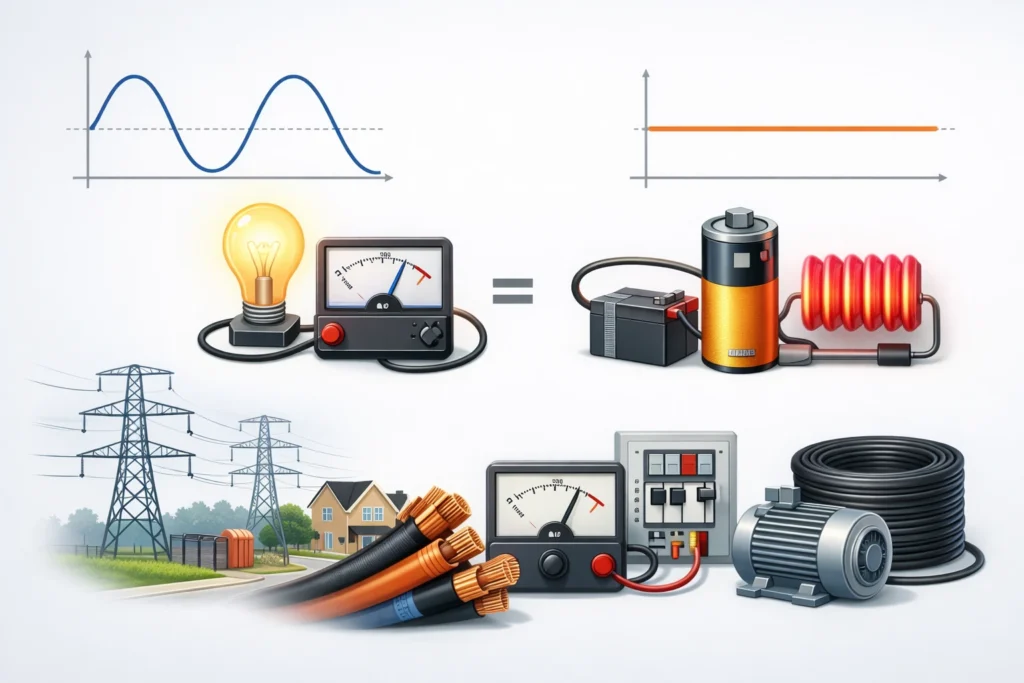
RMS stands for root mean square. In practical electrical engineering, it is the effective value used for normal AC ratings because it reflects the equivalent DC value for power and heating in a resistive load.
That is why utility voltages, cable loading discussions, and many current ratings are expressed in RMS.
RMS vs peak: the simplest comparison
Here is the easiest way to think about rms vs peak:
- RMS = the effective working value
- Peak = the highest instantaneous value
- Peak-to-peak = the total swing from the positive peak to the negative peak
For a pure sine wave:
- Vrms = Vpeak / √2
- Vpeak = 1.414 × Vrms (Note: √2≈1.414)
- Vpp = 2 × Vpeak ≈ 2.828 × Vrms
So if someone says a supply is 230 V AC, that does not mean the waveform tops out at 230 V. It means the supply is 230 Vrms. The actual crest is higher.
Why AC systems are rated in RMS
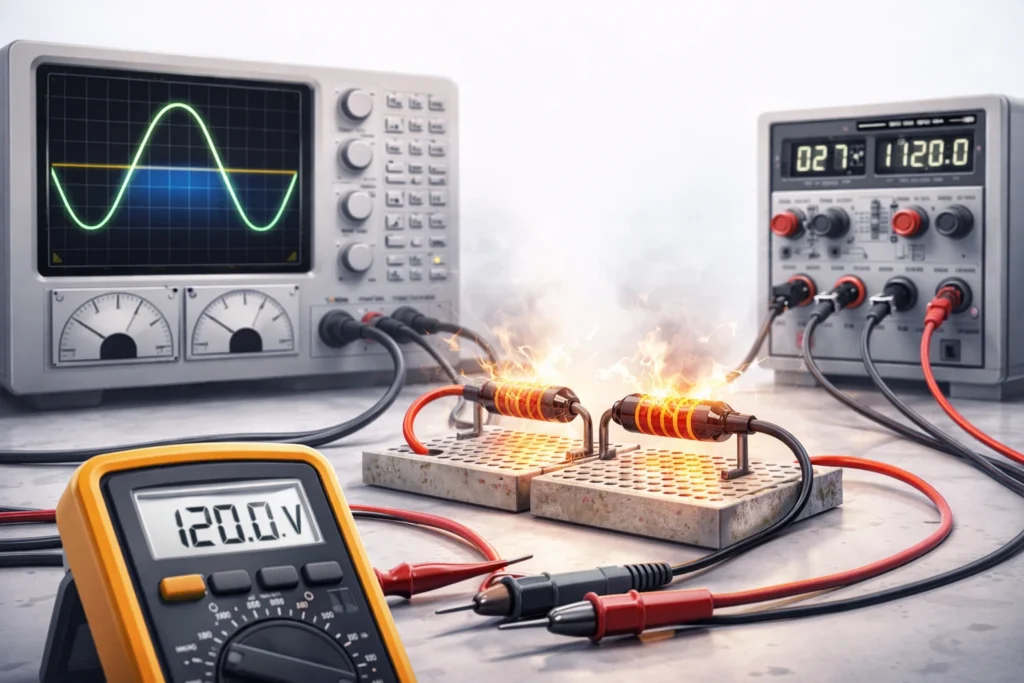
AC systems are normally specified in RMS because RMS is the most useful number for normal operation. It relates directly to power calculations, conductor heating, and everyday load behavior.
For example, a 120 Vrms sine wave produces the same heating effect in a resistor as 120 V DC. That is why RMS is the standard reference for most nominal voltage and current discussions. When you size cables, discuss load current, or talk about standard supply voltage, RMS is usually the value you mean.
Why peak still matters in switchgear and panels
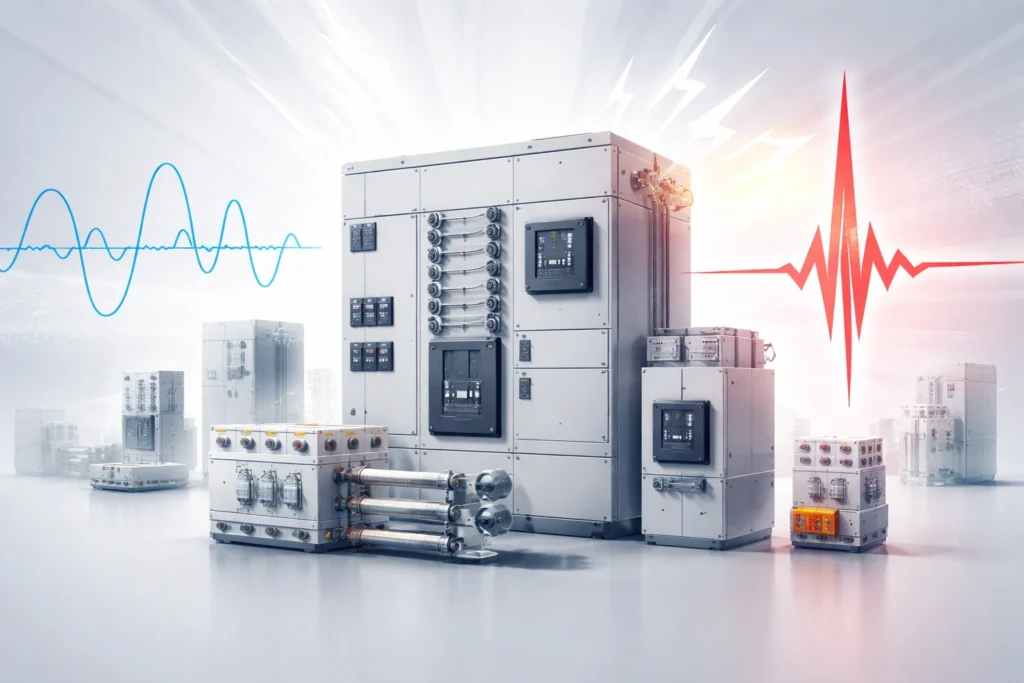
Even though RMS is the normal rating language for many applications, peak still matters a great deal in switchgear and panel design.
IEC-oriented assembly data distinguishes these duties clearly. In ABB’s IEC 61439 overview, continuous and short-time duties are expressed with RMS-based ratings such as In and Icw, while the assembly’s peak short-circuit withstand current is expressed separately as Ipk. The same framework also distinguishes Uimp, the impulse withstand voltage used for transient overvoltage capability. That distinction is important: RMS helps describe continuous or time-defined thermal/electrical duty, while peak helps describe maximum instantaneous mechanical and dielectric stress.
For buyers and engineers, this means one simple thing: RMS tells you how equipment performs under normal or specified-duration duty, while peak tells you how much instantaneous stress it can survive. Both matter in real projects.
Practical examples
1. 120 V AC mains
When people say “120 V AC,” they mean 120 Vrms. The waveform actually swings to about +170 V (≈120×√2) and -170 V at the peaks.
2. 230 V AC mains
Using the same sine-wave relationship, 230 Vrms corresponds to about 325 V peak (≈230×√2) and about 651 V peak-to-peak (≈325×√2). This is one reason component voltage rating cannot be selected by looking only at the RMS number printed on the supply.
3. Distorted waveforms
In modern systems with VFDs, switching converters, harmonic-rich loads, or pulse-like currents, the waveform may no longer be a clean sine wave. In those cases, simple sine-wave assumptions can be wrong, and a true-RMS meter becomes much more important. Fluke notes that average-responding meters can show significant error on non-sinusoidal waveforms.
Common mistakes engineers should avoid
Confusing RMS with peak
This is the most common error. A 230 V AC supply is not peaking at 230 V.
Confusing peak with peak-to-peak
Peak is measured from zero to the crest. Peak-to-peak is the full swing from the positive crest to the negative crest.
Using 1.414 for every waveform
The 1.414 factor applies to a pure sine wave. It should not be blindly used for distorted or non-sinusoidal waveforms.
If the waveform may be distorted, an average-responding meter can mislead you. Use a true-RMS instrument when waveform shape is uncertain or known to be non-sinusoidal.
Designing only for RMS
An assembly may satisfy a continuous RMS current requirement but still fail if peak short-circuit stress, impulse withstand, or transient overvoltage is ignored.
Which value should you use?
Use RMS when you are:
- discussing nominal AC supply values
- estimating heating effect
- sizing loads and conductors
- comparing continuous current ratings
- reviewing normal operating current
Use peak when you are:
- checking insulation stress
- reviewing semiconductor or capacitor voltage limits
- evaluating transient or surge margins
- considering short-circuit mechanical stress
- reviewing peak withstand capability
Use peak-to-peak when you are:
- looking at waveform swing on an oscilloscope
- comparing full excursion of a signal
- discussing analog signal amplitude range
Use true-RMS measurement when:
- the waveform may be distorted
- VFDs, harmonic loads, or switching electronics are present
- measurement accuracy matters beyond ideal sine-wave assumptions
Conclusion
RMS and peak are not competing numbers. They answer different engineering questions.
- RMS tells you the effective working value of AC.
- Peak tells you the maximum instantaneous stress.
- Peak-to-peak tells you the total waveform swing.
In practical power distribution work, especially in panels, switchgear, and industrial systems, good engineering usually requires understanding all three. If you size only by RMS, you may miss transient or short-circuit stress. If you look only at peak, you may misunderstand normal operating duty. The correct approach is to use the right value for the right design question.
FAQ
Is AC voltage usually expressed in RMS or peak?
Usually in RMS. Standard supply values such as 120 V AC or 230 V AC are RMS values, not peak values.
For a sine wave, what is the relationship between RMS and peak?
For a pure sine wave, peak = RMS × 1.414 and RMS = peak × 0.707.
Why does peak matter if equipment is rated in RMS?
Because equipment still experiences the highest instantaneous stress. Peak matters for insulation, transient overvoltage, and peak short-circuit withstand capability.
When do I need a true-RMS meter?
When the waveform is not a clean sine wave or when you are measuring systems with drives, electronic loads, or other nonlinear equipment.
Is peak the same as peak-to-peak?
No. Peak is from zero to the crest. Peak-to-peak is from the positive crest to the negative crest.
*For a deeper look into RMS vs Peak, please refer to Part II: RMS vs Peak in Short-Circuit Current.
For further information about RMS vs Peak, feel free to contact us. Our engineers are ready to assist with technical questions, application discussions, and quotation support.
Reference:
https://search.abb.com/library/Download.aspx?DocumentID=9AKK108466A8513
https://www.fluke.com/en-us/learn/blog/electrical/what-is-true-rms


