
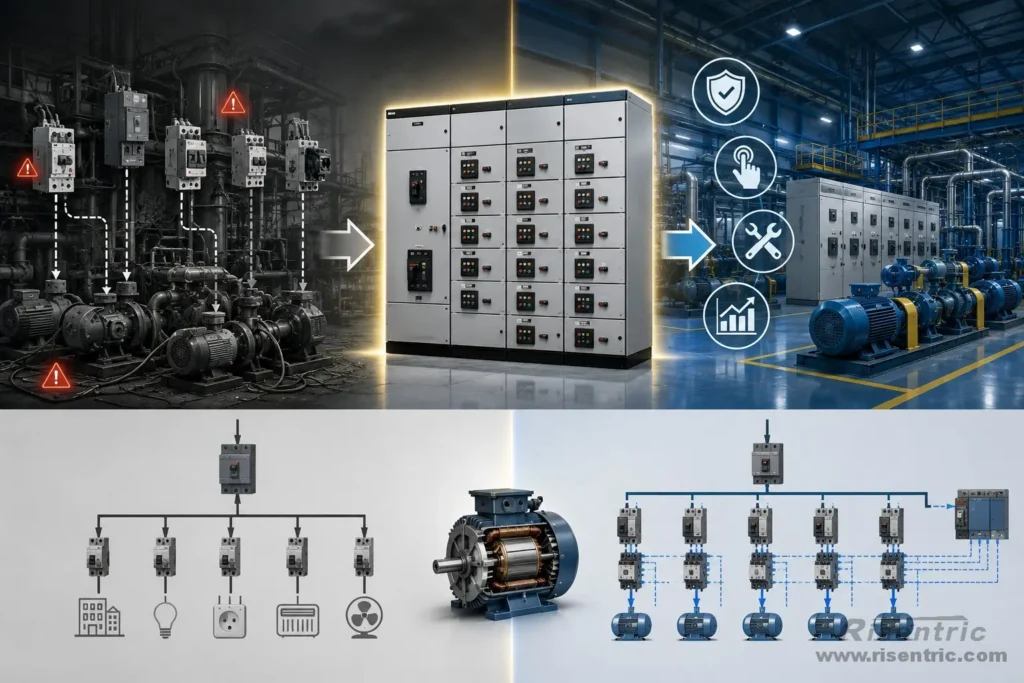
Motors are everywhere in industrial projects.
They drive pumps, fans, compressors, conveyors, chillers, mixers, crushers, and many other machines. In a small system, one motor may only need one starter or one breaker. But in a factory, plant, building, or utility project, there may be dozens or even hundreds of motors working together.
This is where MCC, or Motor Control Center, becomes important.
An MCC is not just a cabinet that supplies power. It is a centralized electrical system used to control, protect, monitor, and organize multiple motors in one place.
What Is an MCC?
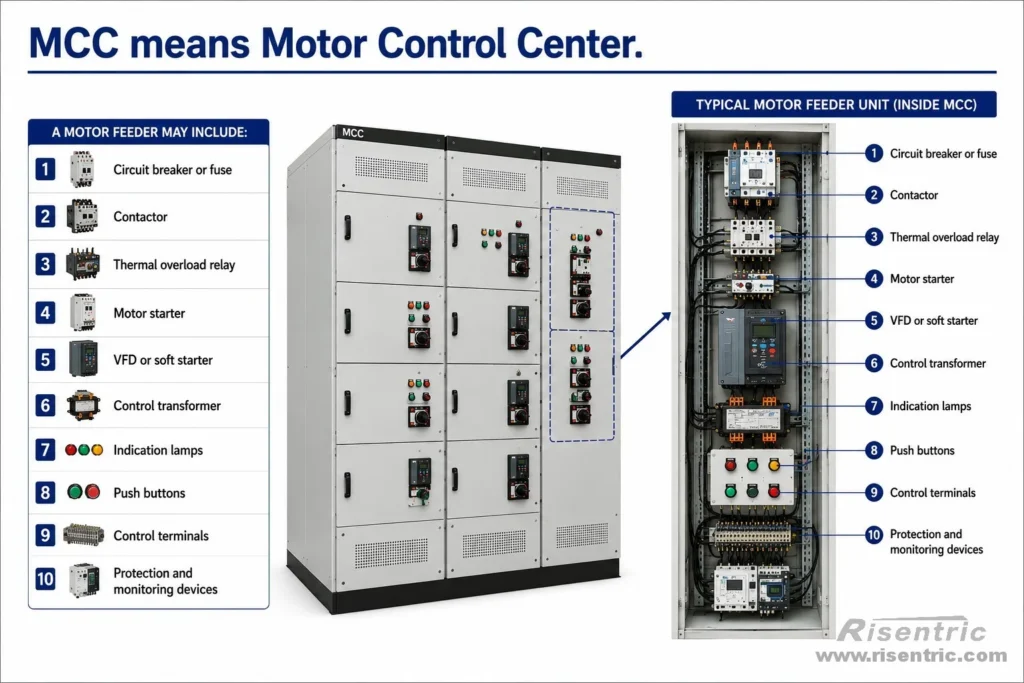
MCC means Motor Control Center.
It is a type of low-voltage switchgear or control cabinet designed mainly for motor loads. Inside an MCC, each motor circuit is usually arranged as an individual motor feeder unit.
In simple words:
A distribution panel mainly sends power to loads.
An MCC sends power to motors and also controls how those motors start, stop, and operate.
Why Do We Need MCC?
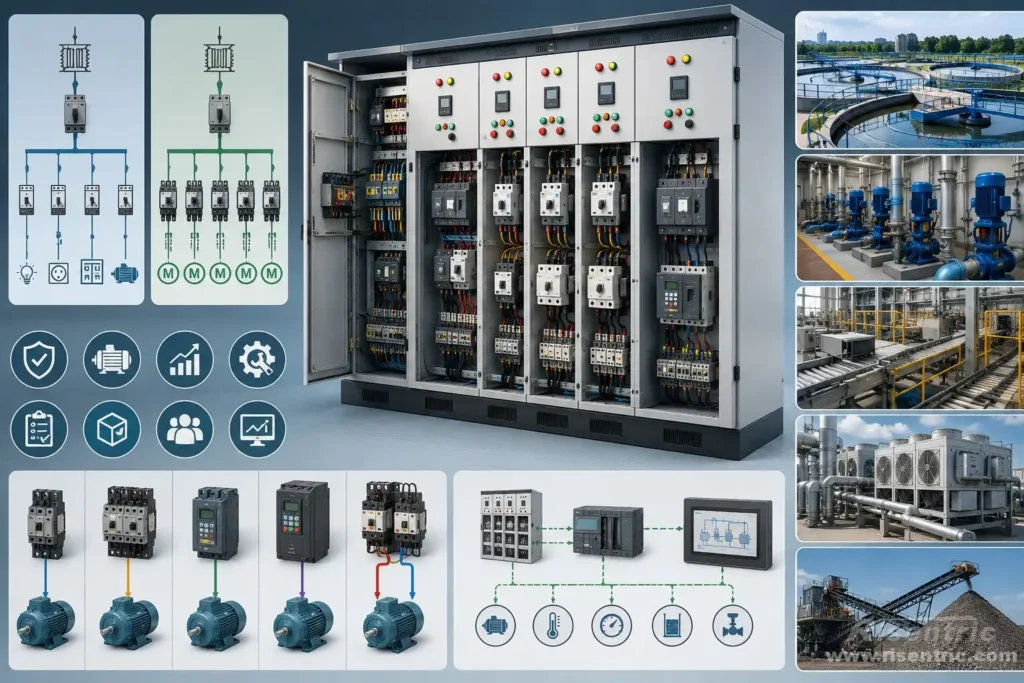
We need MCC because many industrial motors cannot be managed well by a normal distribution panel alone.
A normal distribution panel mainly sends power to different circuits. This is usually enough for general loads such as lighting, sockets, small equipment, and sub-panels.
But a motor is different. A motor does not only need power supply. It also needs starting control, overload protection, operation signals, and sometimes speed control, interlocking, or PLC/SCADA connection.
This is where MCC brings value.
An MCC is designed around motor feeder units. Each motor feeder can include the devices needed to start, stop, protect, monitor, and control one motor.
So the reason we need MCC is simple:
A normal distribution panel distributes power.
An MCC manages motor operation.
That structural difference explains why MCC is needed in industrial motor systems.
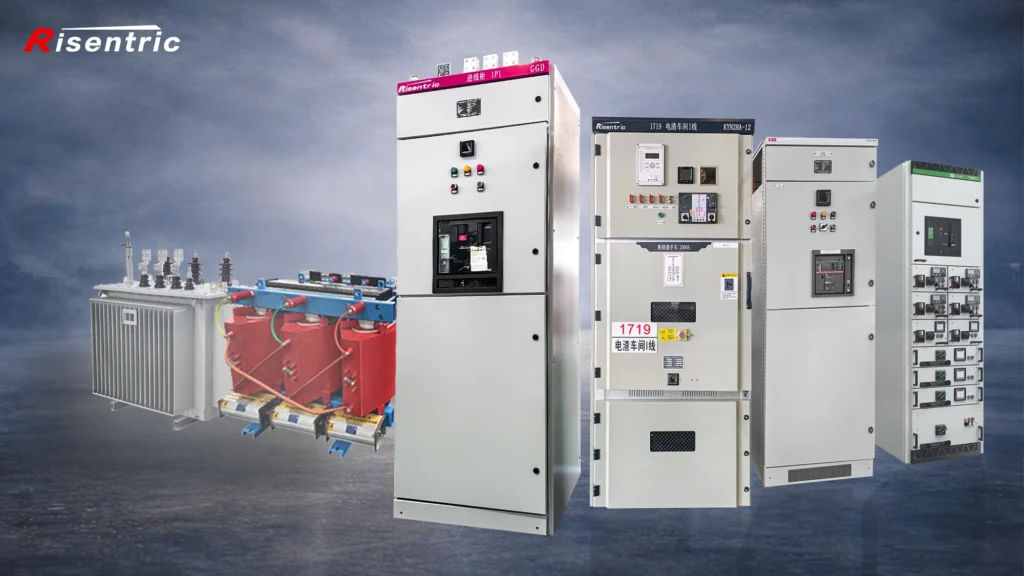
Looking for factory-tested 3-Phase switchgear & Panel boards for your project?
What Does an MCC Have More Than a Normal Distribution Panel?
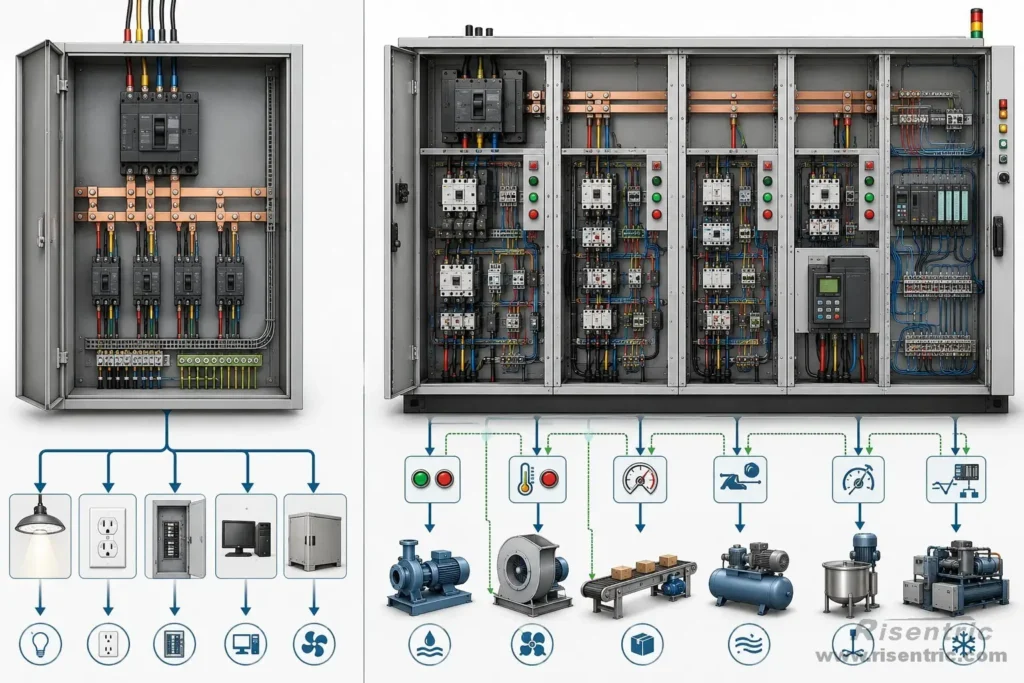
A normal distribution panel mainly contains breakers, busbars, terminals, and cables. Its main job is to distribute power.
An MCC also distributes power, but it adds motor-related structures inside each feeder.
An MCC is not only:
breaker + cable
It is closer to:
breaker + contactor + overload protection + starting device + control wiring + status feedback + motor terminals
These added parts explain why MCC is needed.
| What MCC Adds | What It Does | Why It Matters |
|---|---|---|
| Motor feeder units | Each motor has its own control and protection section | Makes many motors easier to organize |
| Contactor | Starts and stops the motor electrically | Allows frequent, automatic, or remote motor operation |
| Overload relay / motor protection relay | Protects the motor from overload, phase loss, or abnormal running | Reduces motor damage and downtime |
| VFD / soft starter / star-delta starter | Controls how the motor starts or runs | Reduces starting current, mechanical shock, or supports speed control |
| Control terminals | Connects push buttons, sensors, PLC, or SCADA signals | Allows local, remote, and automatic control |
| Auxiliary contacts and indication lamps | Shows running, stop, trip, fault, or local/remote status | Helps operators understand motor condition |
| Organized compartments and wiring | Separates motor feeders, power wiring, and control wiring | Makes maintenance and troubleshooting easier |
| Spare feeder space or modular design | Allows future motor feeders to be added more easily | Makes the system easier to expand |
The key difference is:
A normal distribution panel is built around power distribution.
An MCC is built around motor feeder units.
1. MCC Centralizes Motor Control
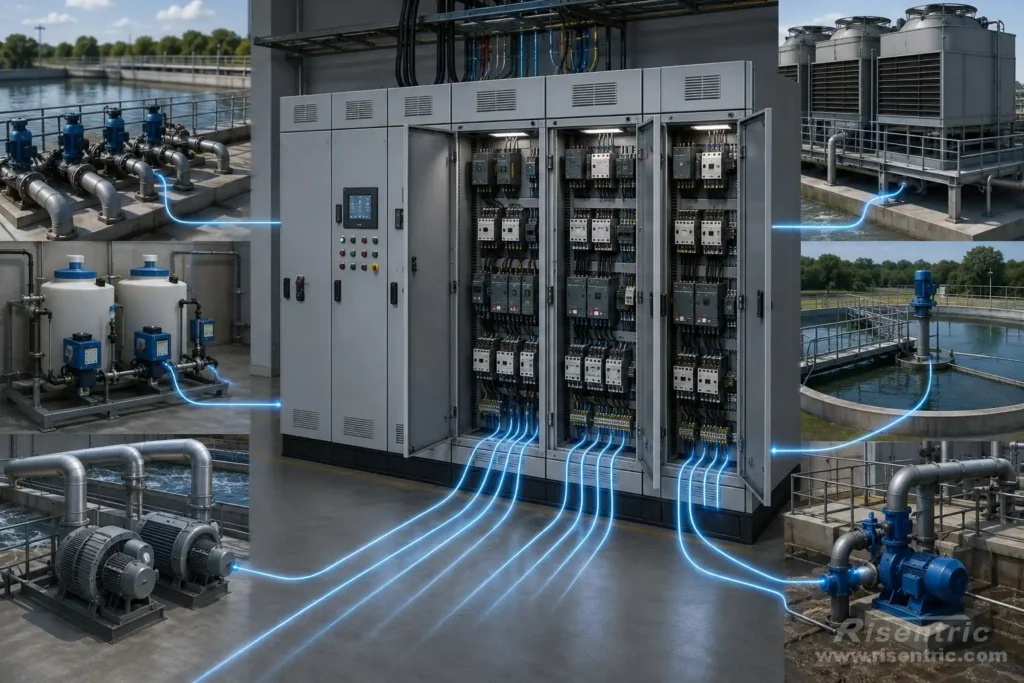
In many industrial projects, motors are installed in different areas of the site.
For example, a water treatment plant may have motors for:
- Raw water pumps
- Dosing pumps
- Blowers
- Sludge pumps
- Cooling fans
- Mixer motors
If every motor has a separate control box, the whole system becomes difficult to manage. Operators may need to check different panels in different locations. Maintenance staff may need to trace many separate circuits.
An MCC solves this problem by bringing multiple motor feeders into one organized cabinet or lineup.
Each motor can have its own feeder unit inside the MCC. This makes operation, wiring, labeling, and maintenance much clearer.
This is one of the most practical reasons why MCC is used.
2. MCC Provides Better Motor Protection
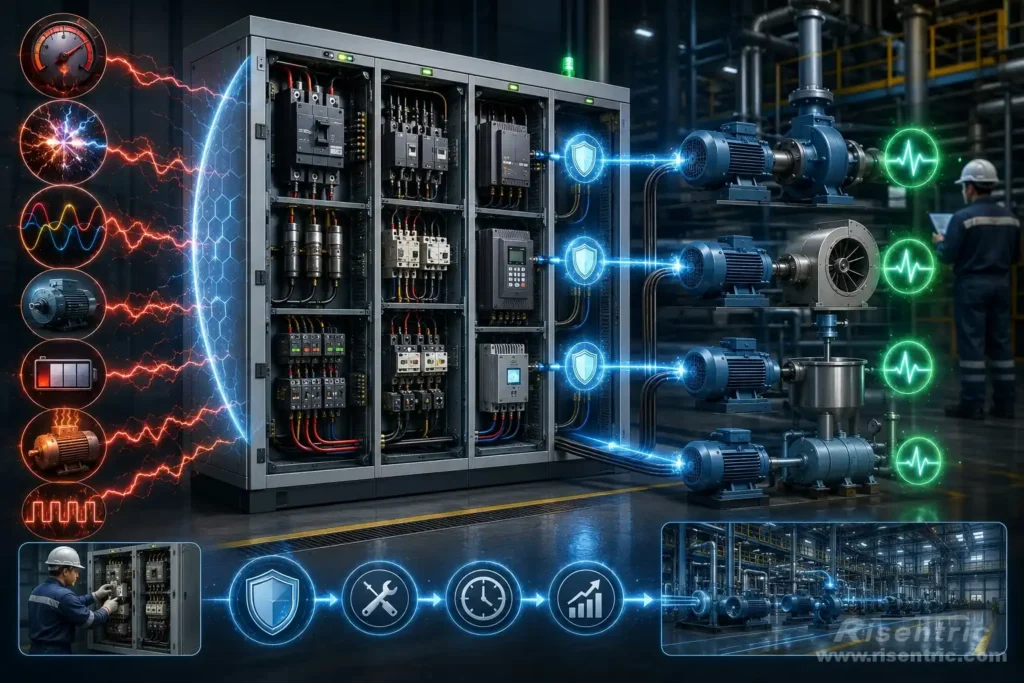
Motors can fail because of many electrical problems, such as:
- Overload
- Short circuit
- Phase loss
- Phase imbalance
- Locked rotor
- Undervoltage
- Overheating
- Frequent starting
A normal distribution panel may protect the cable or circuit, but it may not provide complete motor protection.
An MCC can include protection devices inside each motor feeder, such as MCCB, fuse, overload relay, motor protection relay, VFD, or soft starter.
For example, an overload relay can trip when a motor draws too much current for too long. A circuit breaker or fuse can disconnect the circuit during a short-circuit fault. A VFD or soft starter can reduce starting stress for larger motors.
This protection structure helps reduce motor damage, downtime, and maintenance risk.
3. MCC Makes Motor Starting and Stopping Easier
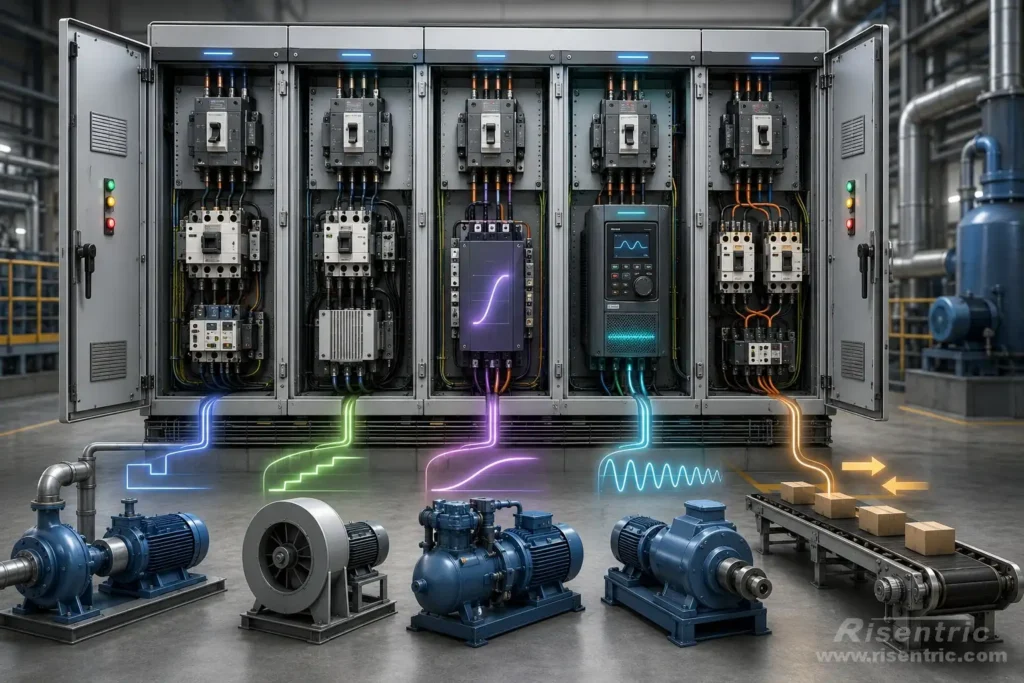
Motors are different from ordinary electrical loads.
A lighting circuit is usually simple: turn it on, and it works.
But a motor may need a specific starting method. Depending on the motor power and application, it may use:
| Starting Method | Common Use |
|---|---|
| DOL starter | Small motors with simple start/stop control |
| Star-delta starter | Medium motors where lower starting current is needed |
| Soft starter | Motors requiring smoother acceleration |
| VFD | Motors requiring speed control |
| Reversing starter | Motors that need forward/reverse operation |
A normal distribution panel is not mainly designed for these motor starting methods.
An MCC, however, is built around motor feeders. Each feeder can be designed with the correct starting method according to the motor size, load type, and project requirement.
This is especially important for pumps, fans, compressors, conveyors, and other industrial motor loads.
4. MCC Supports Control Logic and Automation
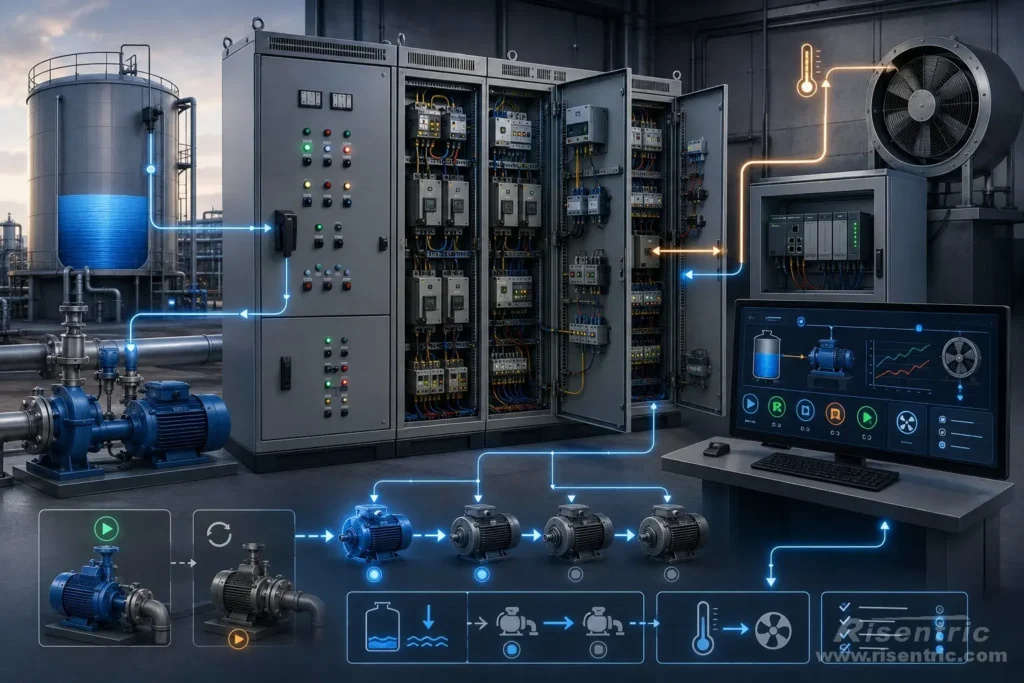
In many projects, motors do not only start and stop manually.
They may need to operate according to process logic, such as:
- Start pump A first, then pump B as backup
- Stop a pump when the tank level is too low
- Run a fan when the temperature is high
- Start motors in sequence to reduce inrush current
- Send running, trip, or fault signals to PLC or SCADA
This is where the control structure of MCC becomes important.
An MCC can include control terminals, auxiliary contacts, indication lamps, relays, interlocks, and communication interfaces. These allow the MCC to connect with field devices, PLC systems, or remote monitoring systems.
So MCC is not only a power cabinet. It can become part of the automation system.
5. MCC Improves Maintenance Safety
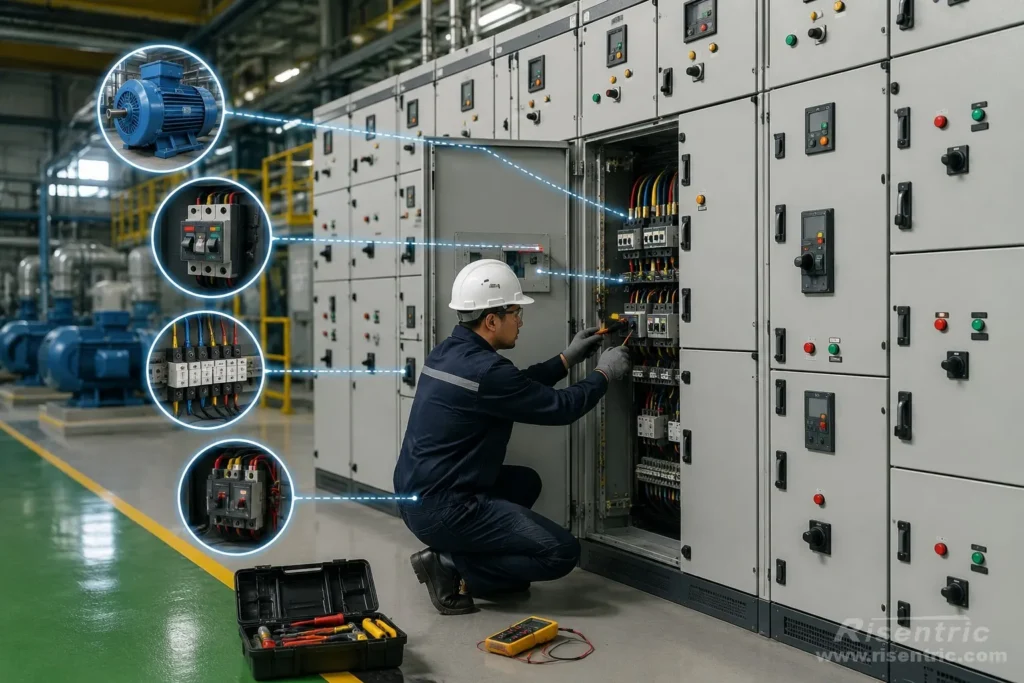
Maintenance is another important reason for using MCC.
When one motor needs inspection or repair, maintenance staff need a clear way to isolate that motor circuit. In an MCC, each motor feeder can be arranged, labeled, and isolated more clearly.
This helps maintenance staff identify:
- Which feeder controls which motor
- Which breaker or isolator should be operated
- Which terminal connects to control signals
- Which circuit has tripped or failed
A well-designed MCC reduces confusion during troubleshooting.
It also makes the system easier to expand in the future. If the project needs more motors later, spare compartments or additional feeder sections can be planned in the MCC lineup.
6. MCC Saves Space and Reduces Wiring Complexity
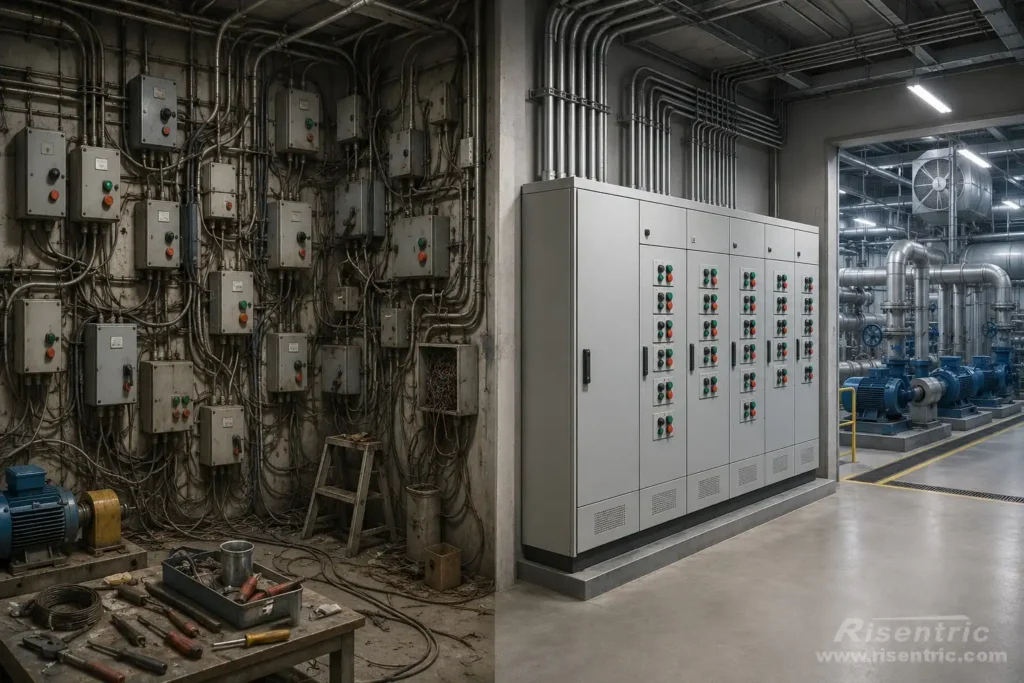
For a small system with only one or two motors, separate starter boxes may be acceptable.
But for a project with many motors, scattered starter boxes can create problems:
- More wall space is needed
- More cable routes are required
- Wiring becomes harder to trace
- Maintenance becomes less organized
- The electrical room becomes messy
An MCC combines multiple motor feeders into one cabinet system. This makes the electrical room cleaner and more compact.
For factories, pump stations, HVAC systems, water treatment plants, and process facilities, this space-saving structure can be very useful.
7. MCC Helps Operators See Motor Status Clearly

Operators often need to know whether a motor is running normally.
An MCC can provide status indication such as:
- Running
- Stopped
- Trip
- Fault
- Overload
- Local / remote mode
- Current or power data
This information can be shown through lamps, meters, HMI, PLC, or SCADA system.
If a motor trips, the MCC can help operators and maintenance staff locate the problem faster.
This is another reason why MCC is more suitable than a normal distribution panel for motor systems.
Do We Need MCC for Every Motor?
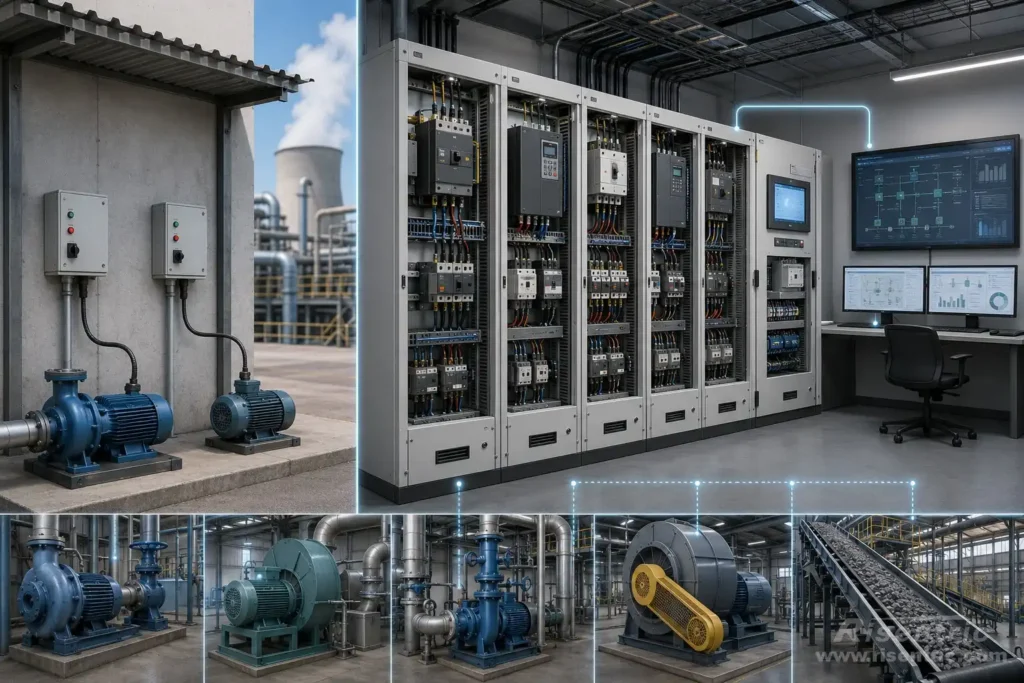
No.
Not every motor needs an MCC.
For a very small project with only one or two simple motors, a local starter box may be enough.
You usually consider MCC when:
- There are many motors in one project
- Motors are important to the process
- Motors need centralized control
- Motors need overload protection
- Motors need PLC or SCADA connection
- Motors require VFDs or soft starters
- Maintenance and isolation must be well organized
- The project needs a clean and expandable electrical layout
In simple terms:
MCC becomes useful when motor control becomes a system, not just a single switch.
Where Is MCC Commonly Used?
MCC panels are commonly used in industrial and infrastructure projects, such as:
- Water treatment plants
- Wastewater treatment plants
- Pumping stations
- Factories
- Mining projects
- Oil and gas facilities
- Power plants
- HVAC systems
- Cement plants
- Food processing plants
- Industrial buildings
In these applications, motors are part of the core process. If the motors stop, the system may stop.
That is why motor control must be reliable, organized, and easy to maintain.
Looking for factory-tested 3-Phase switchgear & Panel boards for your project?
Conclusion
We need MCC because motor loads are different from general electrical loads.
A normal distribution panel mainly distributes power. It is suitable for lighting, sockets, sub-panels, and general circuits.
An MCC is designed around motor feeder units. It can provide power distribution, motor starting, overload protection, status feedback, control wiring, and automation interface in one organized system.
That is why MCC is widely used in factories, pump stations, water treatment plants, HVAC systems, mining projects, and many other industrial applications.
In simple words:
We need MCC because motors need more than power.
They need control, protection, feedback, and organized maintenance.
FAQ
What is the main purpose of an MCC?
The main purpose of an MCC is to control, protect, monitor, and organize motor circuits. A normal distribution panel mainly distributes power, while an MCC manages how motors start, stop, run, trip, and connect with control systems.
Why can’t we use a normal distribution panel for all motors?
A normal distribution panel can supply power to a motor, but it is usually not enough for motor control. Motors often need contactors, overload protection, starting devices, control terminals, status signals, and sometimes PLC or SCADA connection. These functions are normally better organized inside an MCC.
What is the difference between MCC and distribution panel?
A distribution panel is mainly used for power distribution to general loads such as lighting, sockets, sub-panels, and small equipment. An MCC is designed for motor loads. It adds motor feeder units, contactors, overload relays, starters, VFDs, control wiring, and status feedback.
Does every motor need an MCC?
No. A small project with one or two simple motors may only need a local starter box or a small control panel. MCC is more useful when there are many motors, important process motors, centralized control requirements, automation signals, or maintenance needs.
What is a motor feeder in an MCC?
A motor feeder is one section or unit inside the MCC used for one motor circuit. It may include a breaker or fuse, contactor, overload relay, starter, VFD, soft starter, control terminals, and indication devices. Each motor feeder helps control and protect one motor.
Can an MCC include VFDs or soft starters?
Yes. An MCC can include DOL starters, star-delta starters, soft starters, VFDs, or reversing starters depending on the motor power, load type, and control requirement. This is one reason MCC is useful for pumps, fans, compressors, conveyors, and other industrial motors.
Can MCC connect to PLC or SCADA?
Yes. MCC panels can provide control terminals, auxiliary contacts, running signals, trip signals, fault signals, and communication interfaces. These allow the MCC to connect with PLC, HMI, or SCADA systems for automatic and remote motor control.
Where are MCC panels commonly used?
MCC panels are commonly used in water treatment plants, wastewater treatment plants, pumping stations, factories, HVAC systems, mining plants, cement plants, oil and gas facilities, food processing plants, and power or utility projects. These projects usually have many motors that need reliable control and protection.


