
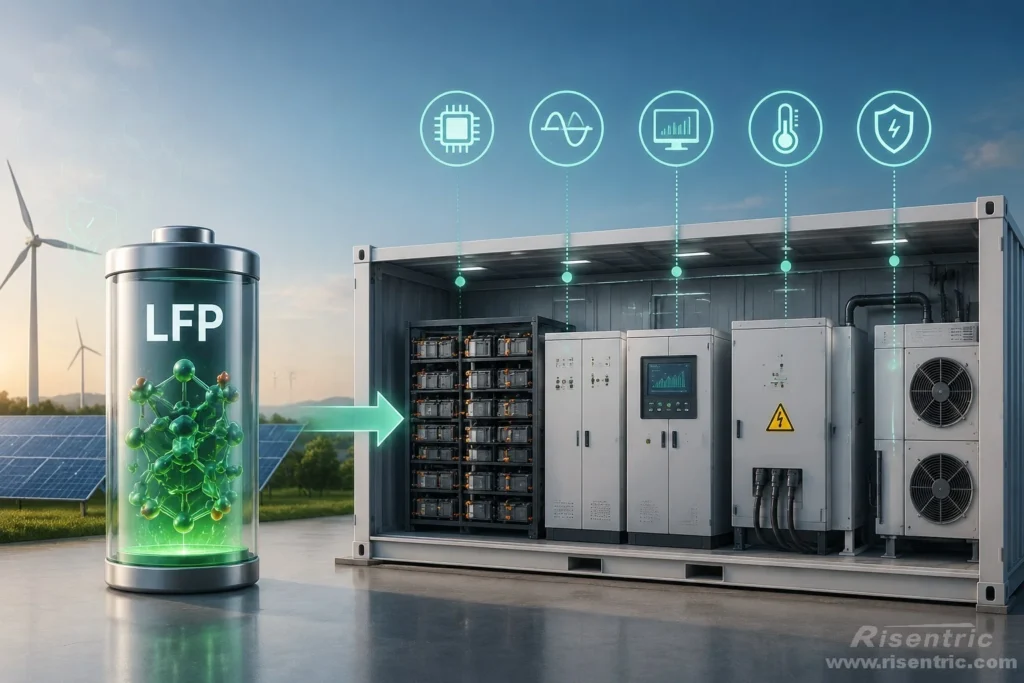
This article is Part I of our ESS Battery series.
According to the IEA, lithium iron phosphate batteries now account for around 90% of battery storage deployments. Just five years earlier, LFP’s market share in deployments was still well below 50%.
| Battery chemistry | Approximate share in battery storage deployments | Main position in ESS |
|---|---|---|
| LFP | Around 90% | Mainstream chemistry for modern battery energy storage systems |
| NMC / NCA and other lithium-ion chemistries | Around 10% combined | Used in some applications, but less common in new stationary ESS deployments |
| Lead-acid | Small and declining share in modern ESS | Still used in some backup systems, but less suitable for frequent cycling |
| Sodium-ion | Emerging, still limited share | Potential future option, but not yet as mature or widely deployed as LFP |
In this article, we explain why LFP batteries are commonly used in energy storage systems, especially from the perspectives of cost, safety, cycle life, procurement, and long-term project value.
- What Is an LFP Battery?
- Perspective Matters: ESS Battery Selection Is Different from EV Battery Selection
- 2. LFP Has Better Thermal Stability and Safety Characteristics
- 3. LFP Is Well Suited for Daily Cycling Operation in ESS
- 4. LFP Has Acceptable Energy Density for Stationary Systems
- LFP Is Not Perfect
- Recycling Value Is More Complicated
- Final Insight: Chemistry Limits Are Managed at System Level
What Is an LFP Battery?
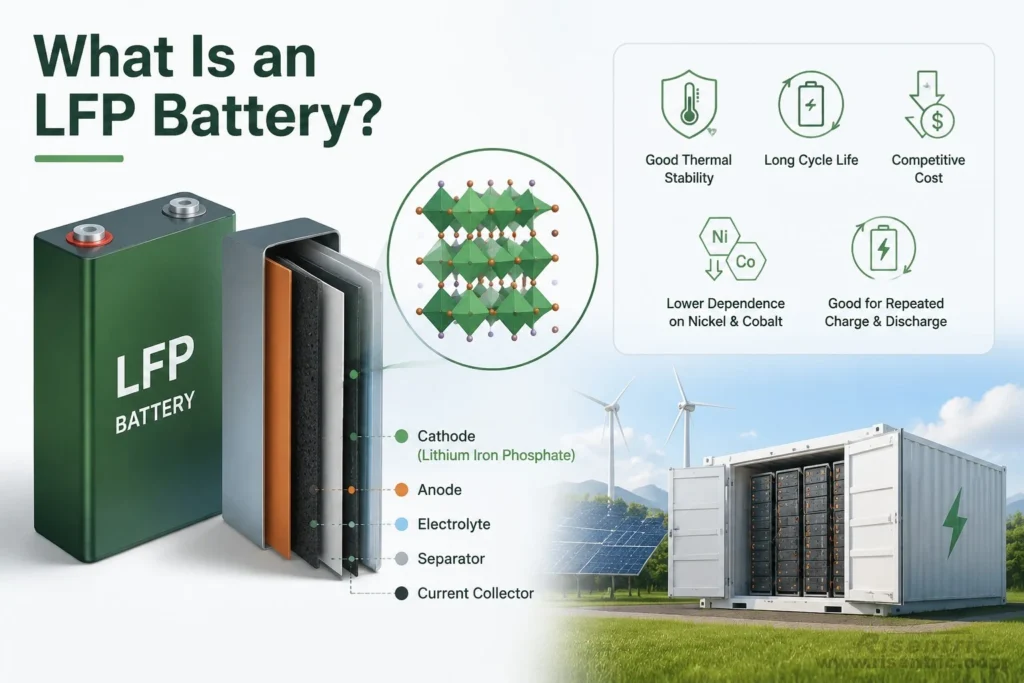
LFP stands for lithium iron phosphate.
It is a type of lithium-ion battery that uses lithium iron phosphate as the cathode material.
A complete lithium-ion battery cell is not made from one material only. It usually includes a cathode, anode, electrolyte, separator, current collectors, casing, and other internal components.
When people describe a battery as “LFP,” they are usually referring to the cathode chemistry.
In an LFP battery, the cathode uses lithium iron phosphate instead of nickel- and cobalt-based cathode materials.
This material choice gives LFP several important characteristics:
- Good thermal stability
- Long cycle life
- Competitive cost
- Lower dependence on nickel and cobalt
- Good suitability for repeated charge and discharge operation
These characteristics match the practical needs of energy storage systems very well.
A more detailed explanation of cathode, anode, electrolyte, separator, and lithium-ion movement can be discussed in a separate article. In this article, we focus on why LFP is commonly selected for ESS applications.
Perspective Matters: ESS Battery Selection Is Different from EV Battery Selection
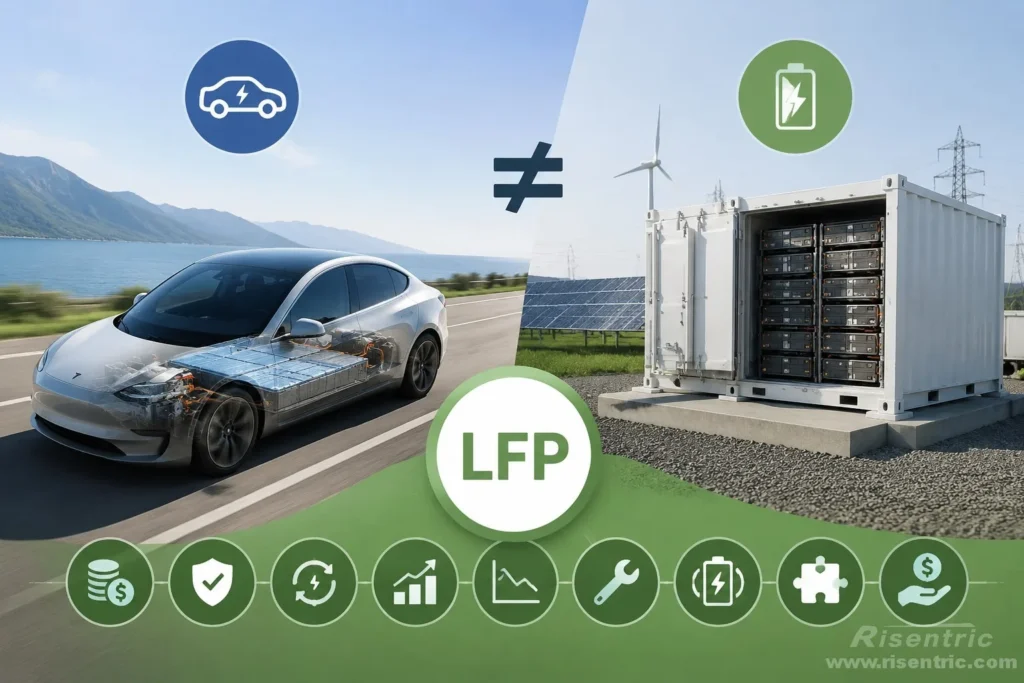
Before explaining why LFP is common in ESS, we need to look at the application.
In electric vehicles, batteries are selected mainly for high energy density because space and weight directly affect driving range.
In energy storage systems, the battery is usually installed in a fixed location, such as a cabinet, container, battery room, factory, or substation. Space and weight still matter, but they are usually less important than cost, safety, cycle life, and long-term reliability.
For ESS, the better question is not:
Which battery stores the most energy in the smallest space?
The better question is:
Which battery can deliver energy safely, repeatedly, and economically over many years?
This is why LFP is attractive for ESS. It may not have the highest energy density, but it offers a strong balance of cost, safety, cycle life, and practical system reliability.
1. Cost Is a Major Reason LFP Is Common in ESS
1.1 Cathode Material Advantage (Core Driver)
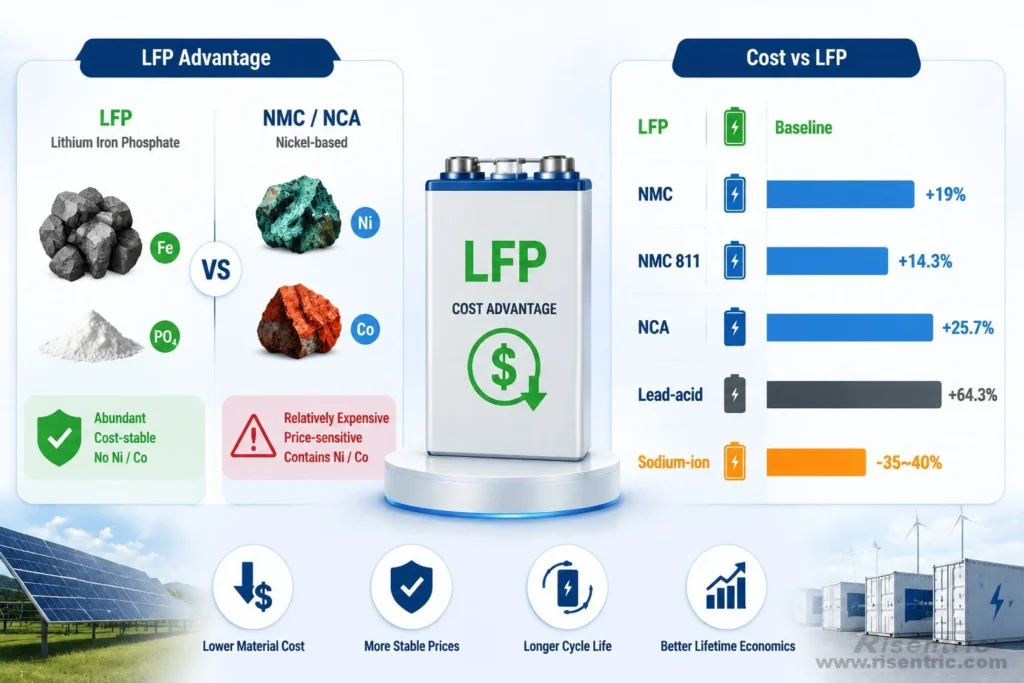
The primary cost advantage of LFP comes from its cathode material.
Nickel-based lithium battery chemistries, such as NMC and NCA, rely on nickel and cobalt. These materials are relatively expensive and price-sensitive. LFP uses lithium iron phosphate instead. Iron and phosphate are generally more abundant and more cost-stable, giving LFP a structural material-cost advantage.
The table below gives a simplified comparison of LFP with other common battery chemistries.
These percentages are based on specific market references and calculation assumptions. Actual battery prices vary depending on raw material prices, supplier scale, cell format, production region, order volume, and project requirements.
Cost Comparison: LFP vs Other Battery Chemistries
| Chemistry | Cost vs LFP | Why |
|---|---|---|
| LFP | Baseline | Uses iron and phosphate; no nickel or cobalt. |
| NMC | 19% higher | Uses nickel and cobalt, resulting in higher cathode material cost. |
| NMC 811 | 14.3% higher | Based on material-cost comparison: NMC 811 below $40/kWh vs LFP below $35/kWh. |
| NCA | 25.7% higher | Nickel-based, high-energy-density chemistry; usually more expensive than LFP. |
| Lead-acid | 64.3% higher lifetime cost | Lower upfront cost, but shorter cycle life and lower usable capacity make lifetime cost worse in cyclic ESS use. |
| Sodium-ion | 35–40% lower potential cell cost | Potentially cheaper due to abundant sodium, but the ESS supply chain is still less mature than LFP. |
For current ESS projects, the most important comparison is usually LFP versus nickel-based lithium batteries such as NMC and NCA. Compared with these chemistries, LFP is usually more cost-competitive because it avoids nickel and cobalt in the cathode.
Lead-acid should be understood differently. It may have a lower initial purchase price, but in cyclic ESS applications, its shorter cycle life and lower usable capacity usually make its lifetime economics less attractive.
Sodium-ion is also a different case. It may become a lower-cost option in the future, but its large-scale ESS supply chain, field experience, and bankability are still developing compared with LFP.
1.2 Manufacturing Scale and Industrial Maturity
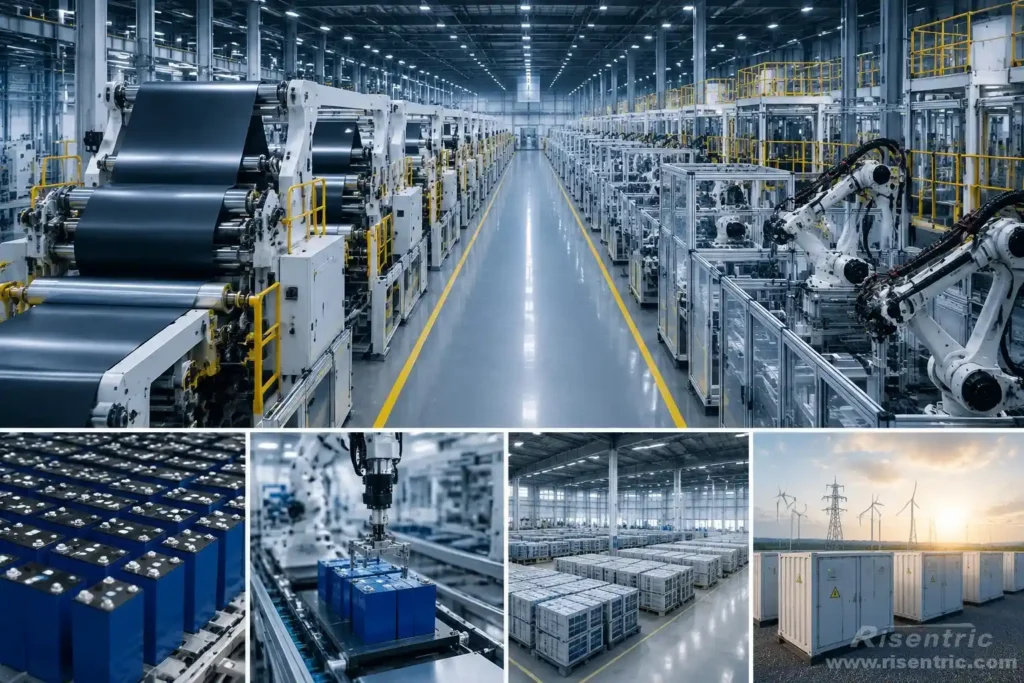
LFP has become the dominant chemistry in energy storage applications, especially in China and large-scale grid projects.
This scale has created a cost advantage through:
- High-volume production
- Strong supplier competition
- Process optimization and yield improvement
- Standardized ESS-oriented designs
Importantly, this is not because LFP is simpler to manufacture, but because it is produced at a much larger industrial scale than most alternatives in ESS applications.
1.3 Cycle Life Translates Directly into Cost per kWh
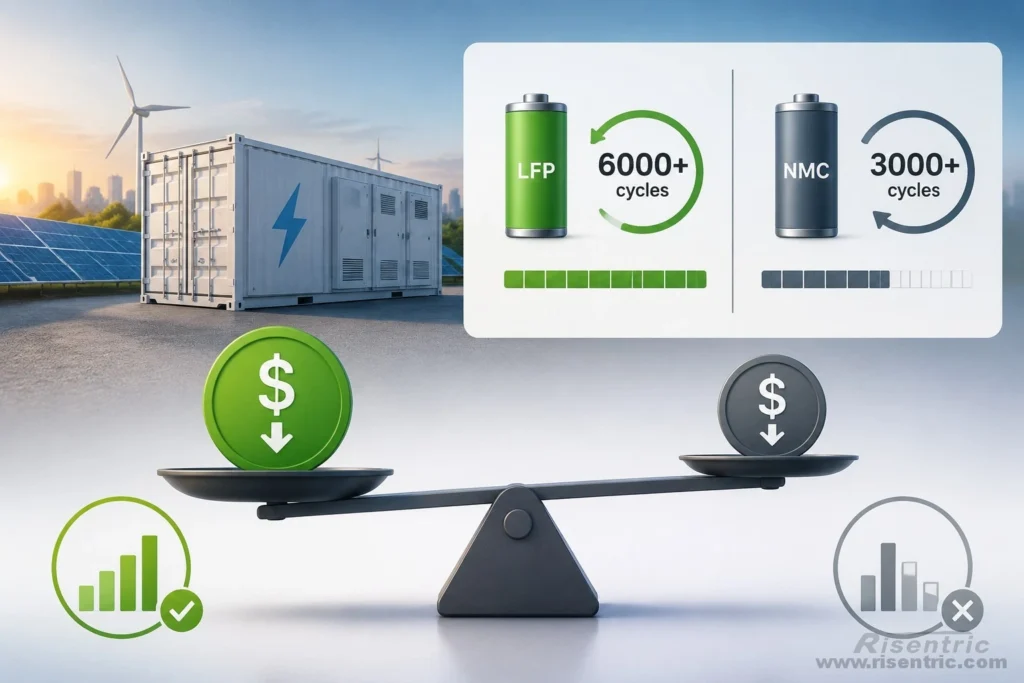
In ESS applications, cost is not measured only at purchase.
It is measured as cost per delivered energy over time.
Since ESS batteries cycle frequently, the total number of cycles directly determines the total energy output of the system.
LFP’s long cycle life means:
- More total energy delivered over its lifetime
- Lower cost per usable kWh
- Better alignment with daily cycling applications such as solar storage and peak shaving
This is a key reason LFP is preferred in ESS, even when upfront price differences are not the only factor.
1.4 Short-Term Procurement Reality
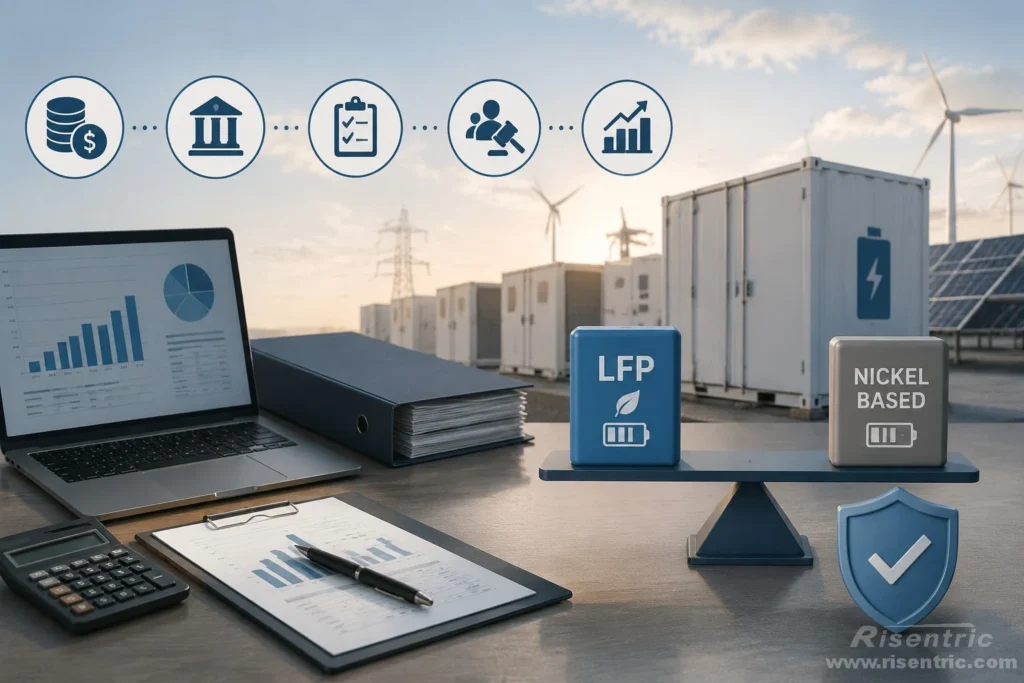
Although lifetime cost is important in theory, ESS procurement is often influenced by short-term economics.
Project decisions are affected by:
- Initial investment budget
- Financing conditions
- Tender competitiveness
- Payback period expectations
LFP performs well in this dimension because it is not only cost-effective over its lifetime, but also competitive in upfront pricing compared with nickel-based chemistries.
This dual advantage strengthens its position in real-world procurement.
Summary
The cost dominance of LFP in ESS is not driven by a single factor, but by the alignment of multiple advantages:
- Lower cathode material cost
- Large-scale manufacturing ecosystem
- Strong cycle life supporting lower lifetime cost
- Competitive upfront pricing in procurement decisions
This combination makes LFP particularly suitable for stationary energy storage applications.
2. LFP Has Better Thermal Stability and Safety Characteristics
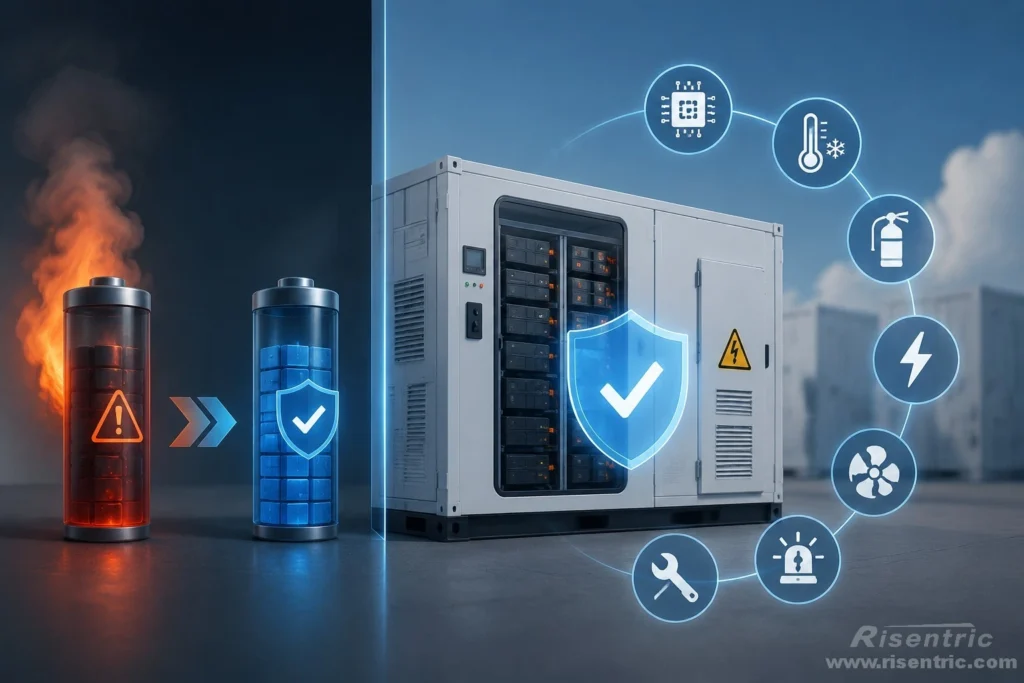
Safety is another major reason LFP batteries are commonly used in ESS.
The key advantage comes from the chemistry itself. LFP has a stable phosphate-based structure, which makes it more thermally stable than many nickel-based lithium-ion chemistries.
In practical terms, this means LFP is less sensitive to overheating and less likely to enter dangerous thermal conditions under abnormal operation.
This is especially important for ESS, because a system may contain thousands of battery cells connected into modules, racks, cabinets, or containers. Once the system becomes large, battery safety is no longer only a cell-level issue. It becomes a system-level design issue.
However, LFP should not be described as completely safe or risk-free.
LFP provides better thermal stability at the chemistry level, but ESS safety still depends on the complete system design.
3. LFP Is Well Suited for Daily Cycling Operation in ESS
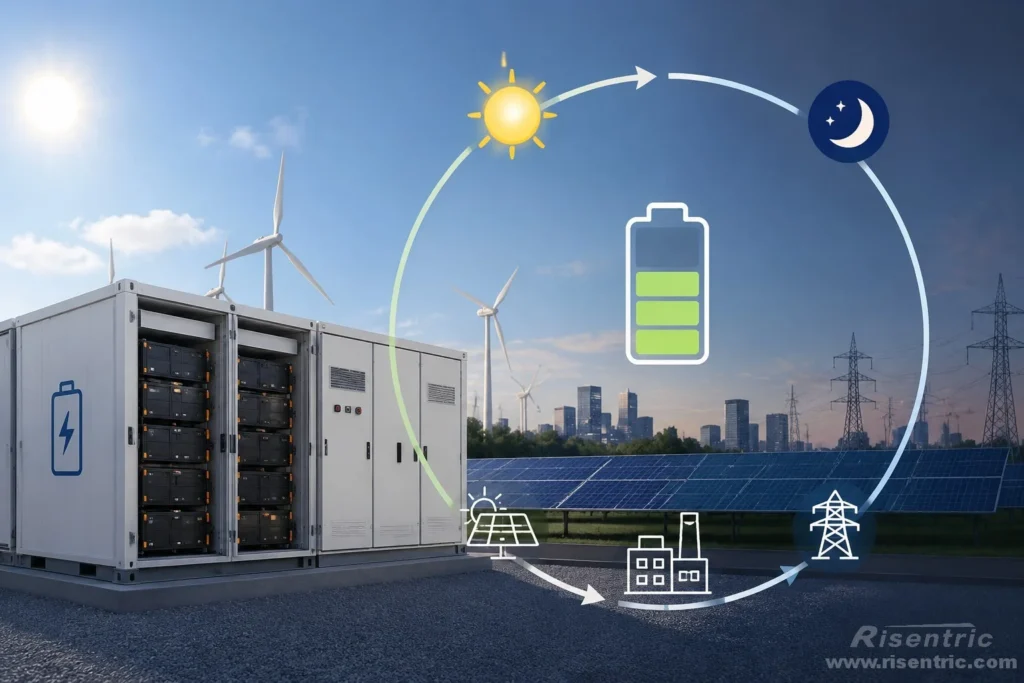
Many ESS projects are not designed for occasional backup use. They operate every day based on energy demand, electricity price, or renewable generation.
Typical applications include solar storage, peak shaving, load shifting, and grid support.
These use cases require the battery to operate in a stable daily cycle, often with partial charging and discharging instead of full 0–100% cycling.
LFP batteries perform well under this type of operating pattern because they offer stable voltage behavior, predictable degradation, and consistent performance across repeated daily cycling.
This is different from applications where the battery is mostly idle or used only occasionally for backup.
In ESS, the battery must handle continuous operational stress without performance instability or rapid degradation.
This makes LFP a practical choice for grid-connected and industrial energy storage systems where daily cycling is the norm.
Looking for industrial power distribution solutions for your project?
4. LFP Has Acceptable Energy Density for Stationary Systems
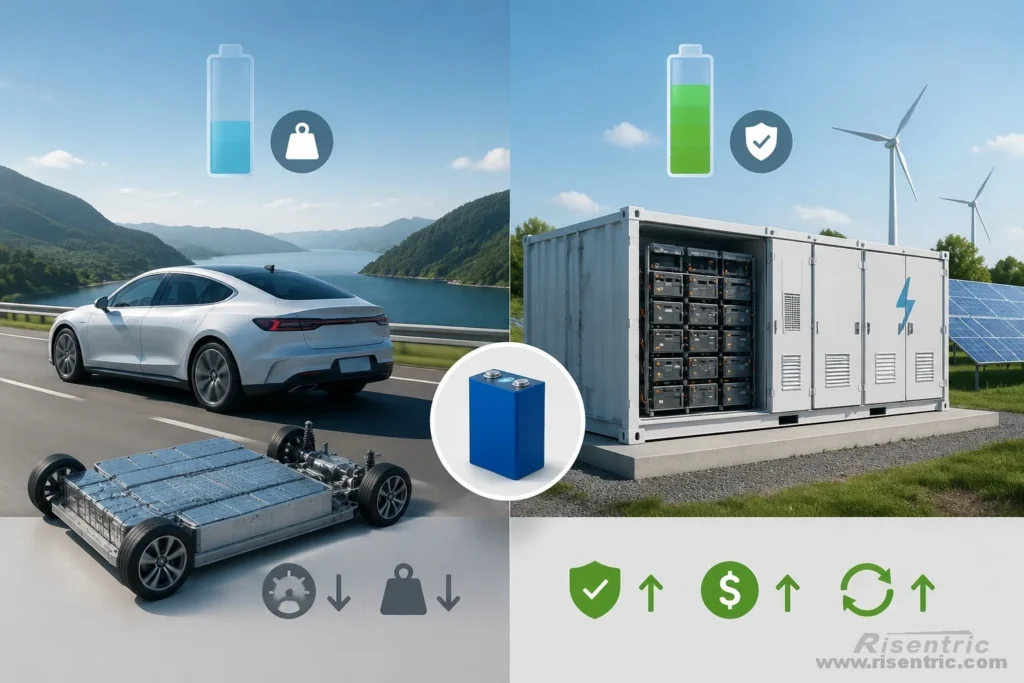
LFP generally has lower energy density compared with nickel-based lithium-ion chemistries such as NMC and NCA.
In electric vehicles, this is a key disadvantage because space and weight directly affect driving range.
In stationary energy storage systems, however, the situation is different.
An ESS is installed in a fixed location such as a battery cabinet, container, battery room, or outdoor energy storage site. In these applications, space and weight constraints are typically less critical than in mobility applications.
As a result, a slightly larger system size is acceptable if it comes with better safety, lower cost, and longer cycle life.
This is one of the reasons LFP is widely used in ESS, even though it does not have the highest energy density among lithium-ion chemistries.
For stationary applications, overall system performance and reliability are usually more important than maximizing energy density alone.
LFP Is Not Perfect
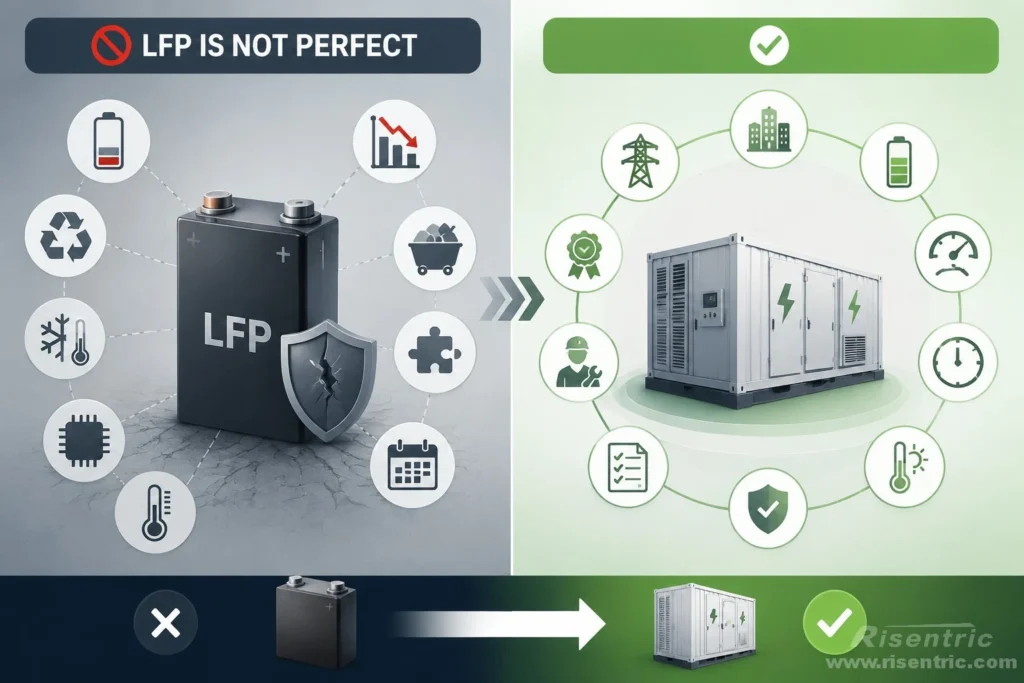
LFP is widely used in ESS, but it is not a perfect battery chemistry. Its limitations should still be considered during system design.
| Limitation | What it means for ESS |
|---|---|
| Lower energy density than NMC or NCA | The system may need more space for the same energy capacity. |
| Lower recycling material value | LFP contains no nickel or cobalt, so recovered material value may be lower. |
| Low-temperature sensitivity | Heating or thermal management may be needed in cold environments. |
| Capacity degradation over time | The system must consider usable capacity loss during its service life. |
| Need for careful system integration | BMS, thermal design, fire protection, and operating strategy still matter. |
This is why ESS selection should not be based only on battery chemistry. LFP is common because it is a strong general choice for many ESS applications, not because it solves every problem automatically.
Recycling Value Is More Complicated
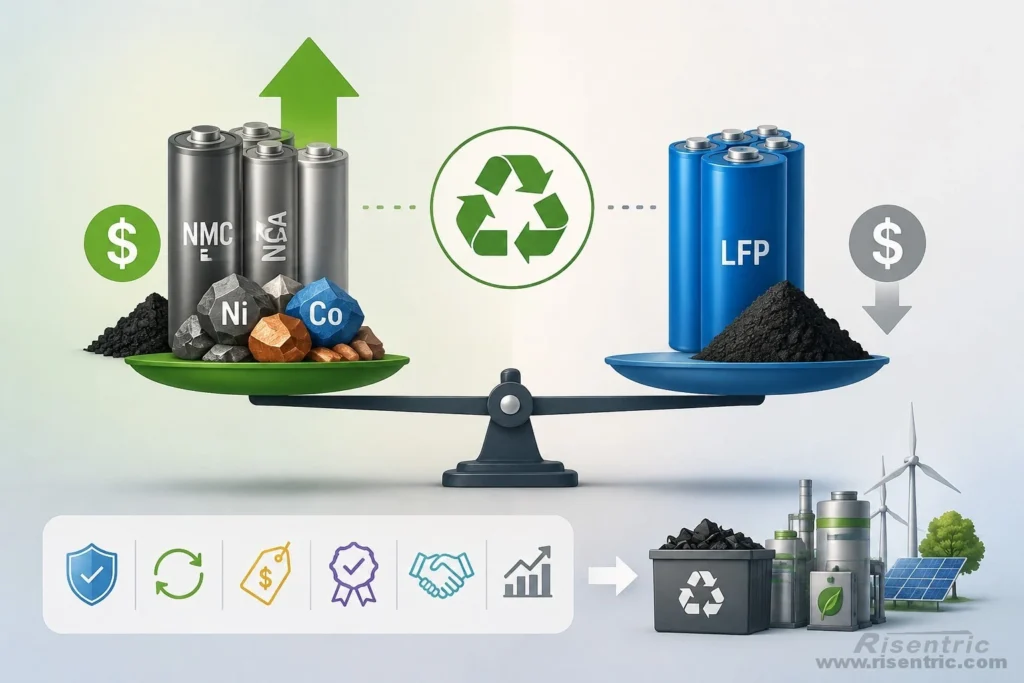
Recycling is another cost-related factor.
Nickel-based batteries such as NMC and NCA contain higher-value metals, especially nickel and cobalt. This can make their recycling value higher.
LFP does not contain nickel or cobalt, so its material recovery value may be lower.
This means LFP is cheaper to produce, but not always more valuable to recycle.
However, for most ESS buyers, recycling value is usually not the first decision factor. Safety, cycle life, initial cost, warranty, supplier reliability, and system performance are usually more important.
In the future, as LFP recycling technology develops and more retired ESS batteries enter the market, recycling may become a more important part of project economics.
For now, LFP’s main economic advantage still comes from upfront cost, cycle life, safety, and manufacturing scale.
Looking for industrial power distribution solutions for your project?
Final Insight: Chemistry Limits Are Managed at System Level
A key principle in ESS engineering is that battery chemistry defines the inherent electrochemical characteristics, while system-level design manages its limitations.
Like all lithium-ion chemistries, LFP has certain constraints, such as lower energy density and specific voltage behavior. However, these characteristics are well understood and predictable, which makes them suitable for system engineering.
In a complete ESS, the BMS, PCS, EMS, thermal system, and protection systems work together to keep the battery operating within safe and efficient boundaries.
This means that real-world performance is not determined by battery chemistry alone, but by how effectively the system is designed around that chemistry.
In summary, LFP is common in ESS because it fits the practical requirements of stationary energy storage. It offers competitive cost, strong cycle life, good thermal stability, mature manufacturing, and acceptable energy density for fixed installations. It is not the best chemistry in every parameter, but it provides one of the best overall balances for modern ESS projects.
FAQ
Why are LFP batteries commonly used in ESS?
LFP batteries are commonly used in ESS because they offer a strong balance of cost, safety, cycle life, and reliability. They may not have the highest energy density, but they are well suited for stationary energy storage applications where long-term operation is more important than minimum size and weight.
Is LFP safer than NMC batteries?
LFP generally has better thermal stability than nickel-based chemistries such as NMC. This makes it less sensitive to overheating and thermal runaway risk. However, LFP is not risk-free. A safe ESS still requires proper BMS protection, thermal management, fire protection, electrical protection, and system-level design.
Why is LFP cheaper than NMC or NCA?
The main reason is the cathode material. LFP uses lithium iron phosphate and does not use nickel or cobalt. Nickel and cobalt are usually more expensive and more price-sensitive, so LFP often has a material-cost advantage compared with NMC and NCA.
Is LFP always the cheapest battery choice?
No. LFP is not always the cheapest in every situation. Lead-acid batteries may have lower upfront cost, and sodium-ion batteries may become cheaper in some future applications. However, for modern ESS projects, LFP often provides a better balance of upfront cost, cycle life, safety, and supply-chain maturity.
What is the main disadvantage of LFP batteries?
The main disadvantage of LFP is lower energy density compared with NMC or NCA. This means an LFP-based system may require more space for the same energy capacity. However, this is usually acceptable in stationary ESS applications.
Is LFP suitable for daily charge and discharge operation?
Yes. LFP is well suited for daily cycling applications such as solar energy storage, peak shaving, load shifting, and industrial energy management. Its long cycle life and predictable degradation make it practical for repeated charge and discharge operation.
Does LFP need a BMS?
Yes. LFP batteries still require a battery management system. The BMS monitors voltage, current, temperature, SOC, SOH, and protection limits. LFP chemistry is stable, but system-level control is still necessary for safe and reliable ESS operation.
Is LFP better than lead-acid for ESS?
For cyclic ESS applications, LFP is usually better than lead-acid because it has longer cycle life, higher usable capacity, better efficiency, and lower maintenance requirements. Lead-acid may still be used in some backup systems, but it is less suitable for frequent cycling.
Can sodium-ion replace LFP in ESS?
Sodium-ion batteries may become an important option in the future because sodium is abundant and potentially low-cost. However, LFP is currently more mature in large-scale ESS deployment, supplier availability, field experience, and bankability.
Should ESS battery selection be based only on chemistry?
No. Battery chemistry is important, but ESS selection should also consider system capacity, power rating, discharge duration, safety requirements, site environment, grid connection, thermal design, certification, supplier quality, and warranty conditions.


