
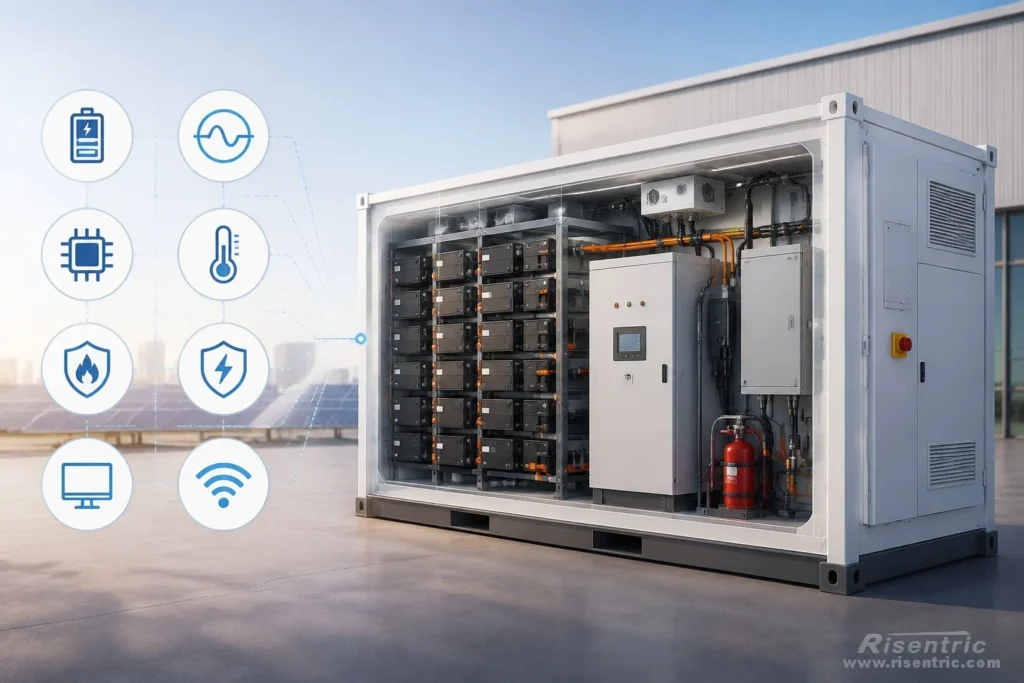
In energy storage projects, the phrase “all-in-one” is attractive because it suggests a system that is compact, integrated, and easier to deploy.
But in practice, it also raises an important question:
What is actually included inside the system?
A battery energy storage system is not only a group of batteries. It may also involve power conversion, battery management, thermal management, fire protection, electrical protection, communication, and control functions.
An all-in-one BESS brings many of these functions into one packaged unit instead of requiring each part to be installed as a separate device on site. This can reduce installation complexity and make the system easier to apply in commercial and industrial projects.
Why “All-in-One” Can Be Confusing
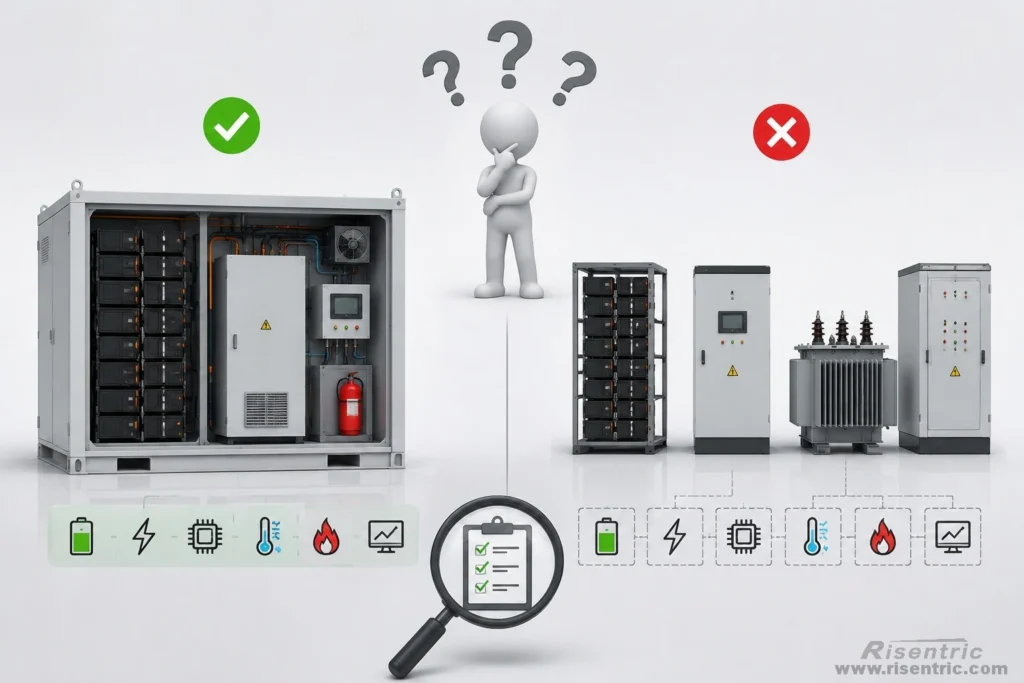
“All-in-one” does not always mean the same thing from every supplier.
- In some systems, the battery, PCS, BMS, cooling, fire protection, and control system are integrated into one cabinet or enclosure.
- In other systems, only part of the system is integrated, while the PCS, EMS, transformer, or distribution cabinet may still be separate.
That is why buyers should not judge only by the product name.
Before comparing prices, always check the technical configuration and scope of supply.
What Is Usually Integrated in an All-in-One BESS?
A typical all-in-one battery energy storage system may include several major subsystems.
The exact design depends on system capacity, voltage level, cooling method, safety requirements, and project application.
1. Battery Modules
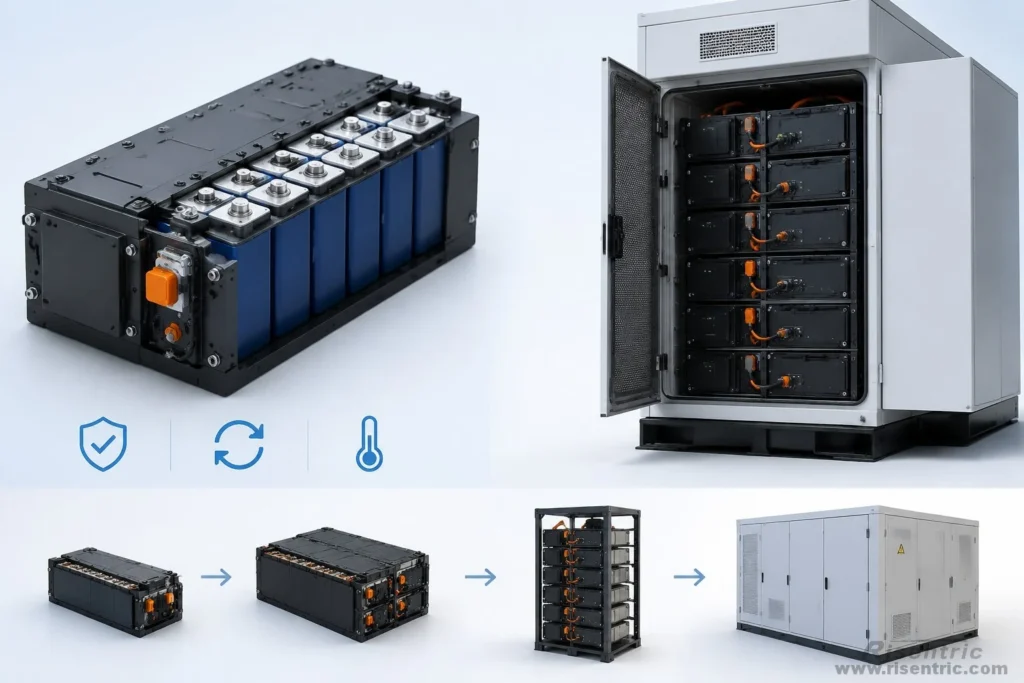
Battery modules are the main energy storage part of a BESS. They determine how much energy the system can store and strongly influence system cost, lifetime, and safety performance.
In many commercial and industrial energy storage systems, lithium iron phosphate batteries are commonly used because they offer good thermal stability, long cycle life, and suitable safety performance for stationary applications.
Depending on the system design, battery modules may be arranged into packs, racks, or clusters inside the cabinet or enclosure.
When evaluating an all-in-one BESS, buyers should check not only the rated capacity, but also the battery chemistry, cell quality, cycle life, warranty conditions, and allowable operating temperature range.
2. Battery Management System
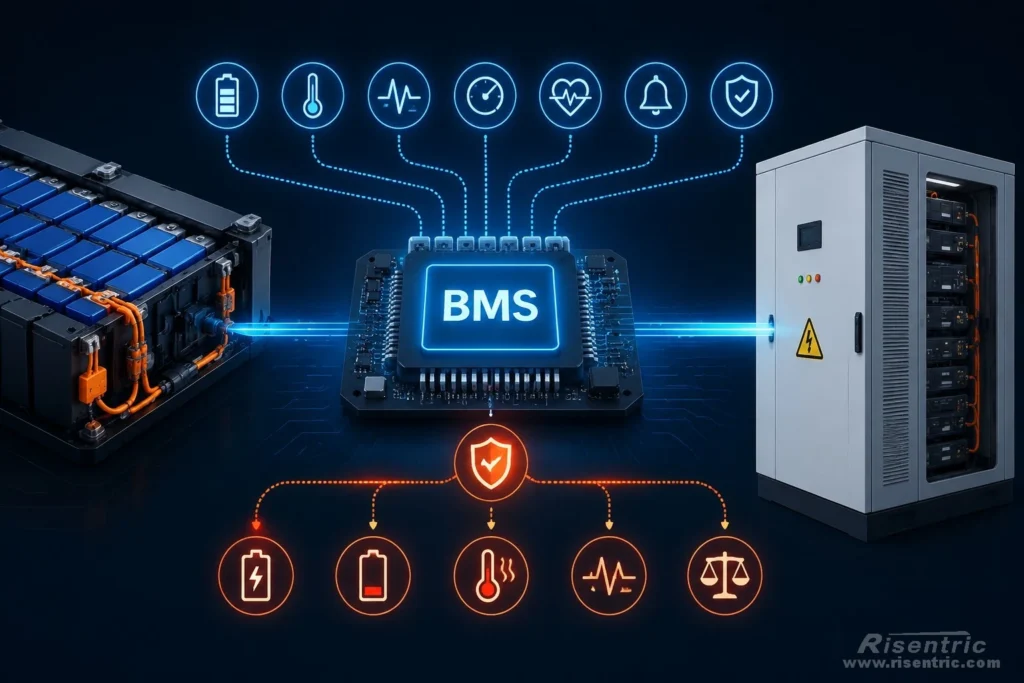
The battery management system, or BMS, is responsible for monitoring and protecting the battery.
It tracks key battery conditions such as cell voltage, temperature, charge and discharge current, state of charge, state of health, alarm status, and protection status.
Based on this information, the BMS helps prevent unsafe operating conditions such as overcharge, over-discharge, overheating, overcurrent, and voltage imbalance.
In an all-in-one BESS, the BMS is a critical safety and control layer. Without it, the battery modules cannot be operated safely or reliably as part of a complete energy storage system.
3. Power Conversion System
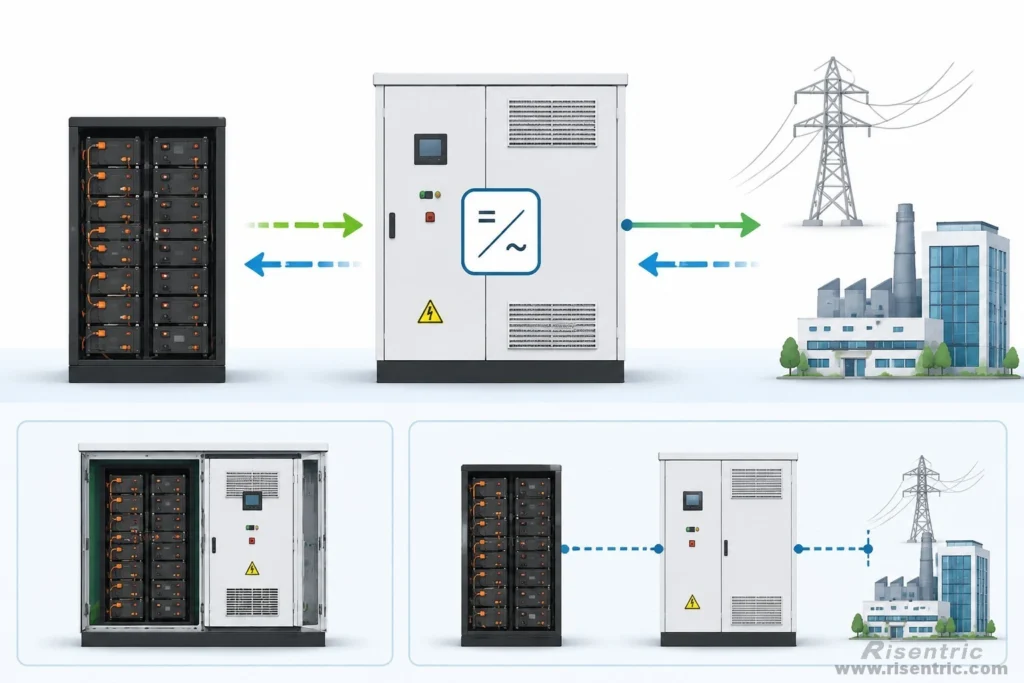
The power conversion system, or PCS, converts power between DC and AC.
Batteries store energy as DC electricity. Most factories, buildings, grids, and loads use AC electricity. The PCS allows energy to move between the battery and the external electrical system.
- During charging, the PCS converts AC power into DC power for battery charging.
- During discharging, the PCS converts DC power from the battery into AC power for the load or grid.
In some all-in-one systems, the PCS is integrated inside the same cabinet or enclosure. In other systems, the PCS may be installed separately. This difference should be confirmed before procurement.
4. Energy Management System
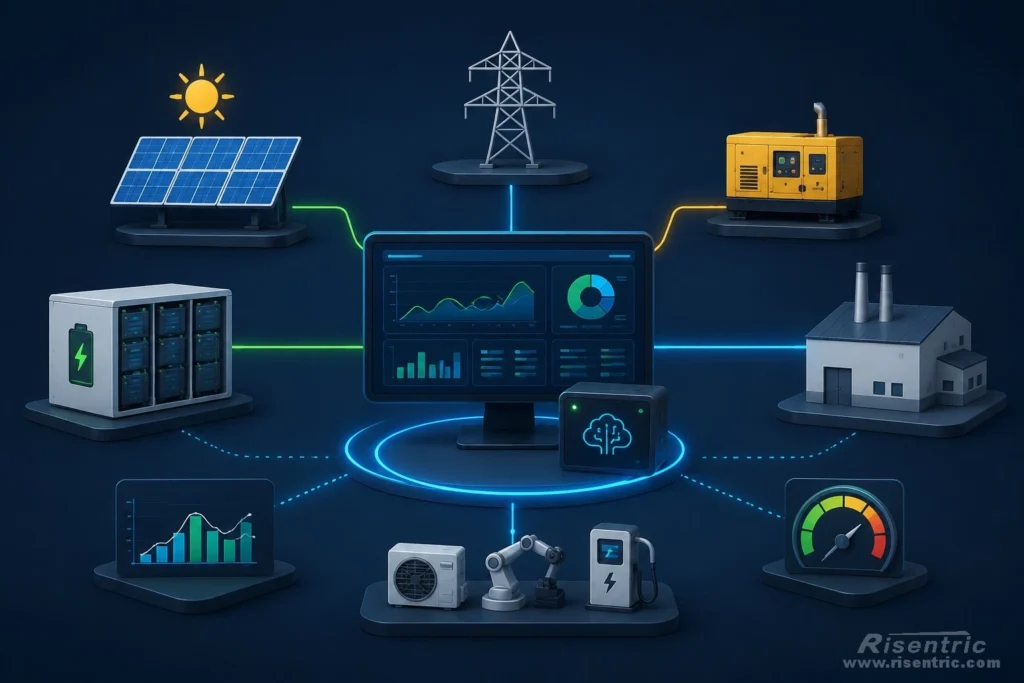
The energy management system, or EMS, controls how the energy storage system operates.
The EMS may decide when the battery should charge, when it should discharge, how much power should be delivered, and how the system should coordinate with solar power, grid power, generators, meters, or site loads.
For example, in a factory, the EMS may control the system to charge during low electricity price periods and discharge during peak price periods.
In a solar energy storage project, the EMS may help store excess solar power during the day and release it later when solar generation is lower.
Some smaller all-in-one systems may use a local controller instead of a more advanced EMS. For larger or more complex projects, EMS capability becomes more important.
5. Thermal Management System
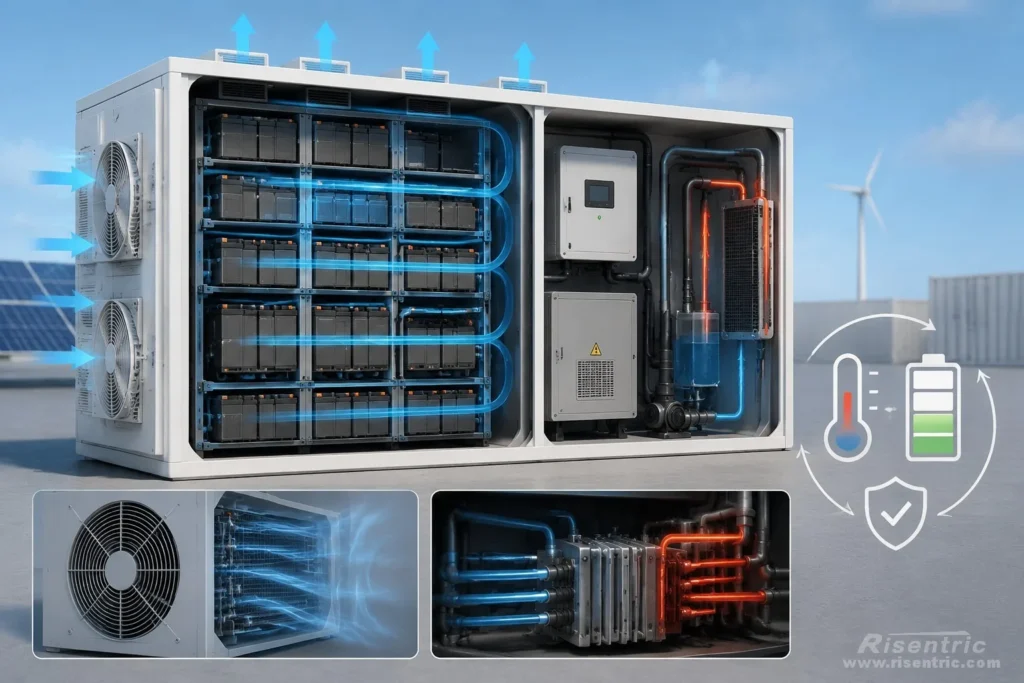
Battery temperature has a direct impact on safety, performance, and service life.
If the temperature is too high, battery aging may accelerate and safety risks may increase. If the temperature is too low, charging and discharging performance may be reduced.
An all-in-one BESS may use air cooling or liquid cooling. Air cooling is simpler and may be suitable for smaller systems or moderate operating conditions. Liquid cooling provides more uniform temperature control and is often used in higher-capacity or higher-power systems.
When selecting an all-in-one BESS, the cooling method should match the installation environment, ambient temperature, operating profile, and expected charge-discharge frequency.
6. Fire Protection and Safety System
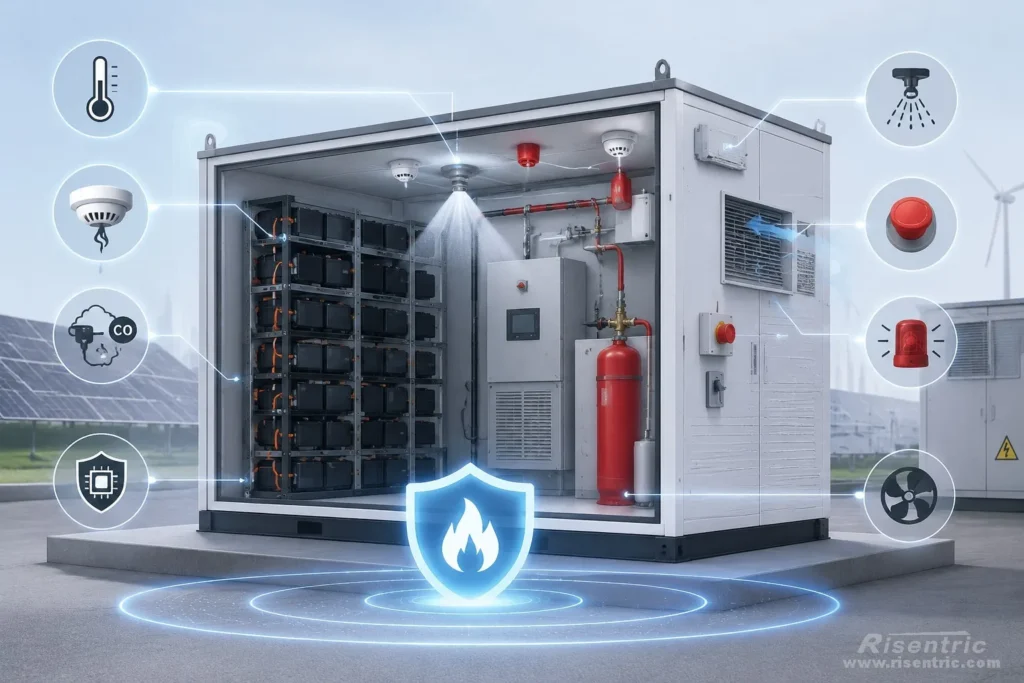
Safety is one of the most important parts of a battery energy storage system.
An all-in-one BESS may include temperature sensors, smoke detection, gas detection, fire suppression, emergency stop buttons, alarms, and system protection logic.
However, fire safety should not be judged only by whether a fire suppression device is installed.
A complete safety design should consider battery chemistry, BMS logic, thermal management, electrical protection, enclosure design, ventilation, installation distance, maintenance access, and local project requirements.
In other words, battery safety is a system-level issue, not only a component-level issue.
7. Electrical Protection and Connection Components
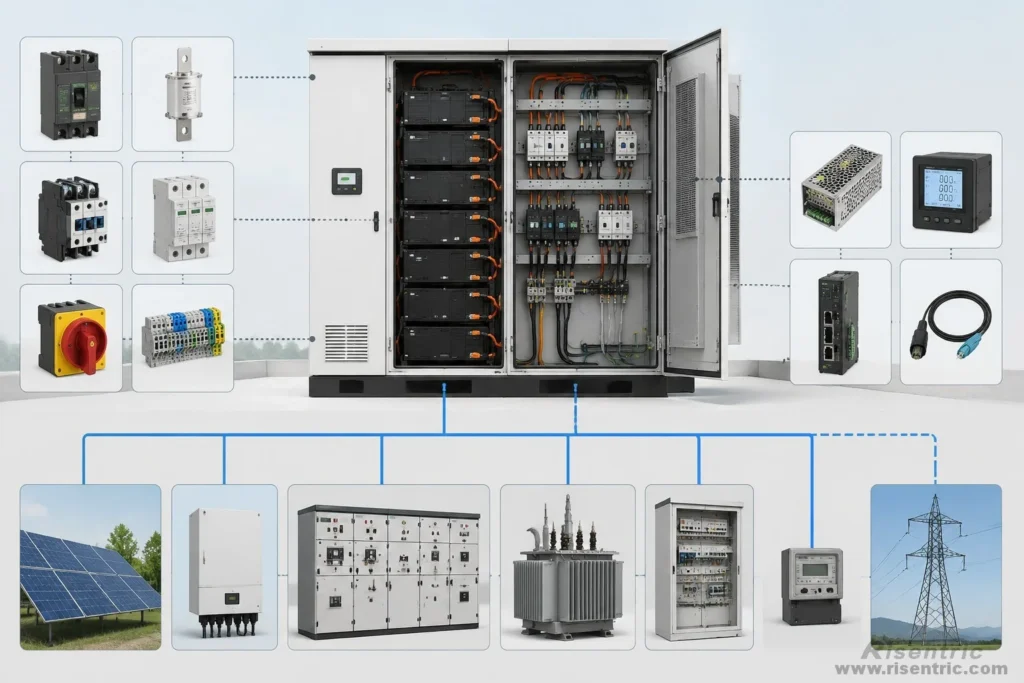
An all-in-one BESS also needs electrical protection and connection components.
These may include circuit breakers, fuses, contactors, surge protection devices, isolation switches, terminals, auxiliary power supplies, metering devices, and communication interfaces.
These components help the energy storage system connect safely to the site electrical system.
In a real project, the BESS may need to work with low-voltage switchgear, transformers, solar inverters, distribution boards, meters, or grid connection equipment.
This is why an all-in-one BESS should not be viewed as an isolated battery product. It is part of the wider power distribution system.
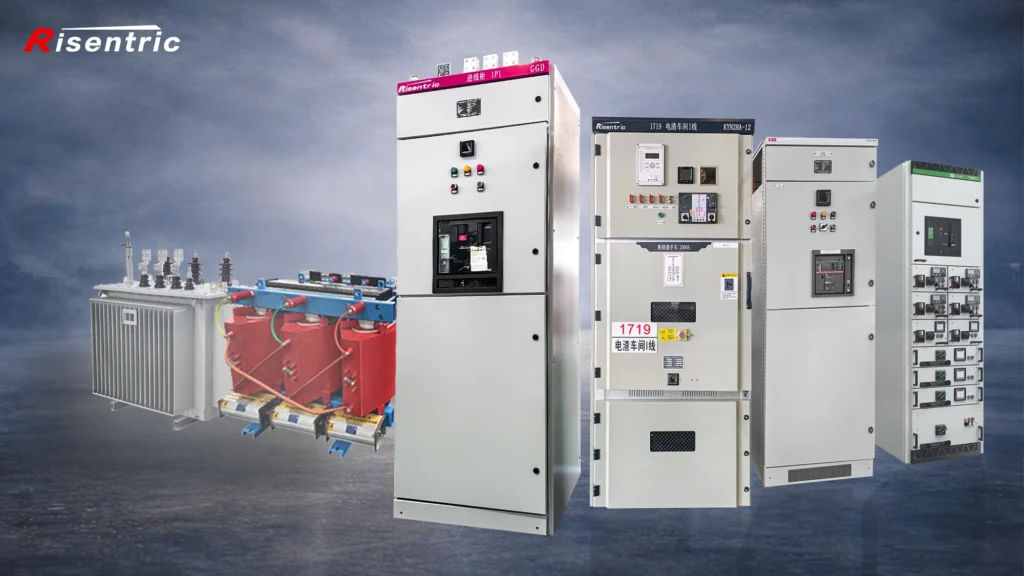
Looking for industrial power distribution solutions for your project?
All-in-One BESS, Battery Cabinet, and Containerized BESS: What Is the Difference?
These terms are sometimes used differently by different suppliers, so buyers should always check the actual scope of supply. The key question is not only the product name, but what is included inside the system.
| Item | Typical meaning | Common scope | Typical application |
|---|---|---|---|
| Battery cabinet | A cabinet mainly focused on battery-side equipment | Battery modules, battery racks, BMS, terminals, fuses, contactors, and other DC-side components. PCS, EMS, cooling, fire protection, or AC-side protection may or may not be included. | Projects where the battery section is supplied separately, or where PCS and other equipment are installed externally. |
| All-in-one BESS | A more integrated battery energy storage system | Usually combines battery modules, BMS, PCS, thermal management, fire protection, electrical protection, and local control functions in one packaged unit. However, the exact scope depends on the supplier. | Compact commercial and industrial projects, solar energy storage, EV charging support, small factories, commercial buildings, and site-level backup power. |
| Containerized BESS | A larger integrated BESS installed in a container | Battery racks, PCS or PCS interface, cooling, fire protection, electrical protection, control system, and auxiliary systems installed in a 10-foot, 20-foot, or 40-foot container. Some transformers or switchgear may still be external. | Larger commercial, industrial, utility, microgrid, or project-scale energy storage applications. |
In simple terms, a battery cabinet usually emphasizes the battery section, an all-in-one BESS emphasizes compact system integration, and a containerized BESS emphasizes larger-scale energy storage in a containerized structure.
Before comparing prices, buyers should confirm what is included, what is external, and where the system boundary is.
Why Integration Matters
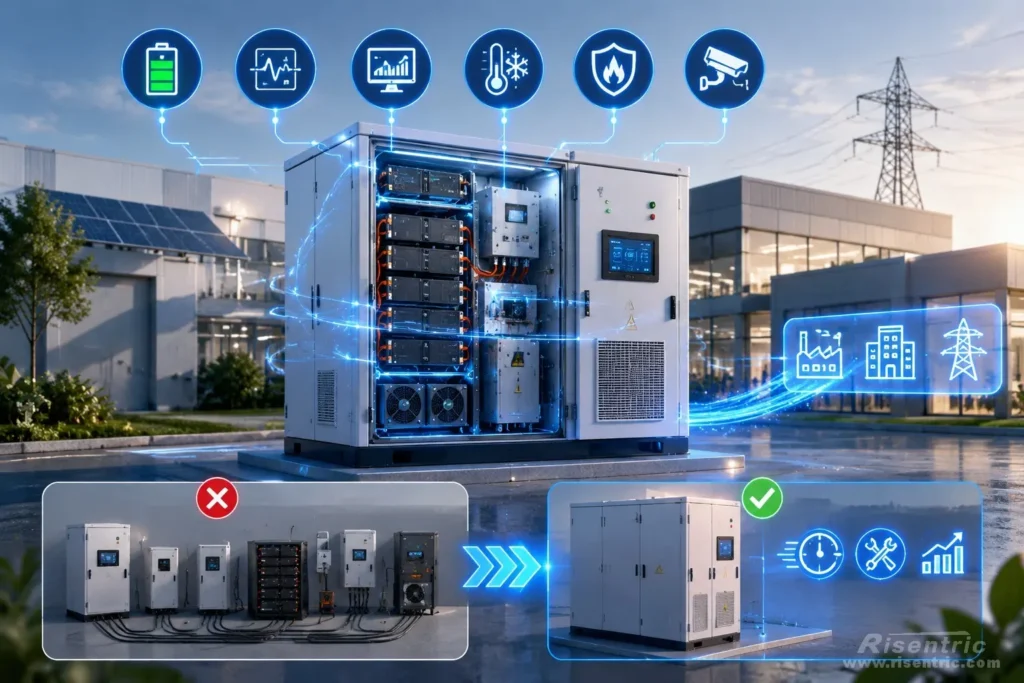
The main value of an all-in-one BESS is integration.
When batteries, power conversion, control, cooling, protection, and communication are designed to work together, the system can be easier to install and operate.
Integration can reduce site wiring, shorten installation time, simplify commissioning, and improve compatibility between subsystems.
For commercial and industrial projects, this can be important because many sites have limited space, limited installation time, and limited engineering resources.
Typical Cost Share of Major BESS Components
In most all-in-one BESS products, the battery modules usually account for the largest share of the system cost.
For project budgeting, these percentages should be treated as a rough reference only. Actual quotations depend on system capacity, PCS rating, cooling design, certification requirements, enclosure type, and site conditions.
The following table gives a general reference only:
| Component | Typical cost share |
|---|---|
| Battery cells / modules / racks | 45–60% |
| PCS / inverter | 10–20% |
| BMS | 5–8% |
| EMS / local control system | 3–8% |
| Thermal management | 5–10% |
| Fire protection and safety system | 3–8% |
| Cabinet / enclosure / structure | 5–10% |
| Electrical protection, wiring, busbars, and auxiliaries | 5–10% |
These percentages should not be used as a fixed quotation formula. They are only a useful way to understand where the main value of a BESS comes from.
What Buyers Should Check Before Selecting an All-in-One BESS
When comparing all-in-one battery energy storage systems, buyers should not only compare battery capacity. The complete system scope and project requirements should also be checked.
| Item to check | Why it matters |
|---|---|
| Scope of supply | Confirm whether the system includes battery modules, BMS, PCS, EMS or local controller, cooling, fire protection, electrical protection, communication interface, and cabinet or enclosure. Also check whether external switchgear, transformers, meters, or grid connection equipment are required. |
| Power and energy ratings | Energy capacity, measured in kWh or MWh, shows how much energy the system can store. Power rating, measured in kW or MW, shows how much power the system can charge or discharge at one time. Both values must match the load and application. |
| Battery chemistry | Battery chemistry affects safety, cycle life, cost, temperature performance, and energy density. For many commercial and industrial energy storage applications, lithium iron phosphate batteries are commonly used, but cell quality, certification, warranty, and system-level safety design should also be checked. |
| Cooling method | Cooling affects battery temperature control and long-term reliability. Air cooling may be suitable for some smaller systems, while liquid cooling may be better for higher-capacity systems or applications with frequent charge-discharge cycles. |
| Safety design | Safety should include battery monitoring, electrical protection, thermal management, fire detection, fire suppression, emergency stop, cabinet structure, ventilation, and maintenance access. For BESS projects, safety should be reviewed at the system level. |
| Site power system connection | The BESS must connect correctly with the site electrical system. Depending on the project, it may need to interface with low-voltage switchgear, transformers, solar inverters, generators, meters, or a building energy management system. Voltage level, grid connection method, protection requirements, communication protocol, and installation layout should be confirmed before purchasing. |
Conclusion
“All-in-one” in a battery energy storage system means that several key subsystems are integrated into one packaged solution.
A typical all-in-one BESS may include battery modules, BMS, PCS, thermal management, fire protection, electrical protection, and control functions. However, the exact scope can vary between suppliers.
For buyers, the important point is to check what is included, what is external, and where the system boundary is.
In short, an all-in-one BESS is not just a cabinet with batteries inside. It is an integrated system designed to store, convert, protect, and deliver electrical energy in a more compact and practical form.
FAQ
Is an all-in-one BESS the same as a battery cabinet?
Not always. A battery cabinet usually emphasizes the battery section, while an all-in-one BESS usually means a more integrated system with battery modules, BMS, PCS, cooling, fire protection, electrical protection, and control functions. However, suppliers may use these terms differently, so the actual scope of supply should always be checked.
Does an all-in-one BESS always include the PCS?
Not always. In many all-in-one systems, the PCS is integrated into the same cabinet or enclosure. In other designs, the PCS may be installed separately. Buyers should confirm whether the PCS is included, what its power rating is, and whether it matches the required application.
Does an all-in-one BESS need external switchgear or a transformer?
Sometimes, yes. Even if the BESS is called “all-in-one,” it may still require external switchgear, transformers, meters, or grid connection equipment depending on the project voltage level, installation layout, and grid connection requirements.
What is the difference between power rating and energy capacity?
Energy capacity, measured in kWh or MWh, shows how much energy the system can store. Power rating, measured in kW or MW, shows how much power the system can charge or discharge at one time. Both values are important when selecting a BESS.
Is liquid cooling always better than air cooling?
Not necessarily. Liquid cooling can provide more uniform temperature control and is often used in higher-capacity or higher-power systems. Air cooling is simpler and may be suitable for smaller systems or moderate operating conditions. The right choice depends on the installation environment and operating profile.
What should buyers confirm before comparing prices?
Buyers should confirm what is included, what is external, and where the system boundary is. Important items include battery modules, BMS, PCS, EMS or local controller, cooling system, fire protection, electrical protection, communication interface, cabinet or enclosure, and required external equipment.


