
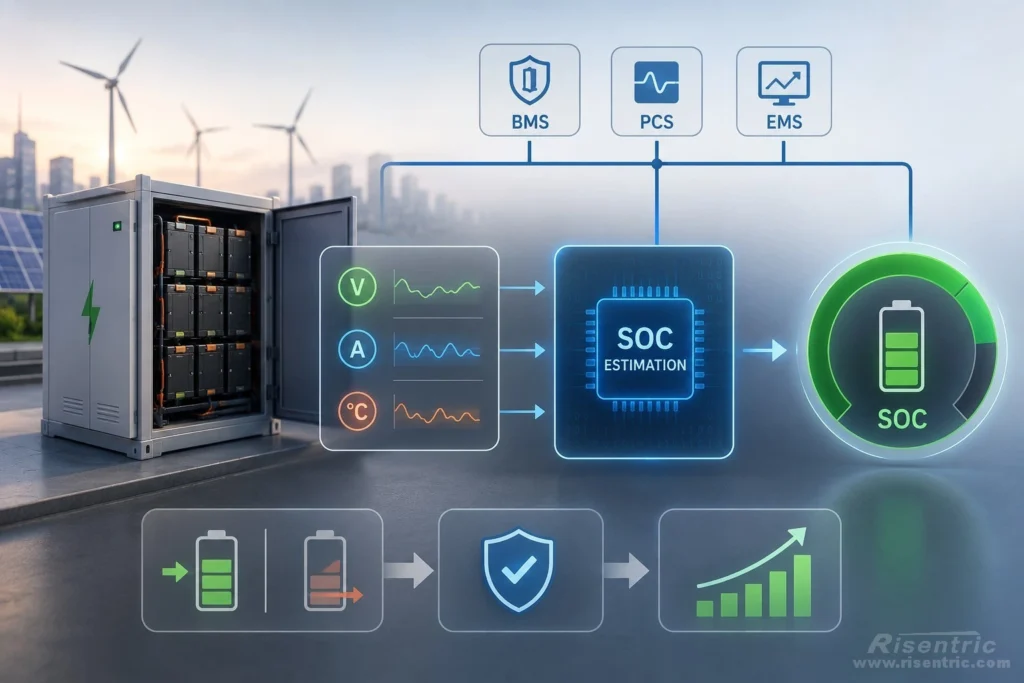
SOC stands for State of Charge. It describes how much usable charge remains in a battery compared with its available capacity.
At first, SOC sounds simple. It is often shown as a percentage, similar to the battery level on a mobile phone. If a battery shows 80% SOC, we usually understand that the battery still has about 80% of its usable charge available.
However, in a battery energy storage system, SOC is more than a display number. It is one of the key operating parameters used by the BMS, PCS, and EMS to control how the system charges, discharges, protects the battery, and manages available energy.
More importantly, SOC is not directly measured by a sensor. Voltage, current, and temperature can be measured directly. SOC cannot. It must be estimated.
What Does SOC Mean in a Battery Energy Storage System?
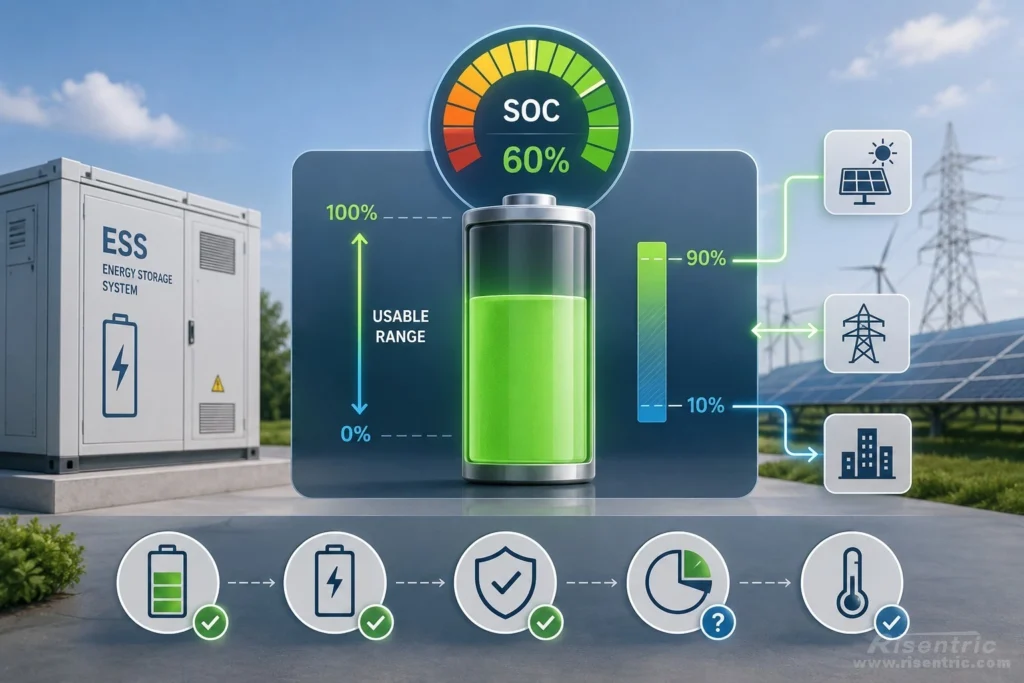
In a simple definition, SOC means the remaining usable charge of a battery expressed as a percentage.
A battery at 100% SOC is considered fully charged within its usable operating range. A battery at 0% SOC is considered fully discharged within its usable operating range.
This does not always mean the battery is physically charged to its absolute chemical maximum or discharged to its absolute chemical minimum. In most energy storage systems, the BMS defines a safe usable window to avoid overcharge, over-discharge, and excessive battery stress.
For example, an ESS may be designed to operate between 10% and 90% SOC. In this case, the system protects the battery by avoiding the most stressful upper and lower regions.
In an ESS, SOC helps the system answer several important questions:
- How much energy is still available for discharge?
- Should the battery continue charging?
- Is backup reserve energy still available?
- Is the battery operating inside a safe range?
These questions show why SOC is important for energy storage operation. It connects the battery’s internal condition with the external power strategy of the whole system.
Why SOC Matters in an ESS
For example, a solar storage system needs to know whether the battery still has room to store more solar energy. A backup power system needs to know whether enough reserve energy is available.
If the SOC estimate is too high, the system may expect more available energy than the battery can actually deliver. If the SOC estimate is too low, the system may stop using the battery too early and leave useful capacity unused.
That is why SOC is not just a display value. It directly affects charging, discharging, protection, backup reserve, and energy management.
SOC Cannot Be Measured Directly
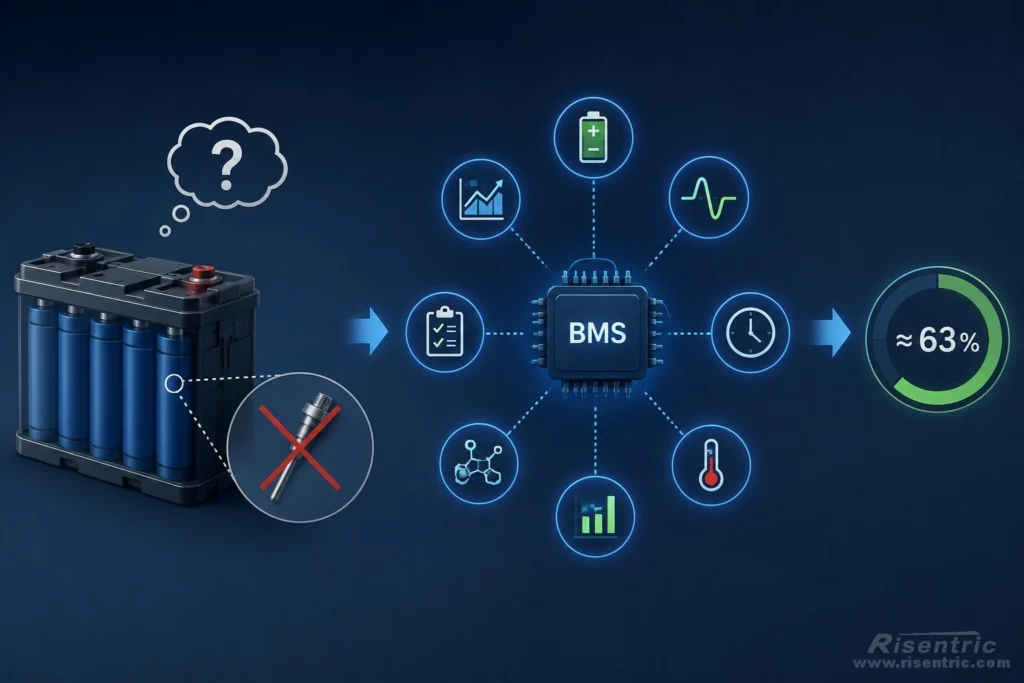
A common misunderstanding is that SOC can be directly measured.
In reality, there is no simple sensor that can be placed inside a battery to directly read “the battery is 63% charged.”
The BMS can directly measure electrical and thermal signals such as voltage, current, and temperature. Then it uses these values, together with battery models and historical data, to estimate SOC.
This is the key point:
SOC is calculated, not directly measured.
The BMS usually estimates SOC based on several types of information:
- battery voltage
- charge and discharge current
- operating time
- battery temperature
- rated and usable capacity
- battery chemistry
- battery aging condition
- previous charging and discharging history
Because SOC is estimated, it is never perfectly absolute. A good BMS can make the estimate accurate enough for safe and reliable operation, but SOC should still be understood as an engineering estimate.
How SOC Is Estimated
There are several methods used to estimate SOC. In real ESS applications, the BMS usually does not depend on only one method. It combines different methods to reduce error and improve reliability.
The three most important methods are open-circuit voltage estimation, coulomb counting, and model-based estimation.
Each method has strengths and limitations.
Open-Circuit Voltage Method

The open-circuit voltage method estimates SOC from the relationship between battery voltage and battery charge level.
When a battery is resting and no significant current is flowing, its voltage becomes more stable. This resting voltage is called open-circuit voltage, or OCV.
In theory, a battery’s OCV has a relationship with SOC. A more charged battery has a higher voltage, and a more discharged battery has a lower voltage. Therefore, the BMS can compare the measured voltage with a known OCV-SOC curve and estimate the SOC.
This method is useful because voltage is easy to measure. It can also help correct SOC drift after the battery has rested for enough time.
However, the method has a major limitation: the battery often does not have enough resting time for accurate OCV estimation. In normal ESS operation, the battery may charge or discharge frequently, so the measured terminal voltage is affected by internal resistance, current direction, temperature, and recent operating history. In that condition, the terminal voltage is not the same as the true open-circuit voltage.
This is why OCV-based estimation is useful for correction and calibration, but it is usually not enough by itself during real-time ESS operation.
For LFP batteries, this method is even more limited in the middle SOC range. LFP batteries have a relatively flat voltage curve over a large part of their operating range. This means the SOC may change significantly while the voltage changes only slightly.
As a result, voltage alone is usually not enough for accurate SOC estimation in an LFP-based ESS.
Coulomb Counting Method
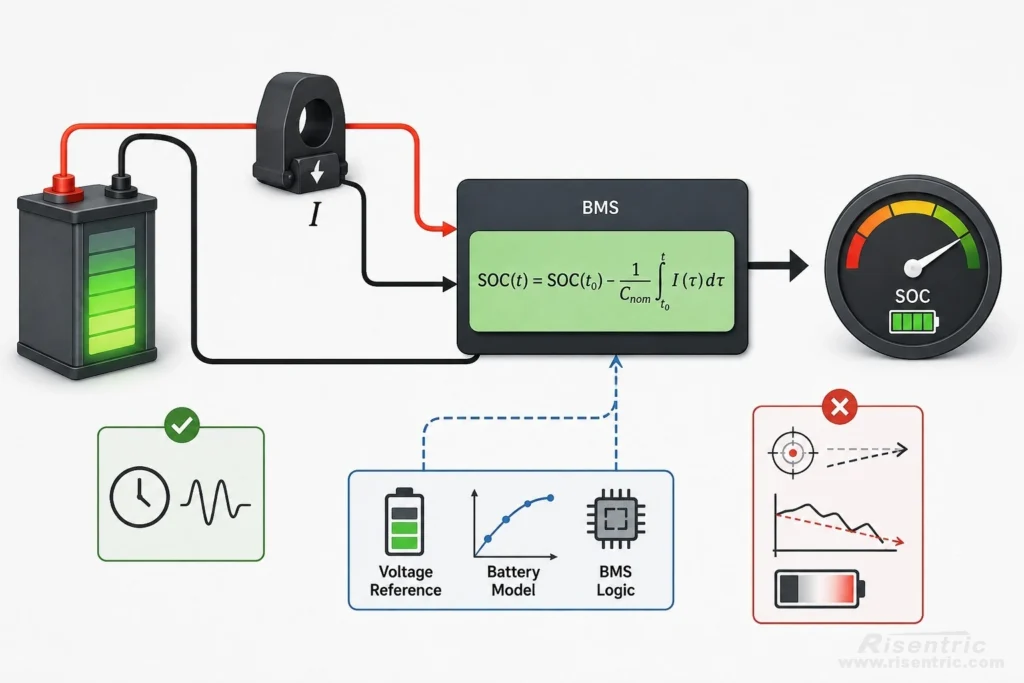
Coulomb counting is one of the most common SOC estimation methods in battery systems.
The basic idea is simple: the BMS measures current over time and calculates how much charge has entered or left the battery.
When the battery charges, SOC increases. When the battery discharges, SOC decreases.
For example, suppose a battery has 100 Ah of usable capacity. If it discharges at 10 A for 2 hours, it has discharged about 20 Ah. In simple terms, the SOC decreases by about 20% of the usable capacity.
This method is useful because it works during real operation. The battery does not need to rest. The BMS can continuously track current during charging and discharging.
However, coulomb counting has one important weakness: small errors can accumulate over time.
If the current sensor has a small error, that error is added into the SOC calculation again and again. If the initial SOC is wrong, the later SOC estimate will also be wrong until the system is corrected. If the battery capacity changes due to aging, but the BMS still uses the old capacity value, the SOC estimate may become inaccurate.
This is why coulomb counting needs calibration. It is powerful during operation, but it should be corrected by voltage reference, battery models, or other BMS logic.
Model-Based SOC Estimation

More advanced BMS designs use model-based SOC estimation.
A battery model describes how the battery behaves under different conditions. It considers the relationship between voltage, current, temperature, SOC, internal resistance, and sometimes aging.
During operation, the BMS compares the measured battery behavior with the predicted behavior from the model. If there is a difference, the algorithm adjusts the SOC estimate.
Some systems may use algorithms such as Kalman filtering or extended Kalman filtering. These methods are useful because batteries are nonlinear systems. Their behavior changes with current, temperature, SOC range, and aging condition.
Model-based estimation can improve SOC accuracy during changing load conditions. This is important for an ESS because the battery may not operate under a steady condition all the time. Power may change because of solar generation, load demand, grid commands, or EMS strategy.
However, model-based estimation also depends on the quality of the battery model. If the model does not match the real battery behavior, the SOC estimate can still be wrong.
Why LFP Batteries Make SOC Estimation More Challenging
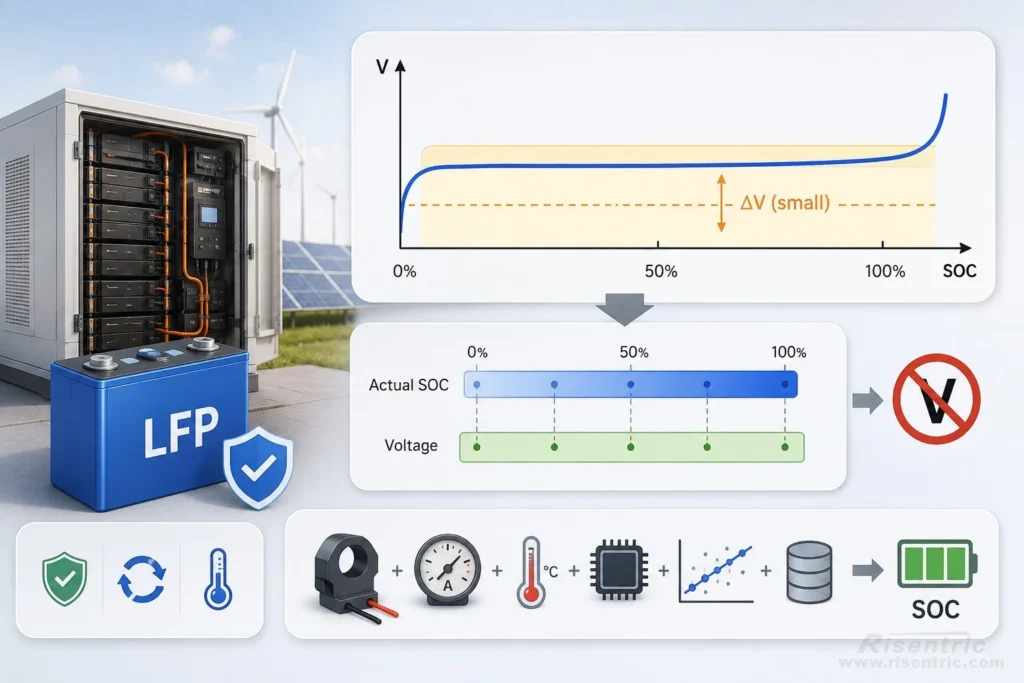
LFP batteries are widely used in energy storage systems because they offer good safety performance, long cycle life, and stable operation.
However, LFP batteries have a relatively flat voltage curve across much of the SOC range. This means the voltage may change only slightly even when the actual SOC changes significantly.
As a result, voltage alone is not enough for accurate SOC estimation, especially in the middle SOC region. An LFP-based ESS usually needs accurate current measurement, coulomb counting, temperature compensation, calibration logic, and battery models to estimate SOC more reliably.
In short, LFP is suitable for ESS, but accurate SOC estimation still depends on a capable BMS, good sensing, and proper calibration.
SOC at Cell, Module, Rack, and System Level
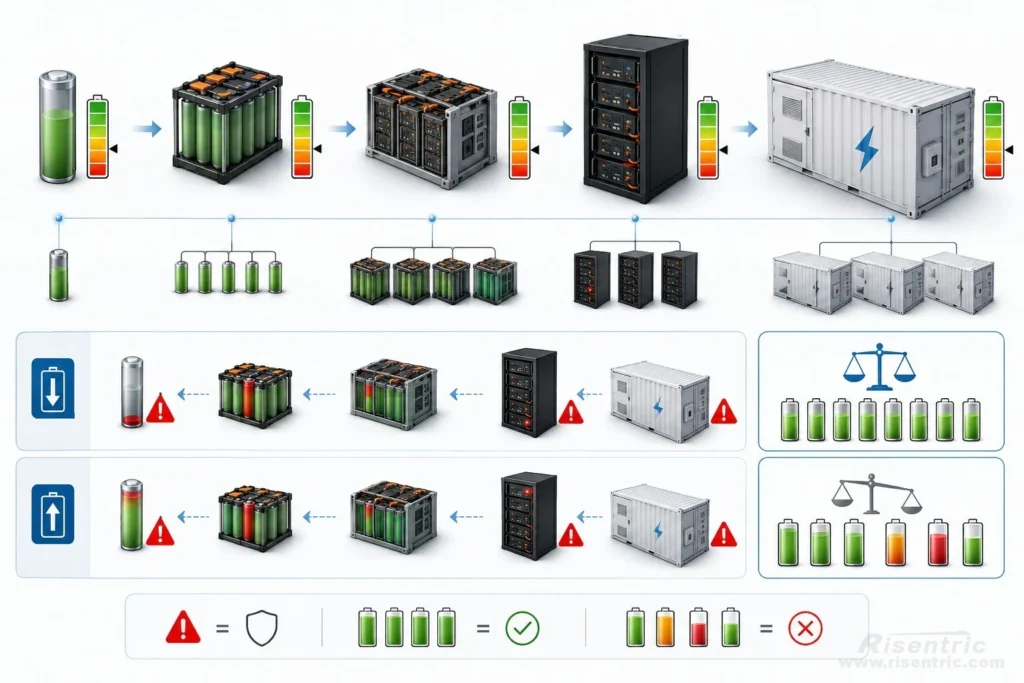
An ESS is not a single battery cell. It is built from many cells connected into modules, packs, racks, and sometimes larger battery clusters.
Because of this, SOC is not only a cell-level value. The BMS may estimate SOC at different levels of the system.
The important point is that system-level SOC is limited by the weakest part of the battery system.
During discharge, if one cell reaches its lower voltage limit earlier than the others, the BMS may need to stop or reduce discharge even if other cells still have remaining energy. During charging, if one cell reaches its upper voltage limit earlier than the others, the BMS may need to stop or reduce charging even if the rest of the battery still has room.
This is why cell consistency and balancing matter.
A well-balanced battery system can use its capacity more effectively. A poorly balanced system may have less usable energy, even if the theoretical rated capacity looks large.
In practical ESS operation, SOC estimation and cell balancing are closely connected. The system is not only estimating how much charge remains; it is also managing how safely and evenly that charge can be used.
SOC and SOH Are Related, But Not the Same
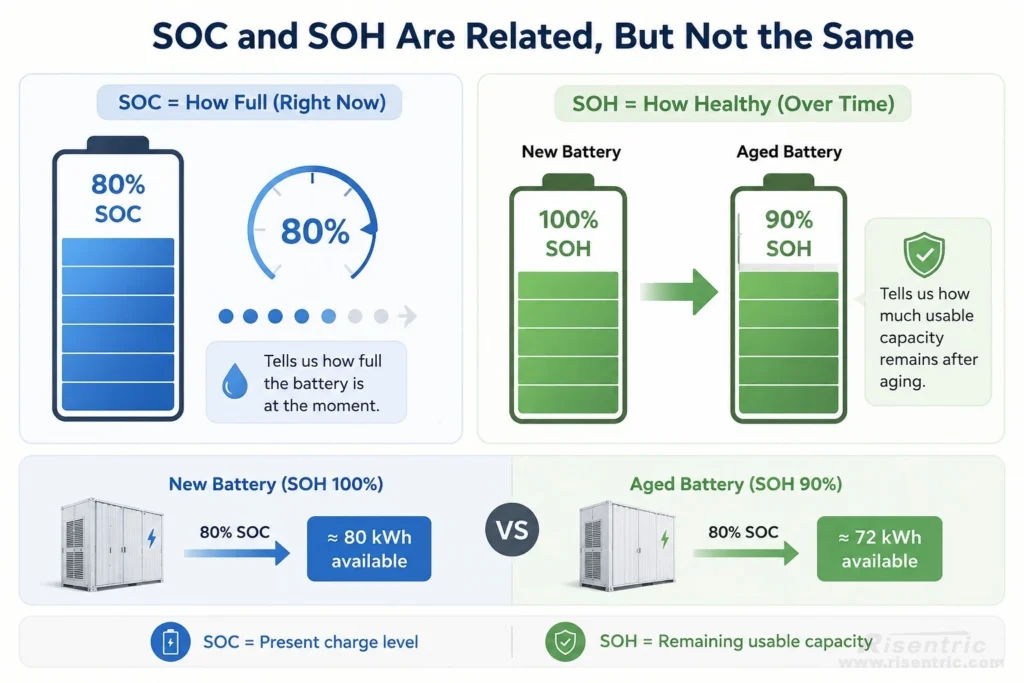
SOC should not be confused with SOH.
SOC tells us how full the battery is at the moment. SOH, or State of Health, tells us how much the battery has aged compared with its original condition.
The connection is important because SOC is calculated based on usable capacity. If the battery is new, 80% SOC may represent close to 80% of its original usable energy. After years of operation, the battery may no longer have the same usable capacity. In that case, 80% SOC still means the battery is 80% full, but it is 80% of a smaller capacity.
For example, a new battery system may have 100 kWh of usable energy. At 80% SOC, it may have about 80 kWh available. If the battery later degrades to 90 kWh of usable capacity, then 80% SOC represents about 72 kWh instead.
This is why SOC should be read together with SOH when evaluating long-term ESS performance. SOC tells us the present charge level. SOH tells us how much usable battery capacity remains after aging.
Common Causes of SOC Error
SOC error can happen because the BMS is estimating a condition that cannot be directly measured. The estimate depends on sensor data, battery models, capacity assumptions, and operating history. If any of these inputs are inaccurate, the displayed SOC may drift away from the real battery condition.
| Cause | Why it affects SOC estimation |
|---|---|
| Current sensor error | Coulomb counting depends on accurate current measurement. Even a small current error can accumulate over time and cause SOC drift. |
| Wrong initial SOC | If the BMS starts from an incorrect SOC value, the later calculation may remain inaccurate until the system is corrected. |
| Battery aging | As the battery ages, usable capacity changes. If the BMS does not update the capacity estimate, SOC may no longer reflect the real available energy. |
| Temperature change | Temperature affects voltage response, available power, and usable capacity, especially under low-temperature conditions. |
| Cell imbalance | Some cells may reach voltage limits earlier than others, forcing the system to stop charging or discharging before all capacity is fully used. |
| Long operation without calibration | If the system operates for a long time without rest, reference correction, or recalibration, SOC drift can increase. |
Looking for industrial power distribution solutions for your project?
Why SOC Matters When Selecting an ESS
When selecting an ESS, SOC may look like a simple software display value. In reality, it reflects how well the system understands and manages the battery.
A reliable SOC estimate depends on several parts of the system working together: accurate sensors, a capable BMS, suitable battery models, proper calibration, good cell consistency, and stable thermal management. If these parts are weak, the SOC value may look normal on the screen but still fail to represent the real usable energy accurately.
This matters in real projects. For backup power, an inaccurate SOC estimate can lead to wrong runtime expectations. For solar storage, it can affect how much solar energy the battery can absorb. For peak shaving, it can affect whether the battery is available when the load reaches a high-demand period.
So when comparing ESS solutions, it is not enough to look only at rated energy. It is better to also consider usable energy, BMS design, cell balancing, SOH monitoring, thermal management, operating temperature range, warranty conditions, and the actual application.
In short, SOC accuracy is part of ESS reliability. It affects how much energy the system can use, how safely it operates, and how predictable its performance will be over time.
Conclusion
SOC, or State of Charge, describes the remaining usable charge of a battery. In a battery energy storage system, it is one of the most important operating parameters.
SOC helps the system estimate available energy, control charging and discharging, protect the battery, manage backup reserve, and support energy management strategies.
However, SOC is not directly measured. It is estimated by the BMS using voltage, current, temperature, battery models, and operating history.
Understanding SOC is a basic but important step toward understanding how a battery energy storage system really works.
FAQ
What does SOC mean in a battery energy storage system?
SOC means State of Charge. It shows how much usable charge remains in the battery compared with its available capacity. In an ESS, SOC is not only a display value. It is also used for charging control, discharging control, backup reserve, and battery protection.
Is SOC directly measured?
No. SOC is not directly measured by a sensor. The BMS estimates SOC using measurable values such as voltage, current, temperature, operating time, battery capacity, and battery history.
How is SOC usually estimated?
SOC is usually estimated by combining several methods. Common methods include open-circuit voltage estimation, coulomb counting, and model-based estimation. In real ESS applications, the BMS often combines these methods instead of relying on only one.
Why is voltage alone not enough to estimate SOC?
Voltage can help estimate SOC, but it has limitations. During charging or discharging, terminal voltage is affected by current, internal resistance, temperature, and recent operating history. For LFP batteries, the voltage curve is also relatively flat over much of the SOC range, so voltage changes may be too small to estimate SOC accurately by itself.
What is coulomb counting?
Coulomb counting is a method that estimates SOC by measuring current over time. When the battery charges, the BMS adds charge to the SOC estimate. When the battery discharges, the BMS subtracts charge from the SOC estimate. It is useful during real operation, but small current measurement errors can accumulate over time.
Why can SOC become inaccurate?
SOC can become inaccurate because of current sensor error, wrong initial SOC, battery aging, temperature changes, cell imbalance, or long operation without calibration. This is why the BMS needs correction and calibration logic.
What is the difference between SOC and SOH?
SOC shows how full the battery is at the moment. SOH, or State of Health, shows how much the battery has aged compared with its original condition. A battery may show 80% SOC, but the actual usable energy also depends on its SOH.


