
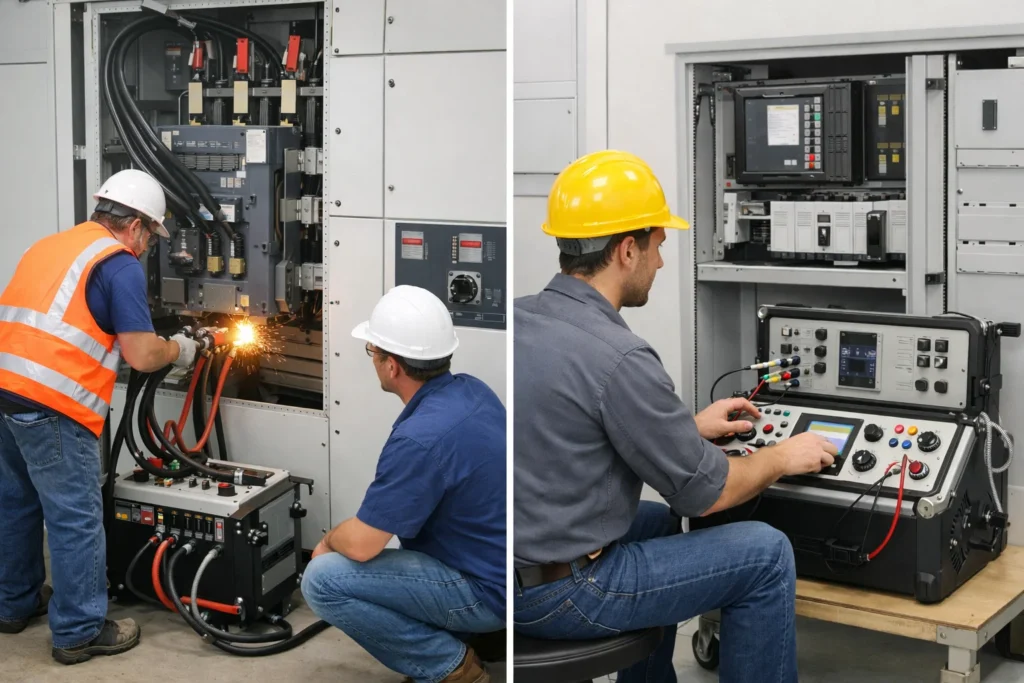
In short, primary injection testing verifies the full protection path using real current, while secondary injection testing verifies relay or trip-unit behaviour using controlled signals.
If you are working with switchgear, understanding how testing fits into the overall system is essential. Injection testing is only one part of a broader testing and maintenance strategy.
For a complete overview of maintenance practices, you can refer to our guide on switchgear maintenance and testing. If you want to understand how protection settings and parameters relate to system performance, see switchgear parameters definition.
In this article, we focus specifically on the difference between primary and secondary injection testing, and when each method should be used.
- What is primary injection testing?
- What is secondary injection testing?
- Primary vs Secondary Injection Testing in Switchgear
- How to choose between Primary vs Secondary Injection Testing?
- How primary and secondary injection testing relate to IEC standards
- Why this distinction matters in real work
- Final takeaway
- FAQ
What is primary injection testing?
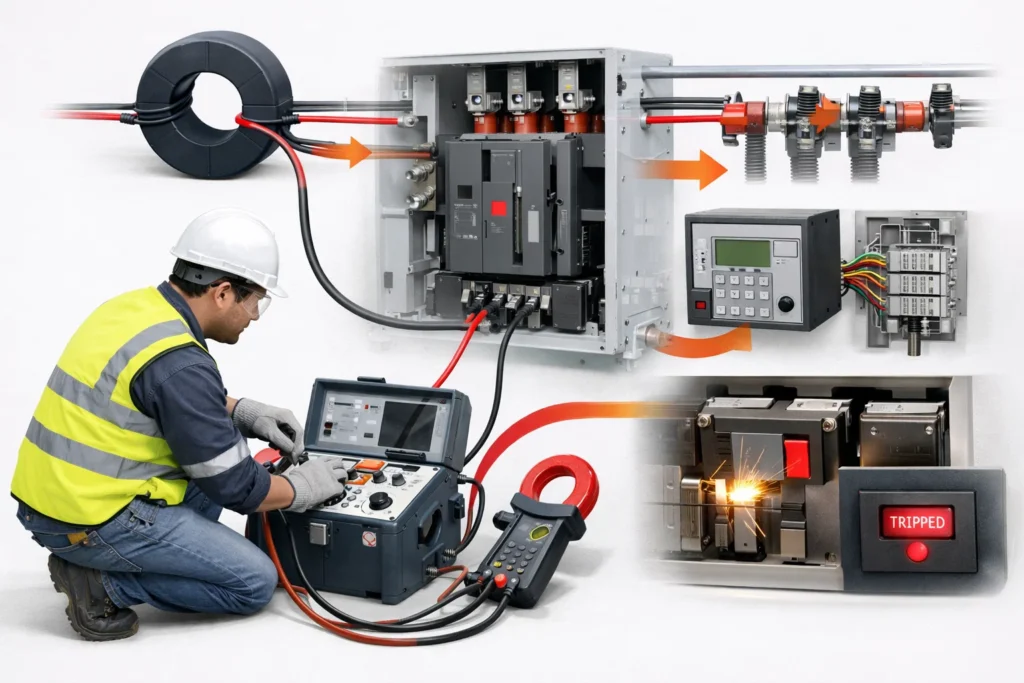
Primary injection testing involves injecting a high test current into the primary side of the circuit. Because current flows through the actual protection path, this method can verify current transformers, wiring, relays, trip circuits, and breaker operation as one complete system. Multiple authoritative sources describe it as the only practical way to prove correct installation and operation of the whole protection chain in the field.
In simple terms, primary injection answers this question: Will the installed system trip correctly when real fault current conditions occur? That makes it especially valuable during commissioning, after major modifications, and when troubleshooting suspected wiring, CT, or breaker issues.
Looking for factory-tested switchgear for your project?
What is secondary injection testing?
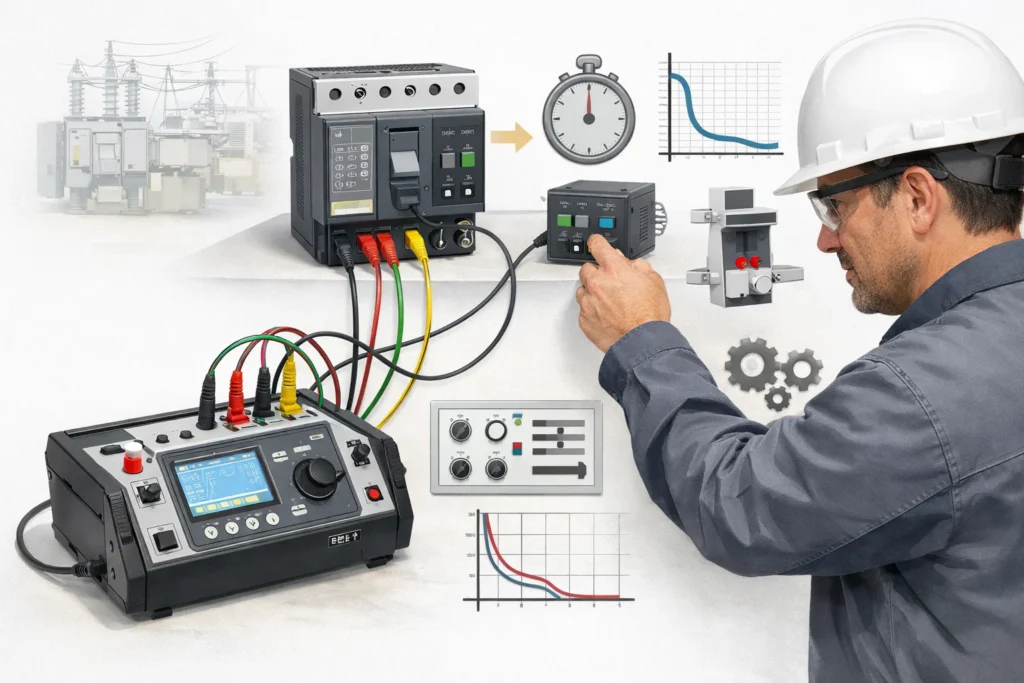
Secondary injection testing works differently. Instead of pushing large current through the primary conductors, the test equipment injects controlled signals into the relay or trip unit on the secondary side. This allows technicians to verify pickup values, timing, trip characteristics, settings, logic, and other protection functions without circulating high current through the complete power path.
That makes secondary injection ideal when the priority is speed, repeatability, and focused testing of relay behavior. It is commonly used for protection settings checks, trip curve verification, and maintenance tasks where full end-to-end primary testing is not necessary.
Primary vs Secondary Injection Testing in Switchgear
| Aspect | Primary Injection Testing | Secondary Injection Testing |
|---|---|---|
| Main purpose | Verifies the complete installed protection path | Verifies relay or trip unit performance directly |
| Test current path | Injects current through the primary circuit | Injects signals on the secondary side |
| What it checks | CTs, wiring, relay inputs, trip circuit, breaker operation | Relay settings, pickup, timing, logic, trip characteristics |
| Test scope | End-to-end system verification | Device-level functional verification |
| Current level | High current required | Much lower test signal level |
| Time and effort | Usually slower and more demanding | Usually faster and easier |
| Best use case | Commissioning, troubleshooting, full system proof | Settings checks, maintenance, functional checks |
| Main advantage | Confirms the installed system works as a whole | Efficient and precise for relay testing |
| Main limitation | Requires larger equipment and more effort | Does not fully prove the whole installed primary path |
How to choose between Primary vs Secondary Injection Testing?
| Use case | Recommended test |
|---|---|
| New switchgear commissioning | Primary injection testing |
| Relay setting verification | Secondary injection testing |
| Suspected CT or wiring problem | Primary injection testing |
| Routine relay maintenance | Secondary injection testing |
| End-to-end trip chain verification | Primary injection testing |
| Fast functional testing of protection device | Secondary injection testing |
How primary and secondary injection testing relate to IEC standards
Secondary injection testing is more naturally associated with protection-relay verification under IEC 60255, while primary injection testing is more closely associated with verifying breaker and installed protection-path behaviour under the relevant equipment and switchgear standards
| Test method | Most relevant IEC layer | Typical focus |
|---|---|---|
| Secondary injection testing | IEC 60255 | Relay pickup, timing, logic, and protection function verification |
| Primary injection testing | IEC 60947-2, plus switchgear context under IEC 61439 or IEC 62271 | Installed trip path, breaker response, and system-level functional verification |
Looking for factory-tested switchgear for your project?
Why this distinction matters in real work
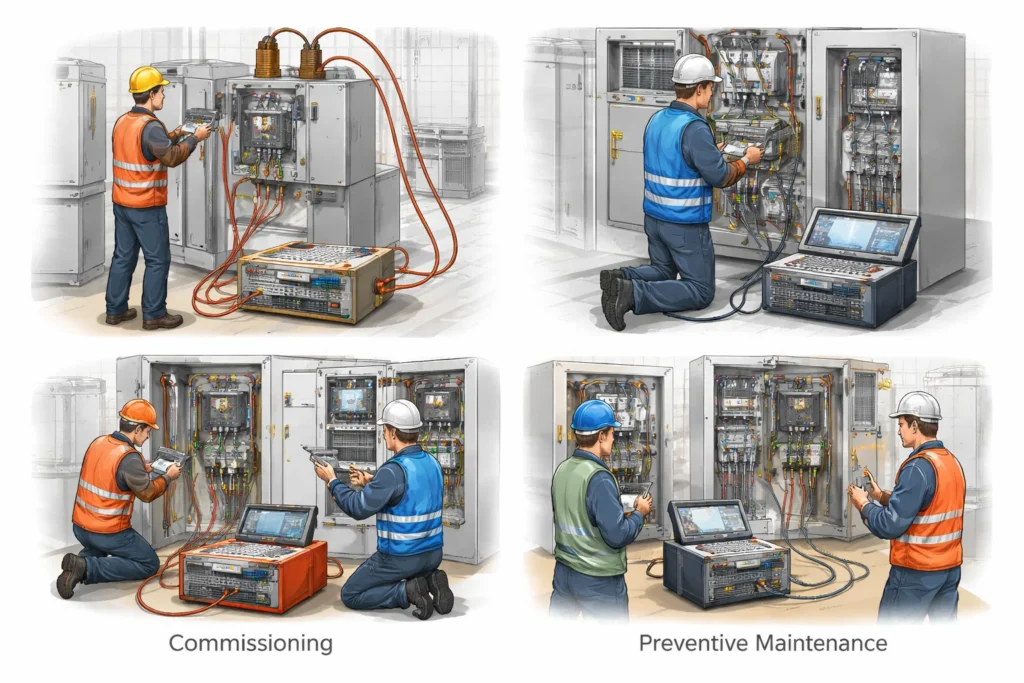
The difference between primary vs secondary injection testing matters because they do not answer the same diagnostic question.
During commissioning, the goal is usually to prove that the installed protection chain will operate correctly as a system, not just that the relay settings look correct on paper. That is why primary injection is valuable: it helps verify the real current path, associated connections, and final trip operation.
During preventive maintenance, the goal is often to confirm that the relay or trip unit still responds according to its settings and timing characteristics. In that context, secondary injection is often the more efficient tool because it focuses directly on device behavior without requiring heavy primary current.
During troubleshooting, the distinction becomes even more important. If secondary injection shows the relay behaves correctly, but the equipment still fails to trip properly in service, the problem may lie elsewhere in the protection chain, such as CT circuits, wiring, or the breaker trip path. If the objective is to locate that kind of system-level problem, primary injection provides a different level of verification.
So the real reason this comparison matters is practical: choosing between primary vs secondary injection testing depends on whether you need to prove device behavior or whole-system behavior.
Final takeaway
Primary vs secondary injection testing is not really a competition. It is a matter of testing depth.
Primary injection testing gives you end-to-end confidence in the installed protection chain. Secondary injection testing gives you fast, precise verification of relay or trip unit performance. The best choice depends on what you need to prove: the entire system or the protection device itself.
FAQ
Is primary injection testing mandatory?
It depends on the equipment, application, manufacturer instructions, and the standard or procedure being followed. For many field scenarios, primary injection is the method used when full-chain verification is required.
Can secondary injection testing find wiring mistakes?
Usually not all of them. Secondary injection is focused on the relay or trip unit response, so it does not fully prove the complete primary path, CT circuit, and all related connections the way primary injection does.
Does primary injection replace secondary injection?
Not entirely. Primary injection is broader, but secondary injection remains useful for detailed settings, timing, and logic verification of the protection device.
Reference:
https://webstore.iec.ch/en/publication/66277
https://www.productinfo.schneider-electric.com/micrologic_active_ug/doca0265-micrologic-active-user-guide/English/DOCA0265_MicroLogicActUserGuide_0000988795.xml/%24/SecInjectTest_DD00807876.XML


