
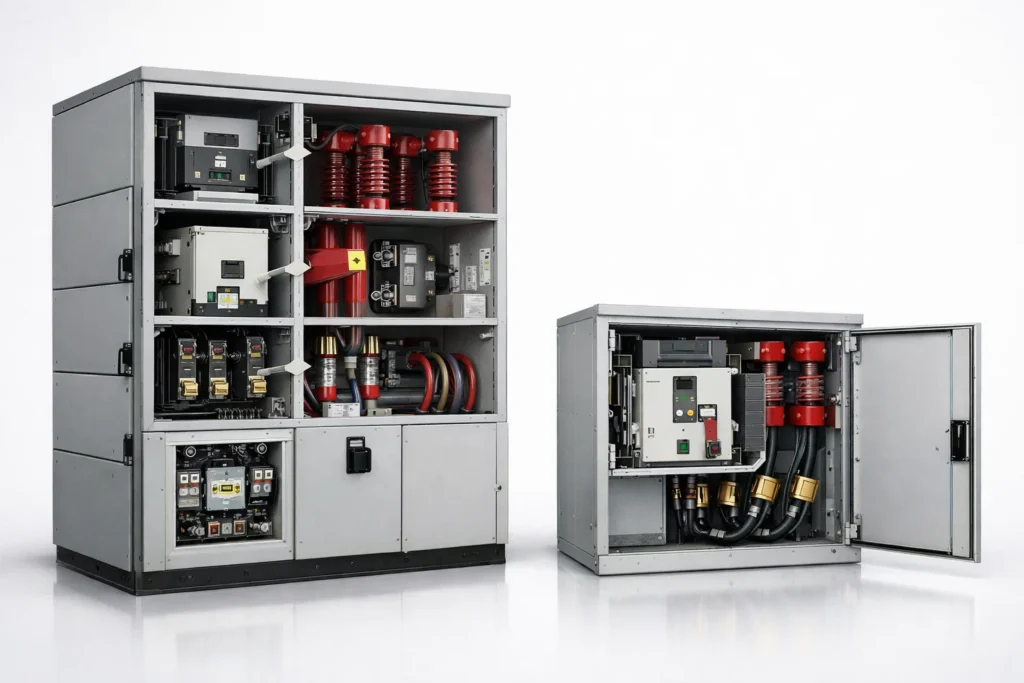
When engineers, EPC contractors, and plant owners compare medium voltage switchgear, one question appears very early in the selection process: metal clad vs metal enclosed switchgear—which one is the right fit for the project?
Both are used in medium-voltage distribution systems. Both use metal enclosures. Both can provide safe and reliable power distribution when properly specified. However, they are not the same in structure, maintainability, space requirements, or typical application.
In practical project terms, metal-clad switchgear is usually preferred when the system requires stronger compartment separation, withdrawable circuit breakers, and easier maintenance access. Metal-enclosed switchgear is often preferred when the project values compact layout, simpler configuration, and a more economical medium-voltage solution.
Metal Clad vs Metal Enclosed Switchgear: Key Differences
| Aspect | Metal-Clad Switchgear | Metal-Enclosed Switchgear |
|---|---|---|
| Basic concept | A more compartmentalized and maintenance-oriented form of MV switchgear | A broader MV switchgear category, often used in practice for more compact and simpler assemblies |
| Internal structure | Separate functional compartments for busbar, breaker, cable, and control sections | Usually simpler internal arrangement with less segregation |
| Switching device | Commonly uses withdrawable vacuum circuit breakers | Commonly uses load switches, switch-fuse combinations, or simpler switching arrangements |
| Maintenance access | Better suited for inspection, servicing, and replacement work | Usually less convenient for frequent maintenance |
| Safety during maintenance | Stronger compartment separation and clearer isolation boundaries | Can still be safe and reliable, but usually offers less separation than metal-clad designs |
| Footprint | Usually larger and deeper panel structure | Usually more compact and space-saving |
| Initial cost | Usually higher | Usually more economical |
| Lifecycle value | Often better where uptime, serviceability, and future maintenance matter | Often better where compact layout and budget control are the main priorities |
| Typical applications | Industrial plants, substations, utilities, critical infrastructure | Compact substations, commercial buildings, transformer feeders, secondary distribution |
| Best choice when | The project needs higher segregation, withdrawable breakers, and easier maintenance | The project needs compact design, simpler configuration, and cost-effective MV distribution |
What is metal-enclosed switchgear?
In formal switchgear terminology, metal-enclosed switchgear is the broader category and metal-clad switchgear is a subset of metal-enclosed switchgear. The term metal-enclosed switchgear covers metal-enclosed assemblies used for switching, protection, control, and isolation in medium-voltage systems. IEC 62271-200 applies to AC metal-enclosed switchgear and controlgear above 1 kV and up to 52 kV, which is the main IEC framework behind many MV switchgear products used internationally.
However in everyday project language, buyers often use “metal-enclosed switchgear” in a narrower sense to describe a more compact MV assembly that does not use the full metal-clad construction approach. That narrower commercial meaning is usually what people are referring to when they compare metal-clad and metal-enclosed switchgear.
What is metal-clad switchgear?
Metal-clad switchgear is a more specifically structured type of medium-voltage switchgear. It is typically built with clear functional separation between major compartments, such as the busbar compartment, circuit breaker compartment, cable compartment, and low-voltage control compartment.
A metal-clad design is usually associated with:
- withdrawable switching devices
- grounded metal partitions between major functional sections
- higher compartment separation
- safer isolation during maintenance
- better suitability for critical indoor MV distribution systems
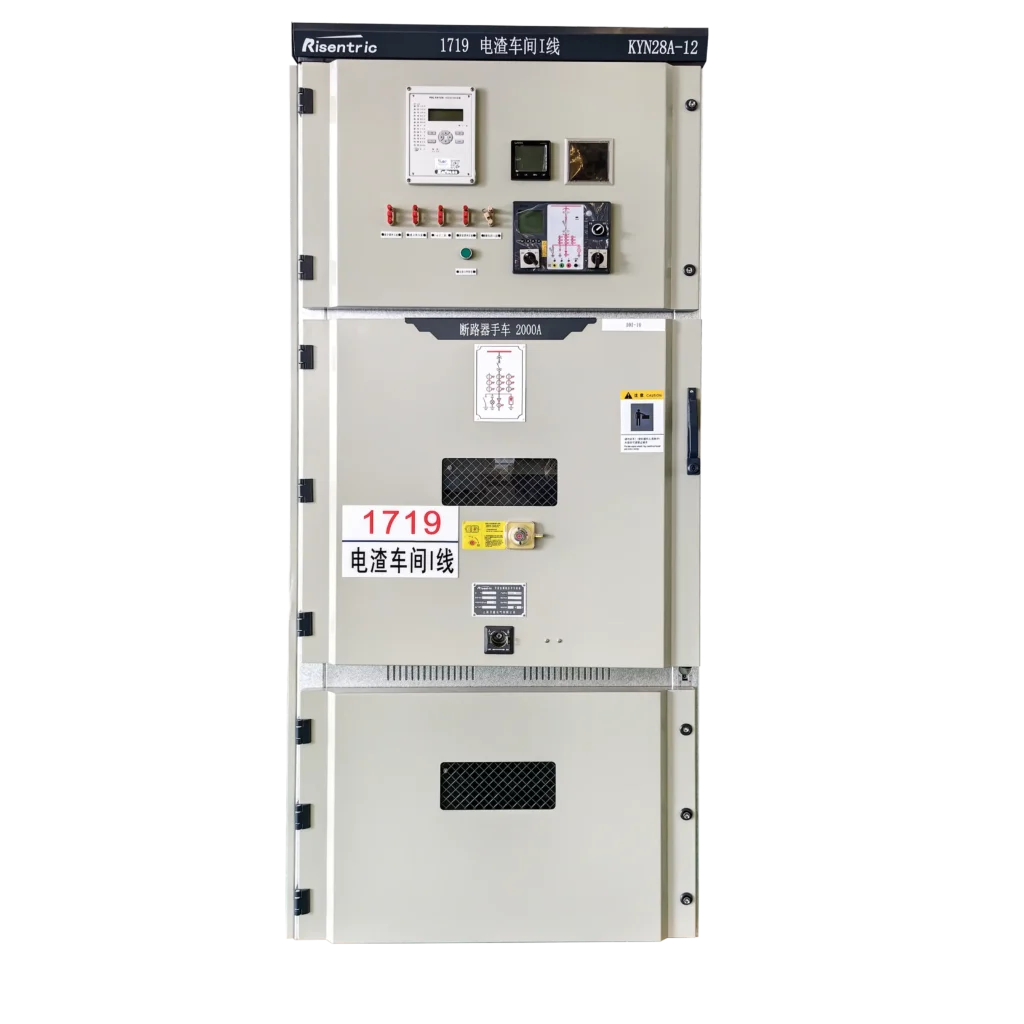
For example: Risentric’s KYN28A-12 is an armoured withdrawable AC metal-enclosed switchgear system with a compartmentalized and modular design, a withdrawable vacuum circuit breaker, and compliance with IEC 62271-200.
Metal clad vs metal enclosed switchgear: the core difference
The simplest way to understand the difference is this:
- metal-clad switchgear is a more strictly defined, more compartmentalized form of medium-voltage metal-enclosed switchgear.
- metal-enclosed switchgear, in the narrower commercial sense, is usually more compact and simpler, but with less separation and usually lower maintenance convenience.
Structural differences
1. Compartmentalization
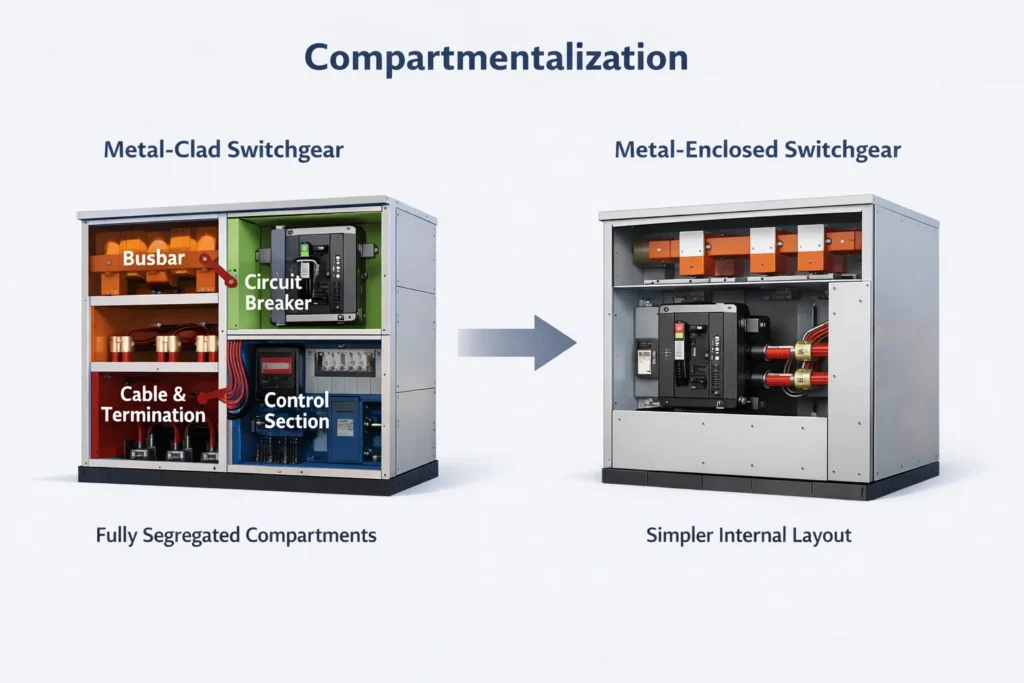
Metal-clad switchgear is built around separated functional compartments. The main busbar, breaker, cable termination, and low-voltage control sections are physically divided, which improves operational segregation and helps reduce maintenance risk.
Metal-enclosed switchgear is often more compact in arrangement. It can still provide reliable protection and switching performance, but the internal structure is usually simpler and may not follow the same degree of compartment separation as a metal-clad lineup.
2. Switching device type
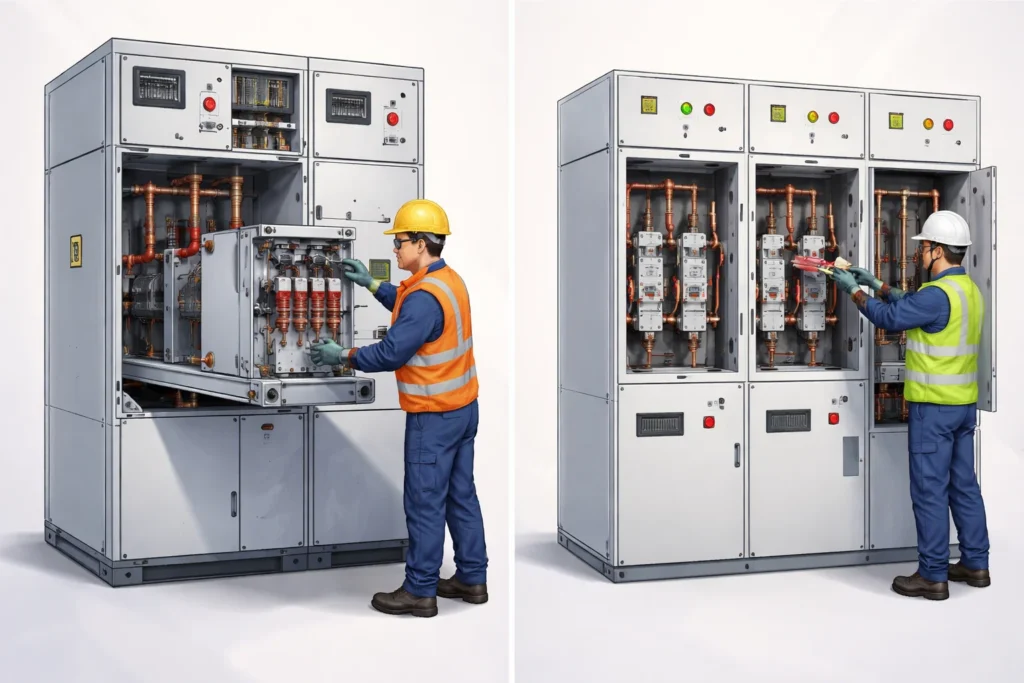
Metal-clad switchgear commonly uses withdrawable vacuum circuit breakers. This makes it well suited to industrial plants, substations, and other installations where breaker inspection, replacement, or maintenance access is important.
As an example, Risentric’s KYN28A-12 fits this pattern. It has a withdrawable vacuum circuit breaker mounted on a truck mechanism and highlights safe insertion, withdrawal, isolation, and maintenance without disturbing adjacent feeders.
Metal-enclosed switchgear often uses load switches, switch-fuse combinations, or simpler switching arrangements depending on network duty and application.
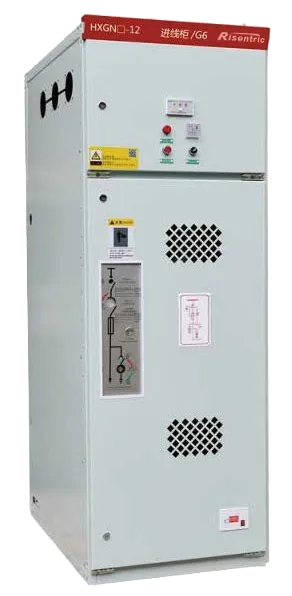
Risentric’s HXGN-12F is a good example of this more compact route. It is an AC metal-enclosed switchgear and controlgear, built to IEC 62271-200, IEC 60265-1, and IEC 62271-105, with a rated operational voltage of 12 kV and rated current options of 630/125 A.
3. Maintenance safety and serviceability
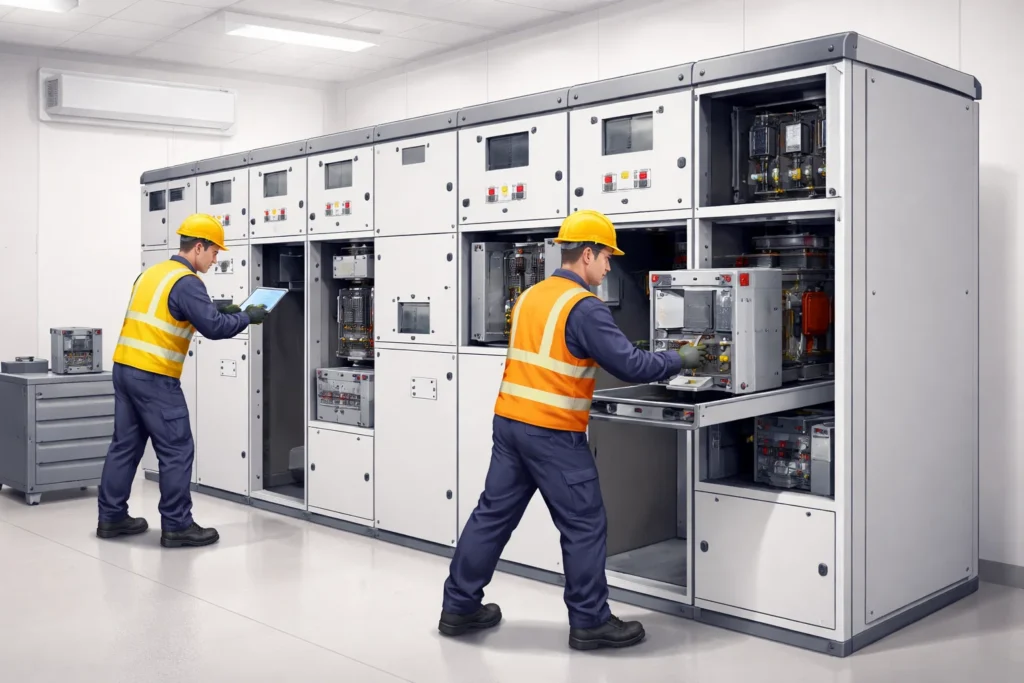
Metal-clad switchgear is usually chosen when maintenance discipline is important. Withdrawable breakers, functional separation, and clearer access boundaries make it better suited to systems that require routine service, isolation, and future replacement work.
This is one of the strongest reasons buyers choose metal-clad structures for higher-duty MV projects. As Risentric’s KYN28A-12 emphasizes: compartmentalized design, withdrawable architecture, interlocking, and front-access maintenance, all of which support this more serviceable positioning.
Metal-enclosed switchgear can still be safe and reliable, but it is more often selected for compact distribution duties where the project values simpler arrangement and lower footprint more than advanced maintenance convenience.
4. Footprint and installation space
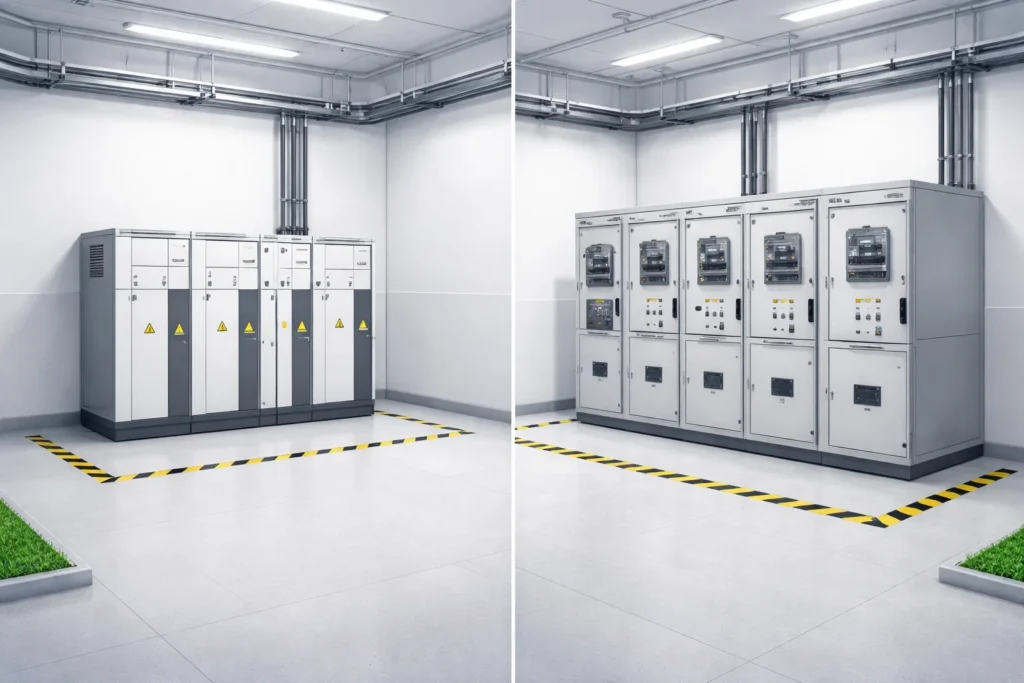
Metal-enclosed switchgear is often the better choice when available installation space is limited. Compact substations, commercial power rooms, and secondary distribution applications often benefit from a more space-efficient configuration.
Metal-clad switchgear usually requires more panel depth, more structural separation, and a more elaborate internal arrangement. That extra space is often justified when the project prioritizes higher segregation, easier maintenance, and more robust operational architecture.
5. Cost and lifecycle value

In many cases, metal-enclosed switchgear is the more economical choice at the initial purchase stage. It can be a practical solution for ring main distribution, transformer feeders, compact substations, and secondary MV networks.
Metal-clad switchgear is usually a higher-specification solution. Initial cost is often higher, but lifecycle value may be better when downtime is expensive, maintenance frequency is high, or future service flexibility matters.
So the better option is not the cheaper one or the more advanced one in isolation. It is the one that fits the actual technical and operational priorities of the project.
Which one is better for your project?
There is no universal winner. The right choice depends on the application.
| Project priority | Better fit |
|---|---|
| Higher safety segregation | Metal-clad switchgear |
| Withdrawable breaker design | Metal-clad switchgear |
| Frequent maintenance or future replacement | Metal-clad switchgear |
| Limited installation space | Metal-enclosed switchgear |
| Compact secondary distribution | Metal-enclosed switchgear |
| More economical MV solution | Metal-enclosed switchgear |
Is “Metal-Clad” Only Used for Medium Voltage?
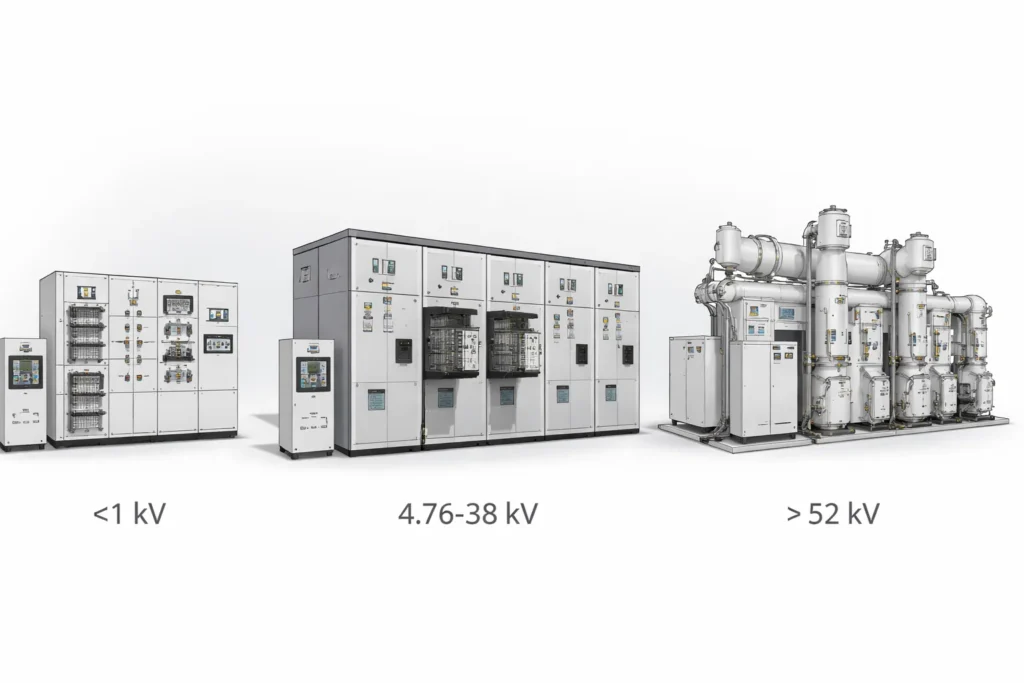
In practice, metal-clad switchgear is mainly used as a medium-voltage classification. The IEEE metal-clad switchgear standard covers medium-voltage switchgear with drawout electrically operated circuit breakers, and the rated maximum voltage range given in the standard preview is 4.76 kV to 38 kV.
For low-voltage equipment, the usual terminology is different. IEC 61439 uses the term low-voltage switchgear and controlgear assemblies, and specifically notes that throughout the document the term assembly is used for low-voltage switchgear and controlgear assemblies. In other words, for LV products, the normal wording is LV switchgear assembly, LV switchboard, MCC, or panel, not “metal-clad switchgear.”
For high-voltage equipment above 52 kV, the common classification language is also different. IEC 62271-203 uses the term AC gas-insulated metal-enclosed switchgear for rated voltages above 52 kV, which reflects the usual HV wording around GIS, AIS, and other high-voltage switchgear types rather than the medium-voltage “metal-clad” label.
Conclusion
The difference between metal clad vs metal enclosed switchgear is not just naming. It affects safety architecture, maintenance method, footprint, cost, and project suitability.
If your project needs drawout breakers, stronger compartment separation, and easier serviceability, metal-clad switchgear is usually the better choice. If your project values compact layout and economical medium-voltage distribution, metal-enclosed switchgear may be the more practical solution.
For many buyers, the best process is not asking which type is “better” in general, but which type is better for the actual network design, voltage class, current rating, protection scheme, maintenance strategy, and installation space.
If you are comparing a 12 kV medium-voltage project now, Risentric’s current product structure already gives you both paths: KYN28A-12 for a more compartmentalized withdrawable solution, and HXGN-12F for a more compact metal-enclosed option.
FAQ
Is metal-clad switchgear a type of metal-enclosed switchgear?
Yes. In formal terminology, metal-clad switchgear is a subset of metal-enclosed switchgear. In everyday project language, however, buyers often use “metal-enclosed” in a narrower sense to describe more compact non-metal-clad MV assemblies.
Is metal-clad switchgear safer than metal-enclosed switchgear?
In many applications, metal-clad switchgear offers stronger compartment separation and maintenance-oriented safety features such as shutters and drawout breakers. But the correct answer depends on the exact design, standard, and application duty.
Which is more compact?
Metal-enclosed switchgear is usually more compact.
Which is better for industrial plants?
For higher-criticality industrial distribution systems, metal-clad switchgear is often preferred because of compartmentalization, drawout breaker design, and maintainability. Eaton and Schneider both describe metal-clad equipment in that more segregated, drawout-oriented way.


