

A transformer may look like a passive piece of electrical equipment, but it can affect your electricity bill every day.
Even when a transformer works normally, part of the electrical energy is not delivered to the load. It is lost inside the transformer, mostly as heat. This wasted energy is called transformer loss.
A transformer with lower losses can help reduce wasted electricity, lower operating cost, control heat generation, and improve the efficiency of the power distribution system.
This article explains the two most important transformer losses: no-load loss and load loss.
We will go through the theory first, for a practical guide to save money, please refer to this.
Besides saving budget, saving energy will benefit the Earth and human beings in the long term. That cost can be invisible but crucial. That is why we need to keep developing new technologies and finding more efficient solutions — for Mother Nature.
–Risentric: where the brightness rises
What Are Transformer Losses?
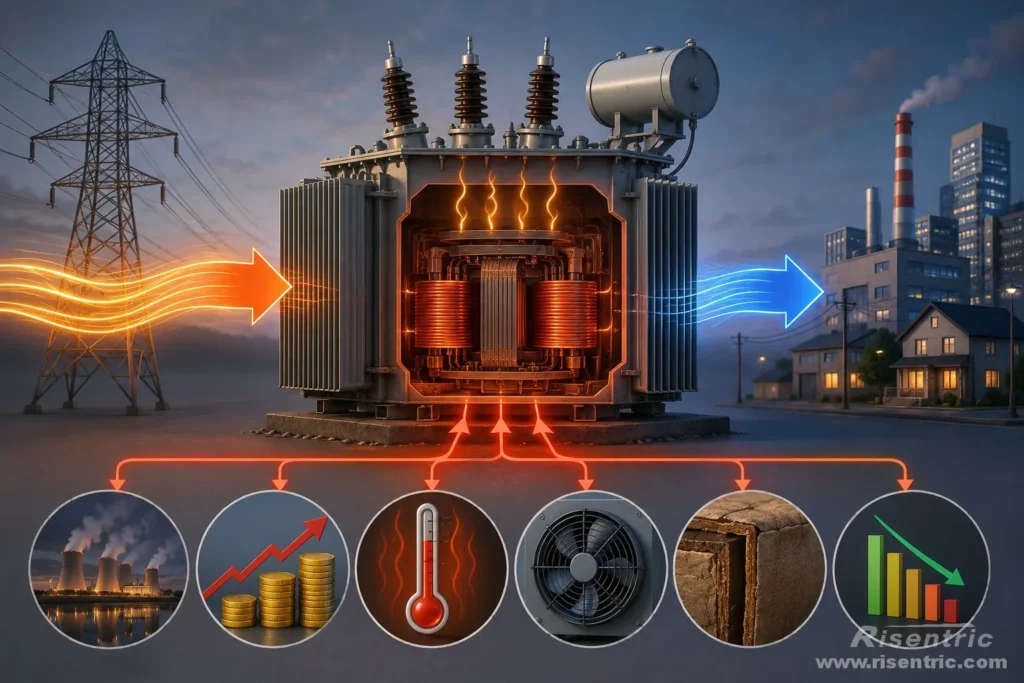
Transformer losses are the part of the input power that is not transferred to the output side.
In simple terms:
Input power = output power + transformer losses
The output power is useful power supplied to electrical loads. The losses are mainly converted into heat inside the transformer.
This is why transformer losses matter in real projects. Higher losses usually mean:
- more wasted electricity
- higher operating cost
- more heat generation
- higher temperature rise
- stronger cooling or ventilation requirements
- greater stress on insulation
- lower long-term efficiency
A transformer with a lower purchase price is not always cheaper over its full service life. If its losses are higher, it may consume more energy every year.
The Two Main Types of Transformer Losses
Transformer losses are usually divided into two major types:
- No-load loss
- Load loss
This distinction is important because these two losses behave differently.
| Loss type | Also called | Main source | Depends on load? | When it occurs |
|---|---|---|---|---|
| No-load loss | Core loss / iron loss | Magnetic core | Mostly no | Whenever the transformer is energized |
| Load loss | Winding loss / copper loss | Current through windings | Yes | When the transformer supplies load |
A good transformer selection should consider both.
What Is No-Load Loss?
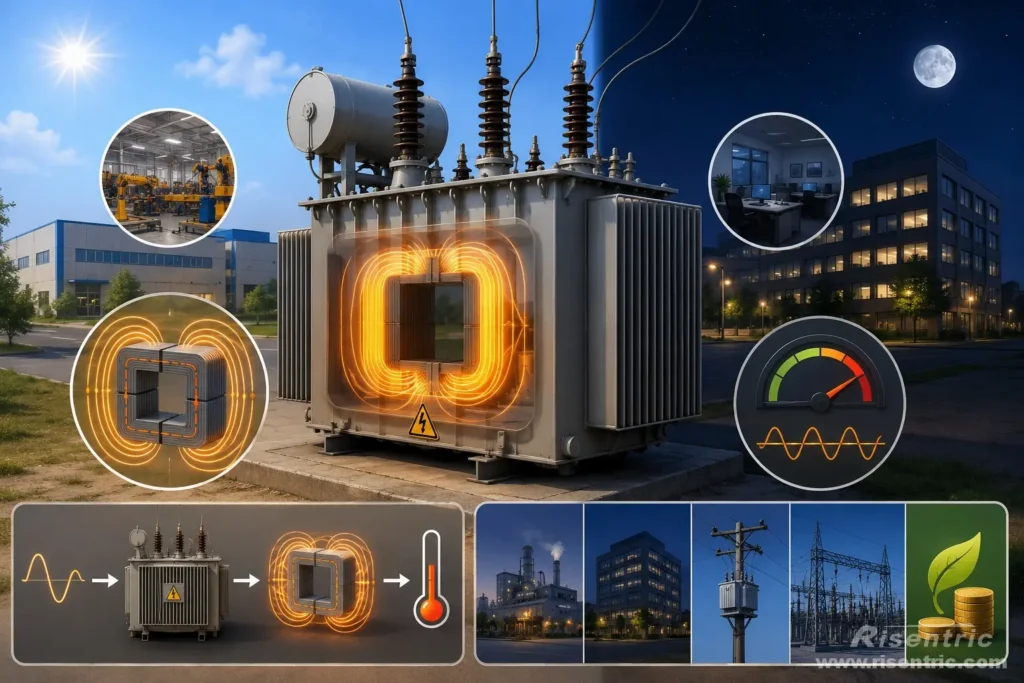
No-load loss is the loss that exists when the transformer is energized, even if there is little or no load connected.
This loss is mainly caused by the transformer core.
When AC voltage is applied to the transformer, the magnetic core is repeatedly magnetized and demagnetized. This changing magnetic field consumes energy. Even if the secondary side is open and no useful load is connected, the transformer still consumes power.
That is why no-load loss is also called:
- core loss
- iron loss
- excitation loss
The key point is simple:
No-load loss exists whenever the transformer is energized.
For example, if a transformer remains energized 24 hours a day, no-load loss continues day and night, even when the building or factory load is low.
This makes no-load loss especially important for:
- factories with long standby periods
- commercial buildings with night-time low load
- distribution transformers energized all year
- substations where transformers remain connected continuously
- projects focused on energy saving and lifetime operating cost
What Causes No-Load Loss?
No-load loss mainly comes from two physical effects inside the transformer core.
1. Hysteresis Loss
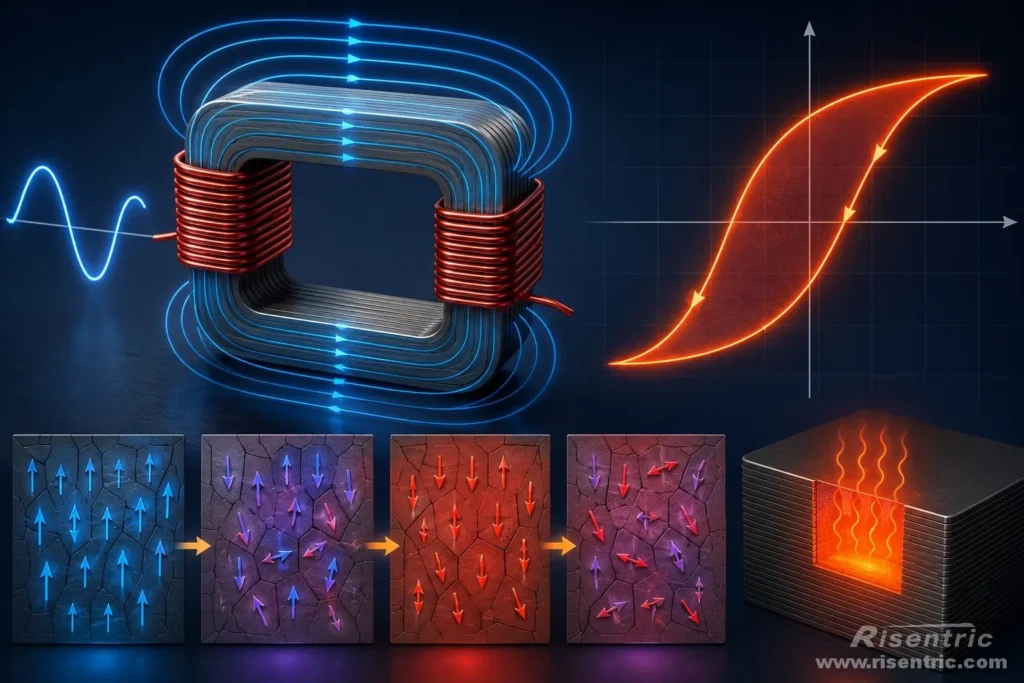
Hysteresis loss occurs because the magnetic material inside the core does not magnetize and demagnetize without energy loss.
During every AC cycle, the magnetic field reverses direction. The magnetic domains inside the core must also change direction. This process consumes energy and creates heat.
Better magnetic core materials can reduce hysteresis loss.
2. Eddy Current Loss
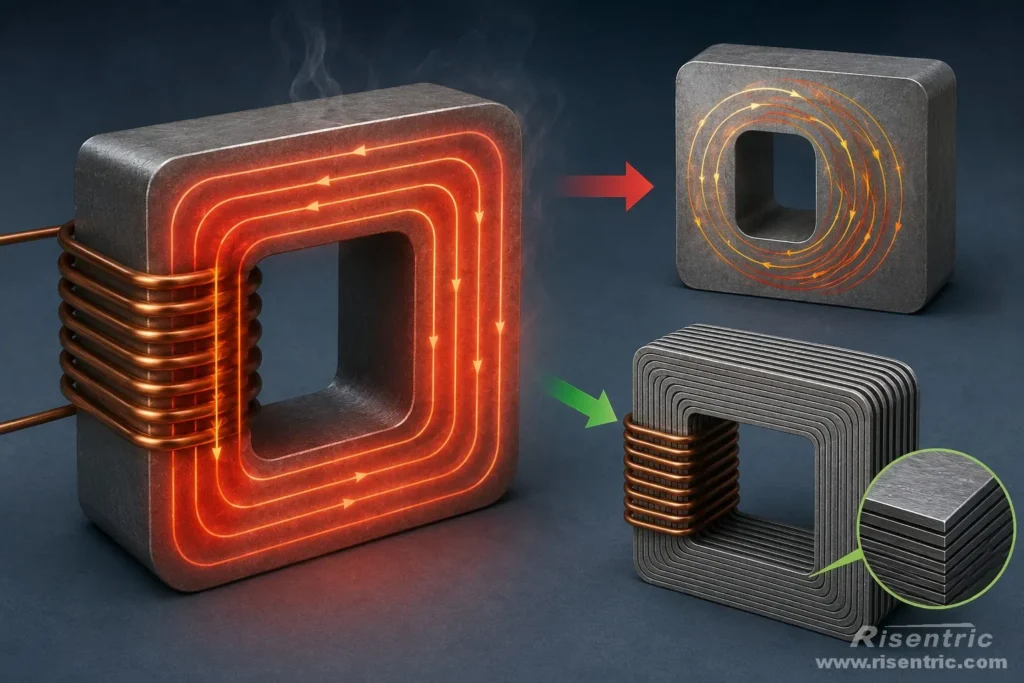
Eddy current loss occurs when circulating currents are induced inside the transformer core.
These currents do not contribute to useful power transfer. They circulate inside the core material and generate heat.
To reduce eddy current loss, transformer cores are usually made from thin laminated steel sheets instead of one solid block of metal. The laminations interrupt the current paths and reduce circulating current.
What Is Load Loss?
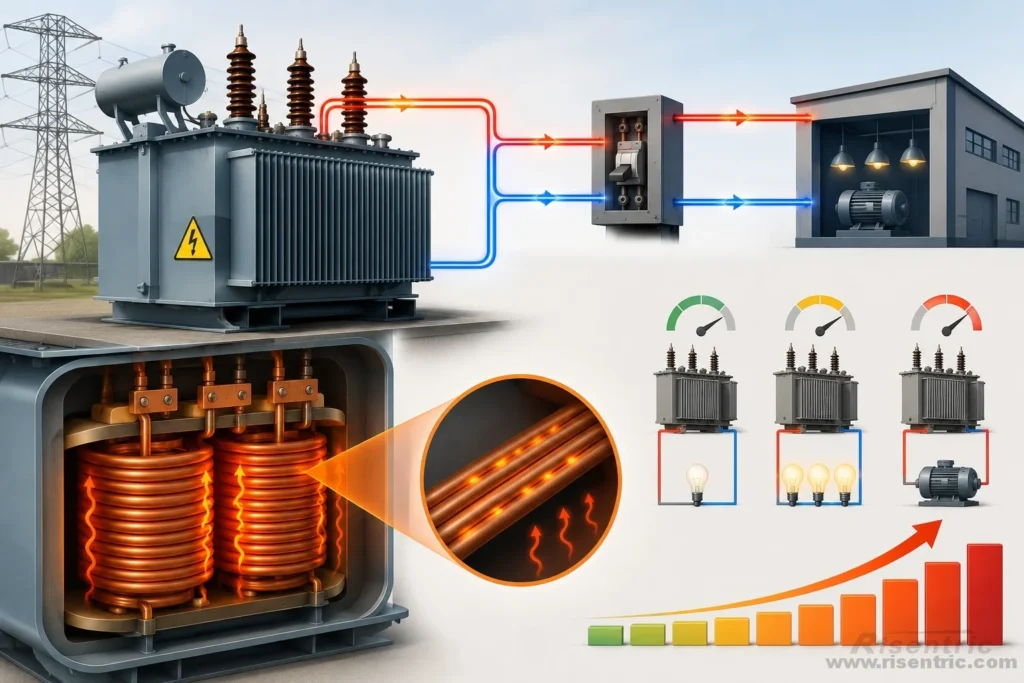
Load loss is the loss that appears when the transformer supplies current to the load.
Unlike no-load loss, load loss changes with load current. When the load is small, load loss is lower. When the load increases, load loss increases.
The main part of load loss is winding resistance loss.
Transformer windings have electrical resistance. When current flows through the windings, part of the electrical energy is converted into heat.
This is often called:
- winding loss
- copper loss
- load loss
Even if the winding is made of aluminum, the term “copper loss” is still commonly used in many technical discussions to describe winding resistance loss.
Why Load Loss Increases Quickly
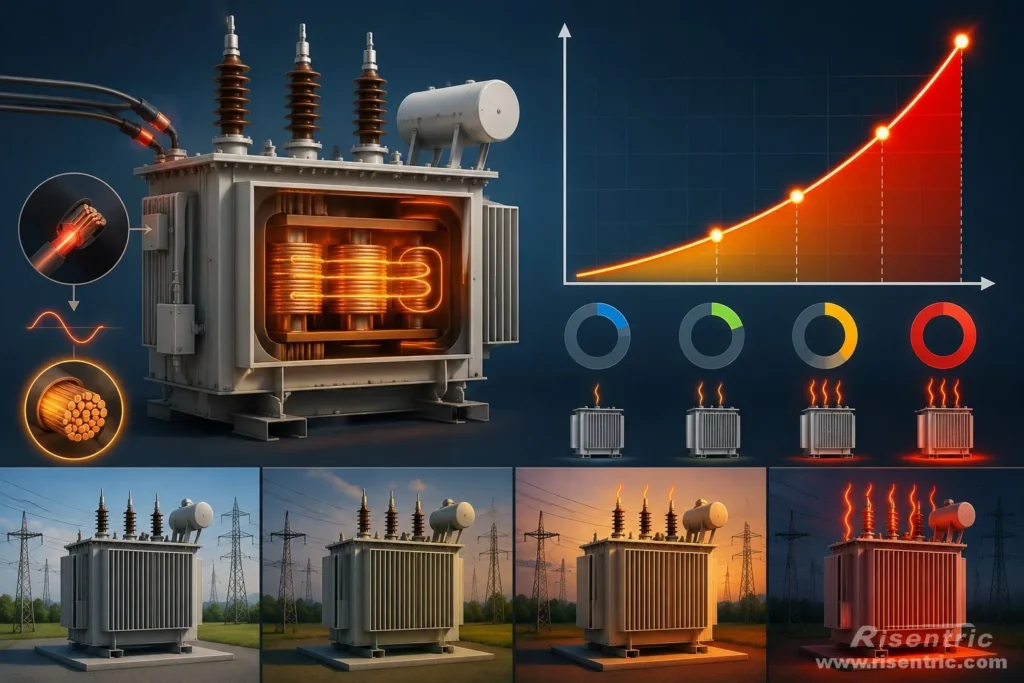
Load loss is strongly related to current.
The basic relationship is:
Winding loss = I²R
Where:
- I is current
- R is winding resistance
The square relationship just comes from the formula- I²R.
If current doubles, the resistance-related loss becomes about 4 times higher.
For example:
| Load current | Approximate winding-loss level (due to I²R) |
|---|---|
| 25% load | 6.25% of full-load winding loss |
| 50% load | 25% of full-load winding loss |
| 75% load | 56.25% of full-load winding loss |
| 100% load | 100% of full-load winding loss |
This is why transformer loading condition has a strong effect on operating loss and heat generation.
A transformer that is often heavily loaded may produce much more heat from load loss. A transformer that is energized but lightly loaded may waste more energy through no-load loss than people expect.
Transformer Losses and Efficiency
Transformer efficiency means how much input power is delivered as useful output power.
Efficiency = output power / input power × 100%
Since input power includes both useful output power and losses:
Efficiency = output power / (output power + losses) × 100%
Lower losses mean higher efficiency.
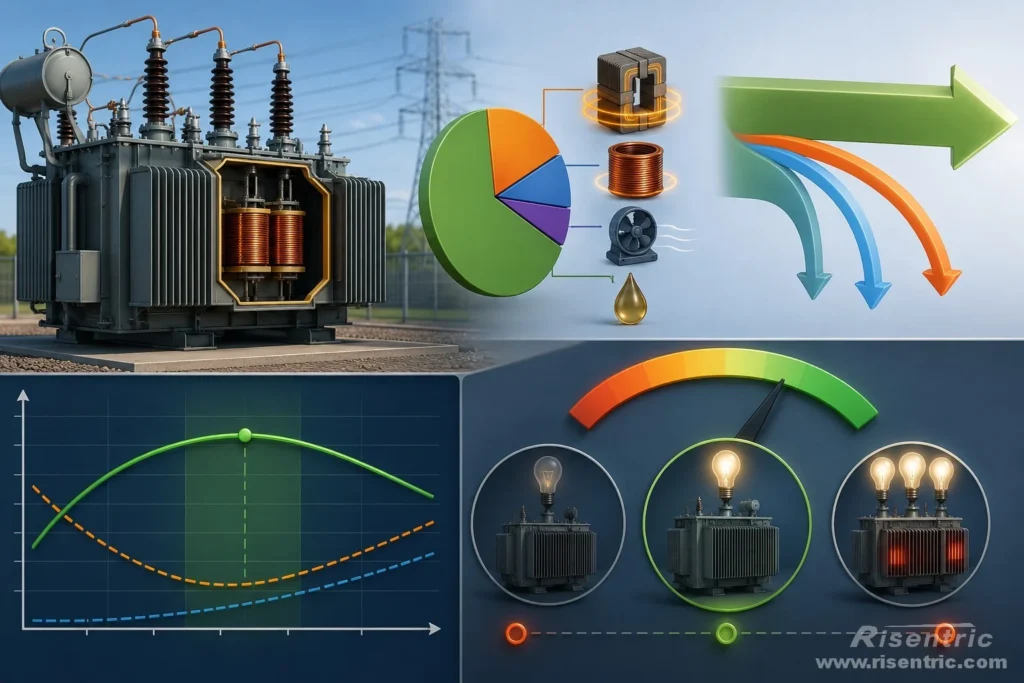
Transformer efficiency usually has a “best operating range.”
At very light load, no-load loss still exists, so efficiency is not ideal. At very high load, load loss increases quickly because it follows the I²R relationship. Therefore, the highest efficiency is usually reached somewhere between light load and full load, depending on the transformer design and actual loss values.
In simple terms, a transformer usually has an efficiency “sweet spot”. It is usually most efficient when properly loaded, not when it is almost idle or heavily overloaded.
Transformer Losses and Thermal Design
Most transformer losses become heat.
This heat must be removed through air, oil, fans, radiators, or other cooling methods.
If losses are too high, the transformer temperature will rise. Higher temperature can accelerate insulation aging and reduce transformer service life.
This is especially important for:
- indoor dry-type transformers
- compact substations
- poorly ventilated electrical rooms
- factories with high continuous load
- hot ambient environments
- transformers installed near other heat-producing equipment
Transformer loss is therefore not only an energy-cost issue. It is also a thermal design issue.
No-Load Loss vs Load Loss: Summary
| Situation | No-load loss is more important | Load loss is more important |
|---|---|---|
| Typical load level | Light load or low average load | Medium to high load |
| Operating pattern | Long standby hours or 24/7 energization | Long high-load operating periods |
| Main concern | Continuous energy waste from the core | I²R winding loss and temperature rise |
In simple terms, no-load loss matters most when the transformer stays energized for many hours, even with little load. Load loss matters most when the transformer often carries high current.
For many industrial and commercial projects, both losses should be checked. A transformer may waste energy during standby because of no-load loss, but it may also generate significant heat during heavy operation because of load loss.
Looking for industrial power distribution solutions for your project?
Buyer’s Guide: How Transformer Losses Affect Cost

Transformer losses are real electricity consumption.
Electricity costs money. If a transformer wastes more energy during operation, that loss becomes part of the electricity bill. So, to save money in the long term, buyers should compare not only the transformer price, but also its no-load loss, load loss, and expected energy consumption.
A Simple Loss Cost Example
If a transformer has a continuous loss of 1 kW, the annual energy loss is:
1 kW × 24 hours × 365 days = 8,760 kWh/year
If the electricity price is 0.12 USD/kWh, the annual cost is:
8,760 × 0.12 = 1,051.20 USD/year
This is only for 1 kW of continuous loss. For larger transformers, or for multiple transformers in one facility, the long-term cost can become significant.
A Better Calculation: Separate No-Load Loss and Load Loss
A more practical estimate should separate no-load loss and load loss, because they behave differently.
Annual transformer loss energy = no-load loss × energized hours + load loss × load factor² × operating hours
Then:
Annual loss cost = annual loss energy × electricity price
For example:
- no-load loss: 1.2 kW
- full-load load loss: 8 kW
- energized time: 8,760 hours/year
This means the transformer is energized 24 hours a day for one year. - operating time under load: 6,000 hours/year
- average load factor: 50%
- electricity price: 0.12 USD/kWh
No-load loss energy:
1.2 × 8,760 = 10,512 kWh/year
Load loss energy:
8 × 0.5² × 6,000 = 12,000 kWh/year
Total annual loss energy:
10,512 + 12,000 = 22,512 kWh/year
Annual loss cost:
22,512 × 0.12 = 2,701.44 USD/year
This calculation shows why transformer loss is directly related to electricity bills. Even at 50% average load, the transformer still consumes significant energy because no-load loss continues as long as the transformer is energized.
How Much Money Can a Lower-Loss Transformer Save?
If a better transformer design can reduce losses, the energy saving can become real money every year.
For example, if a lower-loss transformer saves 4 kW of total loss during operation:
4 kW × 8,760 hours = 35,040 kWh/year
If electricity price is 0.12 USD/kWh:
35,040 × 0.12 = 4,204.80 USD/year
This means the lower-loss transformer may save about 4,204.80 USD per year.
If the better transformer costs several thousand dollars more, that extra budget may be a fair investment because it can be recovered through electricity savings.
| Loss reduction | Operating hours per year | Electricity price | Annual energy saving | Annual cost saving |
|---|---|---|---|---|
| 1 kW | 8,760 h | 0.12 USD/kWh | 8,760 kWh | 1,051.20 USD |
| 2 kW | 8,760 h | 0.12 USD/kWh | 17,520 kWh | 2,102.40 USD |
| 4 kW | 8,760 h | 0.12 USD/kWh | 35,040 kWh | 4,204.80 USD |
| 4 kW | 6,000 h | 0.12 USD/kWh | 24,000 kWh | 2,880.00 USD |
| 6 kW | 8,000 h | 0.15 USD/kWh | 48,000 kWh | 7,200.00 USD |
These examples show an important point:
Transformer loss is not only an efficiency number. It is also an operating cost.
When a transformer operates for many hours every year, even a few kilowatts of loss reduction can save meaningful money over the transformer’s service life.
A simple payback estimate is:
Payback period = extra purchase cost ÷ annual cost saving
For example, if a lower-loss transformer costs 8,000 USD more but saves 4,204.80 USD per year:
8,000 ÷ 4,204.80 ≈ 1.9 years
In this case, the extra budget may be reasonable because the energy savings can recover the additional cost in less than two years.
However, the result depends on actual operating hours, electricity price, load profile, and the real difference in transformer losses.
Practical Guide: How to Reduce Transformer Loss Cost
To reduce transformer loss cost, buyers should not only ask whether the transformer is “low-loss.” They should first understand how the transformer will actually operate.
| Project condition | Main loss concern | What to check | Practical decision |
|---|---|---|---|
| Transformer energized 24/7, but average load is low | No-load loss | No-load loss value in kW | Choose a transformer with lower no-load loss. Avoid unnecessary oversizing. |
| Transformer often operates near rated load | Load loss | Full-load load loss value in kW | Compare load loss carefully. Lower load loss can reduce energy cost and heat. |
| Load changes strongly between day and night | Both losses | No-load loss + load profile | Estimate annual loss using actual operating hours and average load factor. |
| Transformer used only occasionally | No-load loss may be less important | Energized hours per year | A higher-price low-loss transformer may not pay back quickly. |
| Transformer is oversized | No-load loss and poor efficiency | Real average load vs rated capacity | Select capacity closer to the real load, with reasonable future margin. |
| Transformer runs in a hot or poorly ventilated room | Load loss and heat | Load loss, temperature rise, cooling condition | Lower losses and better cooling help reduce temperature stress. |
| Energy price is high | Both losses | Annual loss cost | A lower-loss transformer becomes more financially valuable. |
The practical rule is simple:
No-load loss matters most when the transformer stays energized for many hours. Load loss matters most when the transformer carries high current for many hours.
So before choosing a transformer, buyers should ask:
- How many hours per year will the transformer stay energized?
- What is the expected average load?
- What are the no-load loss and load loss values?
- How much electricity cost can a lower-loss transformer save?
This is enough for a practical purchasing decision. The goal is not always to buy the lowest-loss transformer. The goal is to choose a transformer whose loss level matches the real operating condition.
Conclusion
Transformer loss is one of the most important factors in transformer selection.
For buyers and engineers, transformer loss should not be treated as a small technical detail. It is a key factor in lifetime cost and power distribution system performance.
When comparing transformer quotations, always check no-load loss, load loss, efficiency, temperature rise, and testing data. The transformer with the lowest purchase price may not be the lowest-cost transformer over its full operating life.
FAQ
What are transformer losses?
Transformer losses are the part of input electrical power that is not delivered to the load. Most transformer losses are converted into heat.
What is no-load loss in a transformer?
No-load loss is the loss that exists whenever the transformer is energized, even when there is little or no load. It is mainly caused by magnetic losses in the core.
What is load loss in a transformer?
Load loss is the loss that increases when current flows through the transformer windings. It is mainly caused by winding resistance and stray loss.
Why does load loss increase with current?
Load loss is related to I²R. This means that when current increases, winding resistance loss increases much faster.
Which is more important, no-load loss or load loss?
It depends on the operating condition. No-load loss is more important for transformers energized for long periods with light load. Load loss is more important for transformers operating near rated load.
Do transformer losses affect temperature?
Yes. Most transformer losses become heat. Higher losses can increase temperature rise and accelerate insulation aging.
Is a low-loss transformer always better?
Technically, lower losses are usually better. Economically, it depends on operating hours, electricity price, load profile, and the price difference between standard and low-loss designs.
What should I check in a transformer quotation?
You should check no-load loss, load loss, efficiency, temperature rise, winding material, core material, cooling method, applicable standard, and test report.


