
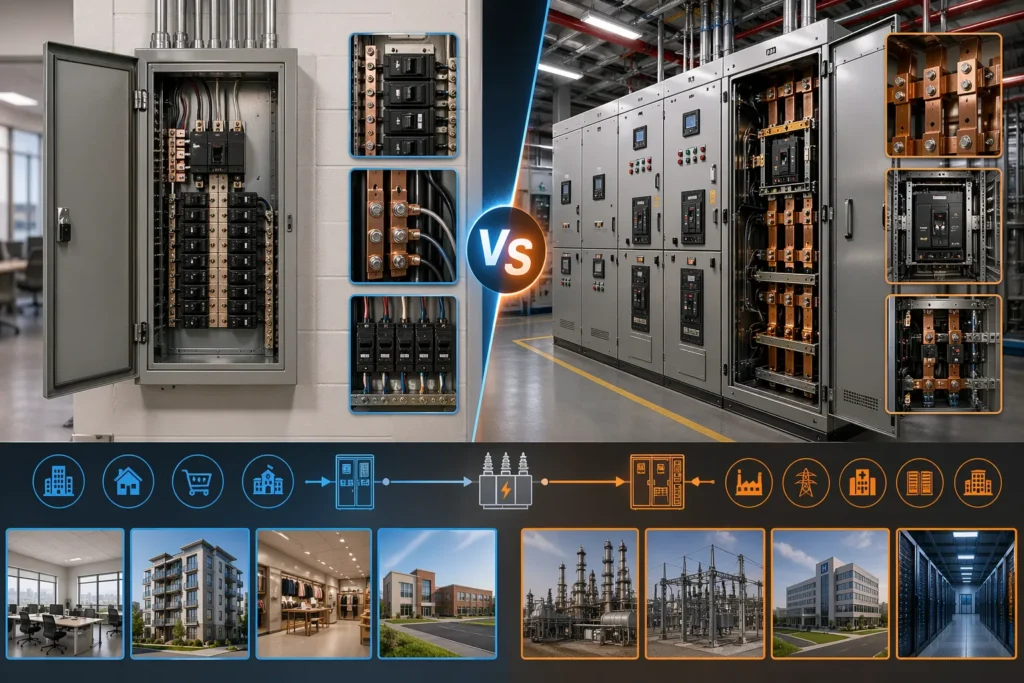
This article will introduce the difference in structure level, from macroscope to microscope. It actually relates to the evolution of distribution systems.
At first glance, switchgear and panel board can look similar.
Both receive power.
Both distribute power.
Both contain protective devices.
Both are installed as part of an electrical distribution system.
So it is natural to ask:
Is switchgear basically just a larger panel board?
The short answer is: not exactly.
A switchgear assembly often does look like a larger, more powerful, more engineered version of a panel board, but the real difference is not just size. The deeper difference is duty: what the assembly is expected to survive, interrupt, isolate, and protect when the system is under stress.
The essence of the difference is: as voltage, current, and fault duty increase, a distribution assembly must evolve from simple branch distribution toward a more robust system of current carrying, insulation, protection, switching, and isolation. Switchgear is one expression of that evolution.
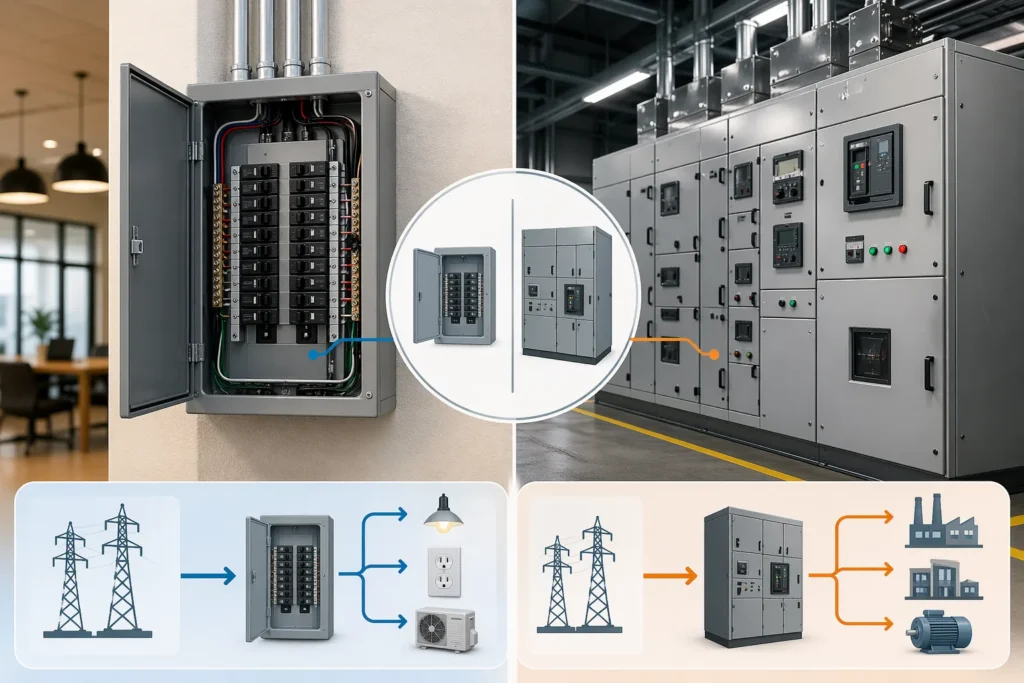
What Are Panel Boards and Switchgear?
A panel board is a distribution assembly that divides incoming electrical power into multiple branch circuits. It usually contains protective devices such as circuit breakers or fuses and is commonly installed in commercial buildings, residential facilities, and light industrial sites.
Its main purpose is practical and straightforward: take incoming power and distribute it safely to final circuits or smaller loads.
Switchgear is a more heavily engineered distribution assembly designed not only to distribute power, but also to switch, protect, and isolate circuits under more demanding electrical conditions.
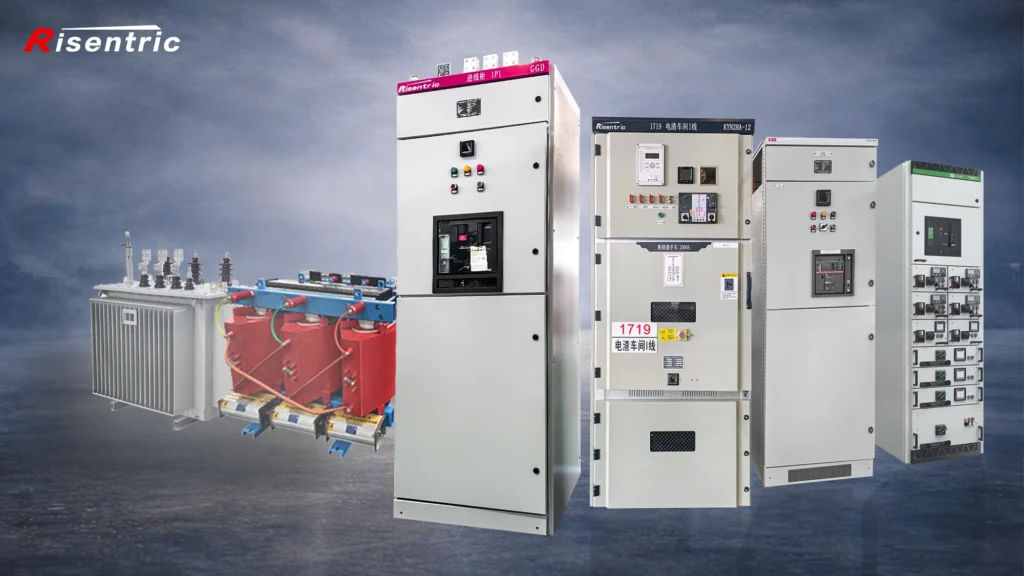
Looking for factory-tested switchgear & Panel board for your project?
Why Switchgear Can Feel Like a “Bigger Panel Board”
This idea is not completely wrong.
In many projects, engineers first encounter panel boards as practical downstream distribution assemblies. Later, when they move into larger commercial or industrial systems, they see switchgear and it appears to be the same idea scaled up:
- larger enclosure
- larger incoming breaker
- larger busbars
- higher current
- more feeders
- stronger internal structure
From that angle, switchgear can indeed seem like a higher-end, larger-scale distribution assembly.
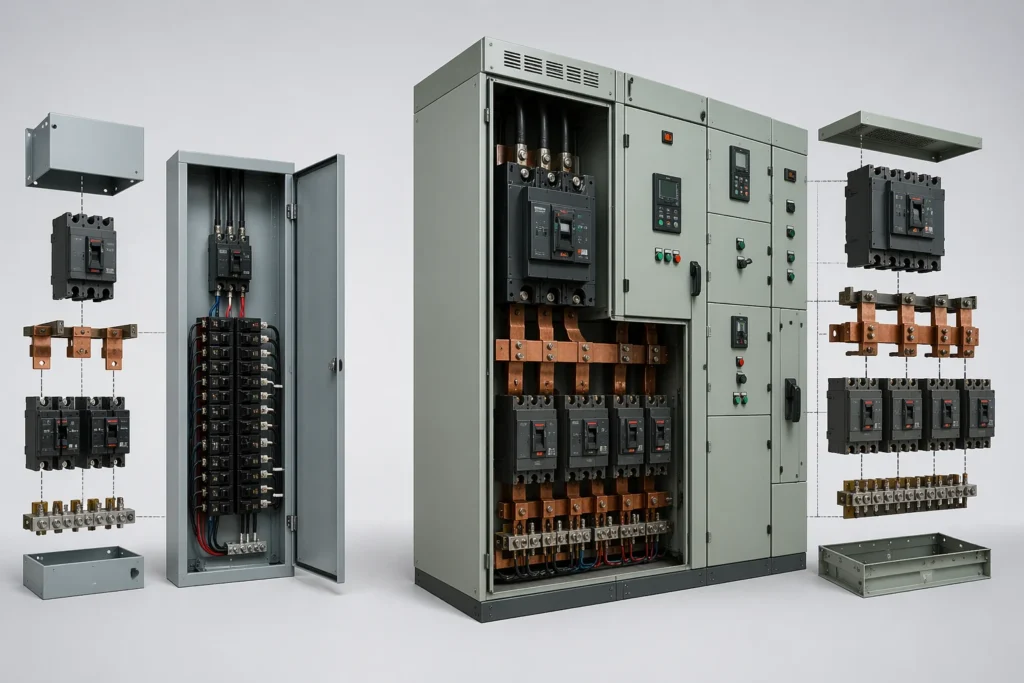
Typical Structural Comparison: Switchgear vs Panel Board
| Structural aspect | Panel Board | Switchgear |
|---|---|---|
| Main purpose | Downstream branch distribution | Higher-duty distribution, protection, switching, and isolation |
| Enclosure | Usually simpler and more compact | Usually larger, stronger, and more engineered |
| Incoming device | Often a main breaker or main lugs | Often a main breaker or more advanced incoming functional unit |
| Outgoing circuits | Branch breakers feeding downstream loads | Feeder breakers or functional units feeding larger circuits or subsystems |
| Busbar system | Internal busbars for practical power distribution | More robust busbar system with greater emphasis on thermal and short-circuit performance |
| Internal segregation | Usually limited | Often higher degree of separation depending on design |
| Protection devices | Mainly branch circuit protective devices | More advanced protection functions and coordination are common |
| Isolation function | Usually more limited at system level | Stronger emphasis on safe isolation and operational switching |
| Metering and control | Often basic or moderate | More likely to include expanded metering, control, and protection interfaces |
| Maintenance access | Usually simpler, but less specialized | Often designed with greater consideration for operation and maintenance |
Looking at the structure, panel board and switchgear are not completely different worlds. They often use many of the same basic elements, such as enclosures, busbars, and breakers. The difference is that switchgear is usually built with a stronger focus on protection, isolation, control, and fault performance. In other words, as the electrical duty becomes more demanding, the assembly does not just get bigger — it becomes more engineered.
The real issue is not that switchgear is merely bigger. It is that switchgear is usually designed for a more demanding electrical and mechanical task.
The Real Difference: From Distribution Duty to System Duty
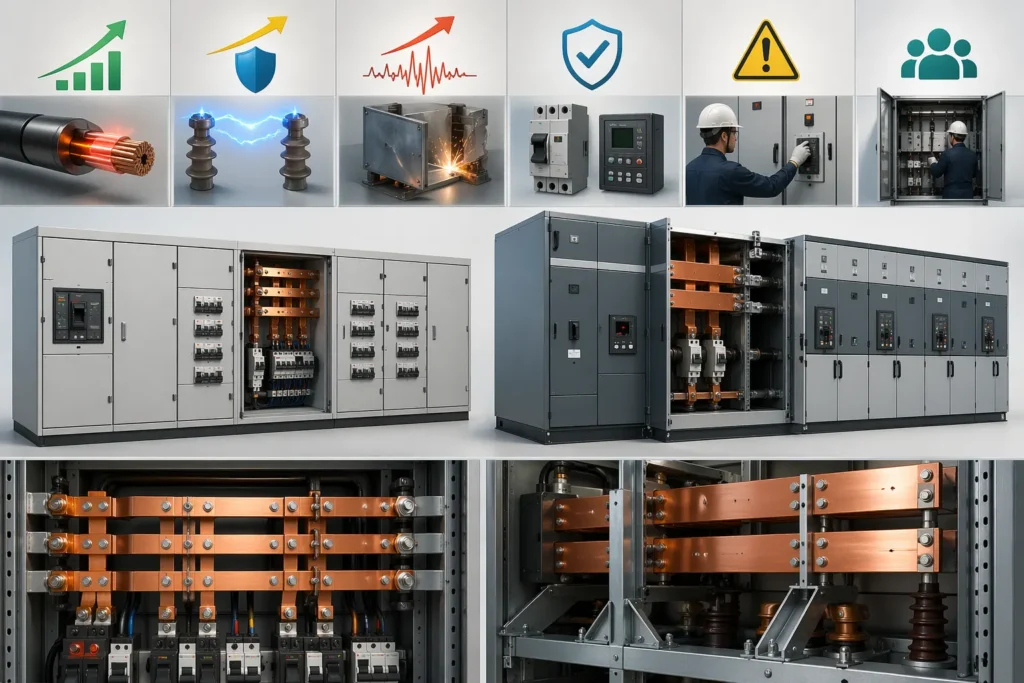
The engineering logic
As voltage and current increase, the distribution system usually changes in several ways:
| What increases | What the assembly must do differently |
|---|---|
| Current | Carry more thermal load, use stronger busbars, manage temperature rise more carefully |
| Voltage | Improve insulation, clearance, creepage distance, and safe isolation |
| Fault level | Withstand stronger thermal and mechanical stress during short circuits |
| System importance | Provide more reliable protection, switching, and maintainability |
| Operational risk | Improve segregation, safety, and access for operation and maintenance |
The busbar
The Busbar Gives an Important Clue
One of the easiest ways to see the difference between a panel board and switchgear is to look at the busbar system.
Both use busbars to distribute current inside the assembly. But in switchgear, the busbar is usually designed for a heavier electrical duty.
| Busbar aspect | Panel Board | Switchgear |
|---|---|---|
| Basic role | Distribute current internally | Distribute current under higher-duty conditions |
| Current level | Usually lower | Usually higher |
| Thermal demand | More moderate | More serious temperature-rise control |
| Fault stress | Usually lower | Usually higher short-circuit stress |
| Mechanical support | Simpler | Stronger support and bracing are often needed |
| Internal design emphasis | Practical distribution | Performance, strength, and fault survival |
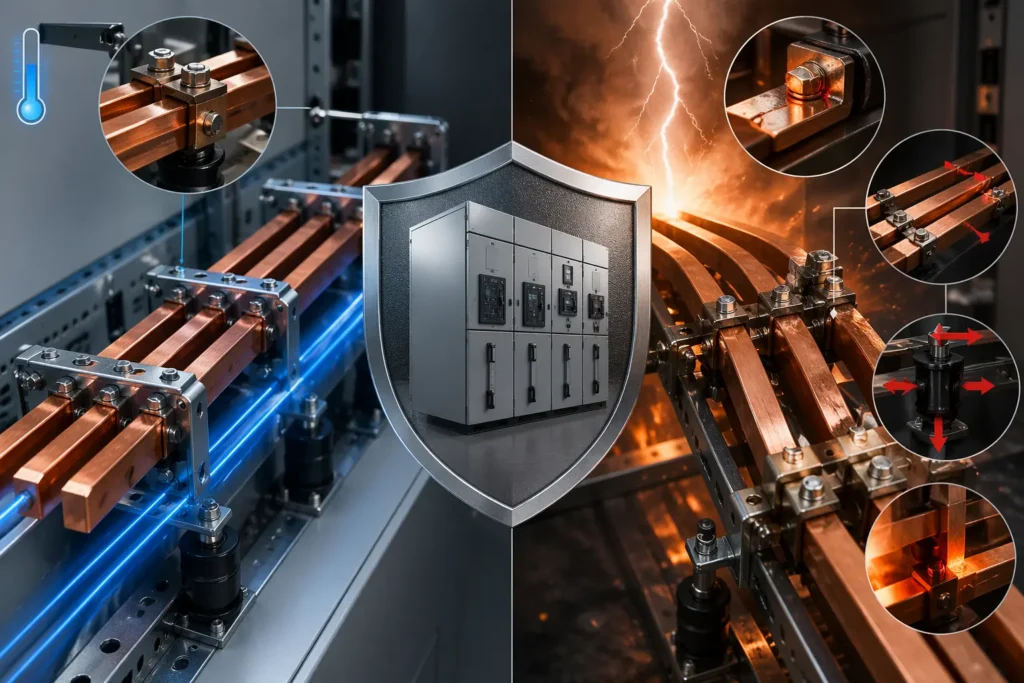
Why does that matter?
Under normal operation, a busbar mainly needs to carry current without overheating.
Under fault conditions, the situation becomes much more severe. The busbar may need to withstand:
- high short-circuit current
- high first peak force
- strong mechanical stress between conductors
- thermal stress at joints and supports
That is why switchgear is usually built with a more robust busbar system.
A Better Way to Think About It
Instead of saying:
“Switchgear is a larger panel board.”
A better statement is:
“Switchgear is usually a more heavily engineered power distribution assembly, often with a stronger busbar system and higher fault-duty expectations than a panel board.”
It explains why people often feel the two are related, while still preserving the fact that switchgear is normally associated with a different performance level.
Looking for factory-tested switchgear & Panel board for your project?
Typical Applications
| Assembly | Typical applications |
|---|---|
| Panel Board | • offices • residential buildings • retail spaces • small or light commercial projects • hotels and schools • ordinary building services distribution |
| Switchgear | • industrial plants • substations • infrastructure projects • hospitals • data centers • large commercial facilities • systems with higher fault levels |
Apparently, panel boards are more often used for smaller-scale or localized distribution duties. However, this does not mean the overall project itself must be small. Large projects can still use many panel boards at the downstream level. The real distinction is that switchgear is more often used at the points where the electrical duty, fault level, and system responsibility become more demanding.
Final Conclusion
So, is switchgear a kind of larger panel board?
Partly in appearance, but not in engineering meaning.
A switchgear assembly often does look like a larger and heavier distribution board, and one important reason is that it usually has a more robust busbar system designed for more demanding current and fault conditions.
But the real difference goes deeper than size or busbar thickness.
A panel board is mainly for downstream distribution.
Switchgear is usually built for a more serious system role involving distribution, protection, isolation, and fault performance.
That is the distinction that really matters.
Looking for factory-tested switchgear & Panel board for your project?
FAQ
What is the main difference between switchgear and panel board?
The main difference is that switchgear is designed for higher-level protection, switching, isolation, and fault performance, while a panel board is mainly used for branch circuit distribution.
Is switchgear more advanced than a panel board?
In general, yes. Switchgear is usually considered a more robust and higher-performance assembly for demanding electrical systems.
Where is a panel board usually installed?
Panel boards are commonly installed in commercial buildings, residential projects, and light industrial environments for downstream distribution.
Where is switchgear usually used?
Switchgear is typically used in industrial plants, utilities, infrastructure projects, hospitals, data centers, and other systems where protection and reliability are critical.
Which is more expensive, switchgear or panel board?
Switchgear is usually more expensive because it is built for higher protection duty, stronger fault handling, and more advanced operational requirements.


