
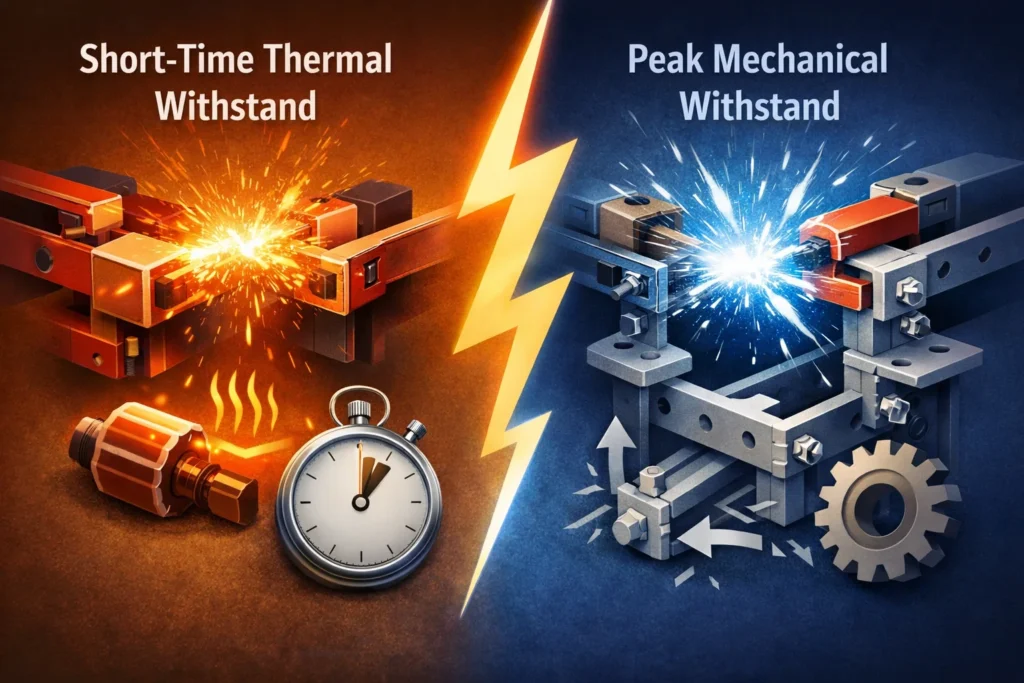
This article mainly discusses Icw and Ipk in the low-voltage IEC 61439 assembly context.
When engineers read a busbar or switchgear datasheet, two ratings often cause confusion: Icw and Ipk.
A simple way to think about them:
- Icw is about short-time thermal withstand
- Ipk is about instantaneous mechanical withstand
This matters because a short circuit does not stress switchgear in only one way. It creates heat in conductors and contacts, but it also creates strong mechanical forces in busbars and internal supports.
That is why IEC assembly standards treat these ratings seriously. In IEC-based low-voltage switchgear, both the RMS fault duty and the peak fault duty matter when evaluating short-circuit strength.
Here is a table briefly compare Icw vs Ipk:
| Parameter | Full name | Main focus | What it tells you |
|---|---|---|---|
| Icw | Rated short-time withstand current | Thermal withstand | How much fault current the assembly can withstand for a specified time |
| Ipk | Rated peak withstand current | Mechanical withstand | The highest instantaneous fault current peak the assembly can withstand |
- This blog contains concept of RMS, to understand the basic concepts of RMS and peak, please see our related article: RMS vs Peak: Difference in Voltage and Current.
- To understand why RMS is used in electrical engineering, and to get a deeper explanation of RMS and peak in short-circuit conditions, please see: RMS vs Peak in Short-Circuit Current: Why Both Matter.
- For a broader overview of electrical parameters in switchgear, please see: Switchgear Parameters Definition.
What is Icw?
Icw means rated short-time withstand current.
It is the short-circuit current that an assembly can withstand for a specified time, such as 1 second or 3 seconds, under stated conditions.
So when a datasheet says:
Icw = 50 kA / 1 s
it means the assembly or busbar system can withstand 50 kA for 1 second under the stated test and verification conditions. It does not mean the equipment is interrupting that current. It means the assembly can remain intact for that short duration without unacceptable damage.
In IEC-related assembly data, Icw is expressed in RMS terms.
What is Ipk?
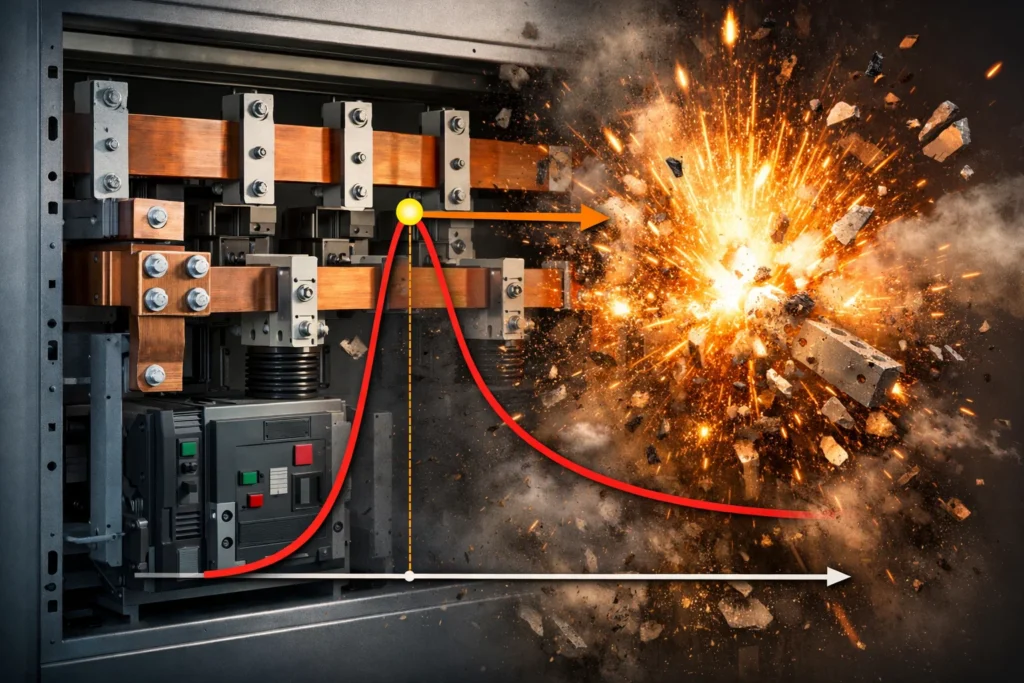
Ipk means rated peak withstand current.
It is the maximum instantaneous short-circuit current peak that an assembly can withstand under stated conditions.
So if Icw answers the question, “Can the assembly survive the fault for a short time?”, then Ipk answers the question, “Can the assembly survive the highest instantaneous peak of the fault current?”
That difference matters because the current peak is often the moment when busbars, supports, joints, and internal conductors experience the strongest mechanical stress.
In busbar and switchgear design, this is why support strength, spacing, bracing, joints, and conductor geometry are so important. Even if the assembly can endure the fault current for a short duration, it must also survive the mechanical shock caused by the peak current.
In IEC-related assembly data, Ipk is expressed in peak terms.
Icw, Ipk, and the busbar system
Both Icw and Ipk are strongly influenced by the busbar system, but the final declared rating belongs to the complete verified assembly, not to the copper bar alone.
How Icw and Ipk relate to the busbar system
| Parameter | More influenced by | Main risk |
|---|---|---|
| Icw | Busbar material, cross-section, resistance, joints, fault duration | Heating |
| Ipk | Busbar spacing, support insulators, bracing, clamps, joints, frame rigidity, fastening | Mechanical force |
For Icw
Busbar size and material usually have a very strong influence, because Icw is tied to short-time thermal withstand.
So for Icw, the busbar often influences:
- conductor heating
- temperature rise
- short-time current carrying ability
But joints, contact resistance, fault duration, enclosure ventilation, and the full current path also matter.
For Ipk
The busbar layout is still very important, but mechanical structure becomes even more critical.
Ipk depends heavily on:
- busbar spacing
- support strength
- bracing
- mounting rigidity
- joint strength
What do Icw and Ipk mean for busbars?
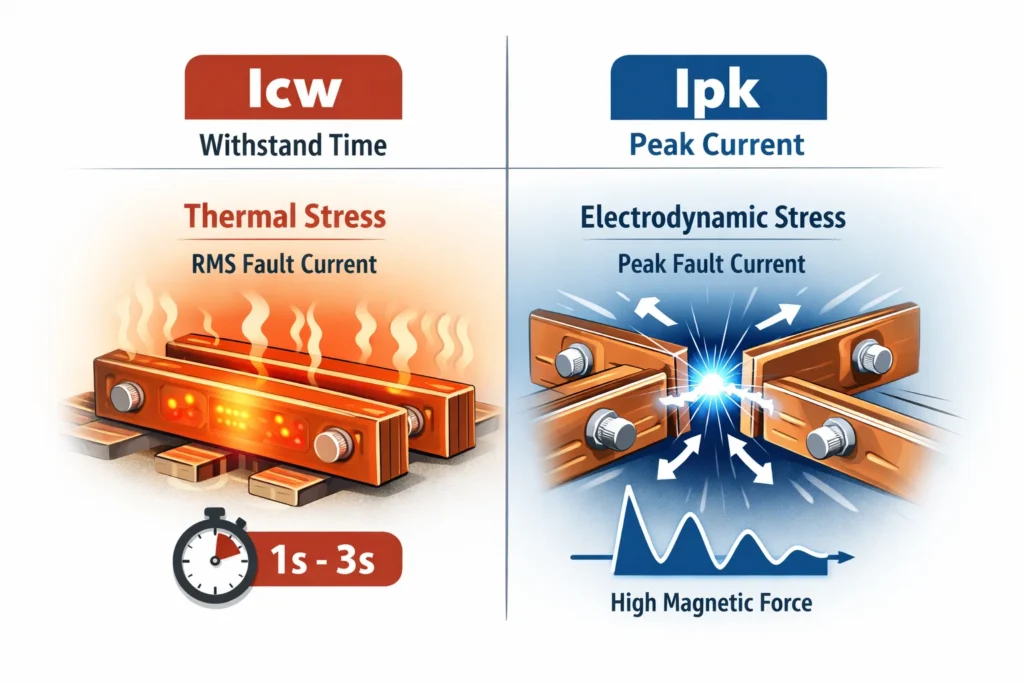
For busbars, the pairing is especially important.
The busbar system is not just a conductor. It is a mechanical structure inside the assembly. It has bars, joints, insulators, supports, spacings, and mounting hardware. Under fault conditions, the busbar must survive both:
- thermal stress, which relates to RMS current over a stated duration
- electrodynamic stress, which relates to the peak current and the magnetic forces between conductors
This is why busbar ratings should never be read only as “current carrying capacity.” A busbar that is thermally adequate at normal load current can still fail mechanically if the short-circuit peak duty is beyond the assembly’s verified withstand strength.
The relationship between Icw vs Ipk
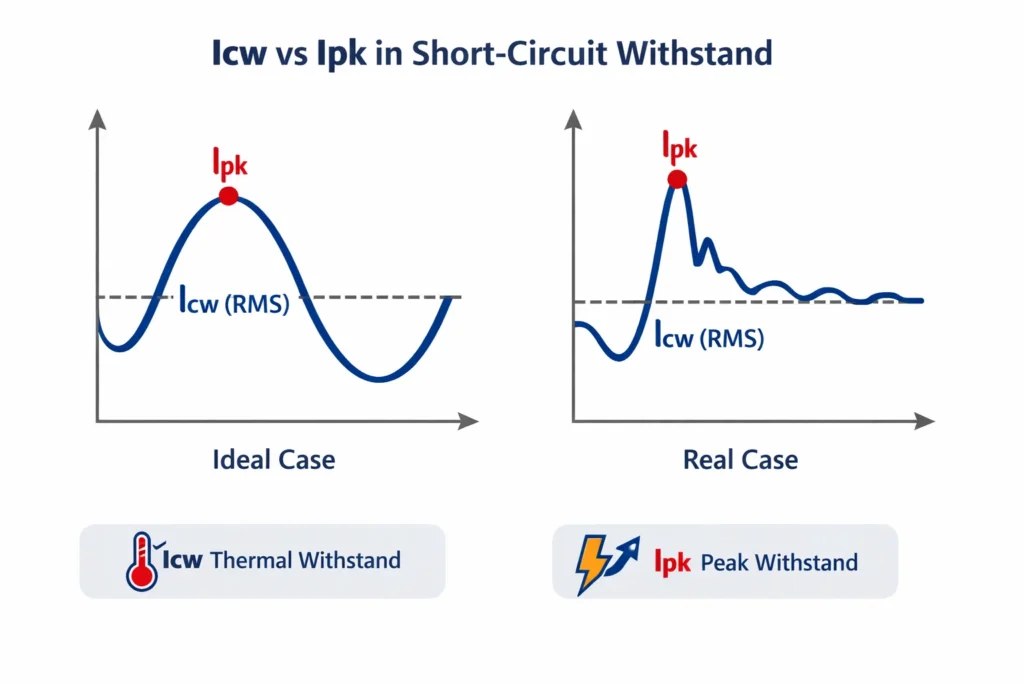
Icw and Ipk are closely related because both describe short-circuit withstand. They are both linked to the same fault current waveform, which has two important features: the RMS value and the peak value.
For the great details of peak and RMS, please check another blog: RMS vs Peak: Difference in Voltage and Current.
The relationship between Icw and Ipk is similar to the relationship between RMS and peak, but only in the ideal case.
Ideally:
Icw is the RMS side of short-circuit withstand.
It is the rated short-time withstand current, usually given with a time such as 1 second. In practical terms, it tells you how much fault current the assembly can endure over a short duration from a thermal point of view.
Ipk is the peak side of short-circuit withstand.
It is the rated peak withstand current, which means the highest instantaneous current peak the assembly can survive during a fault. In practical terms, it is more closely related to mechanical stress and electrodynamic force.
In practice:
Short-circuit current does not usually begin as a perfectly symmetrical sine wave.
The first peak is often higher because the fault current can include a DC offset at the beginning. That is why real short-circuit withstand ratings cannot be understood using the simple ideal relationship alone, and why Ipk is often higher than 1.414 × Icw.
For more detail on short-circuit current behavior in terms of RMS and peak, please see our related article: RMS vs Peak in Short-Circuit Current: Why Both Matter.
Looking for factory-tested switchgear for your project?
A simple datasheet example
Suppose a switchgear assembly is declared as:
Icw = 50 kA / 1 s
Ipk = 105 kA
The correct interpretation is:
- the assembly can withstand 50 kA RMS for 1 second
- the assembly can also withstand an instantaneous peak of 105 kA under the specified conditions
This does not mean 105 kA is a long-duration current. It also does not mean the assembly is “rated 105 kA” in the same way people casually discuss breaker interruption capacity. These two values describe different dimensions of fault duty.
Conclusion
Icw is the RMS short-time withstand current. It answers the thermal question: how much short-circuit current can the assembly endure for a specified time?
Ipk is the peak withstand current. It answers the mechanical question: what is the maximum instantaneous short-circuit peak the assembly can survive?
For busbars and IEC switchgear assemblies, both matter. One helps define short-time thermal withstand. The other helps define resistance to the violent electrodynamic forces produced at the fault peak. Read together, they give a much more accurate picture of assembly strength than one fault-current number alone.
Looking for factory-tested switchgear for your project?
FAQ
Is Icw an RMS value?
Yes. Schneider defines it as the RMS value of current that the switchgear can carry in the closed position during a specified short time, and ABB’s IEC 61439 material describes it as the RMS value of short-time current declared by the assembly manufacturer.
Is Ipk a peak value?
Yes. IEC Electropedia defines it as the value of peak current a circuit or switching device in the closed position can withstand, and ABB uses the same peak-withstand meaning for assemblies.
Is Ipk always 1.414 times Icw?
No. That relationship only belongs to a clean sinusoidal waveform. Real short-circuit current can include asymmetry and a decaying DC offset, so the first peak can be more severe than the symmetrical sine-wave ratio suggests.
Are Icw and Ipk only busbar ratings?
Not exactly.
Icw and Ipk are most commonly used for busbar systems and switchgear assemblies, because both describe short-circuit withstand. But they are not strictly limited to the busbar alone. In practice, they are better understood as ratings of the complete current path and assembly structure.


