
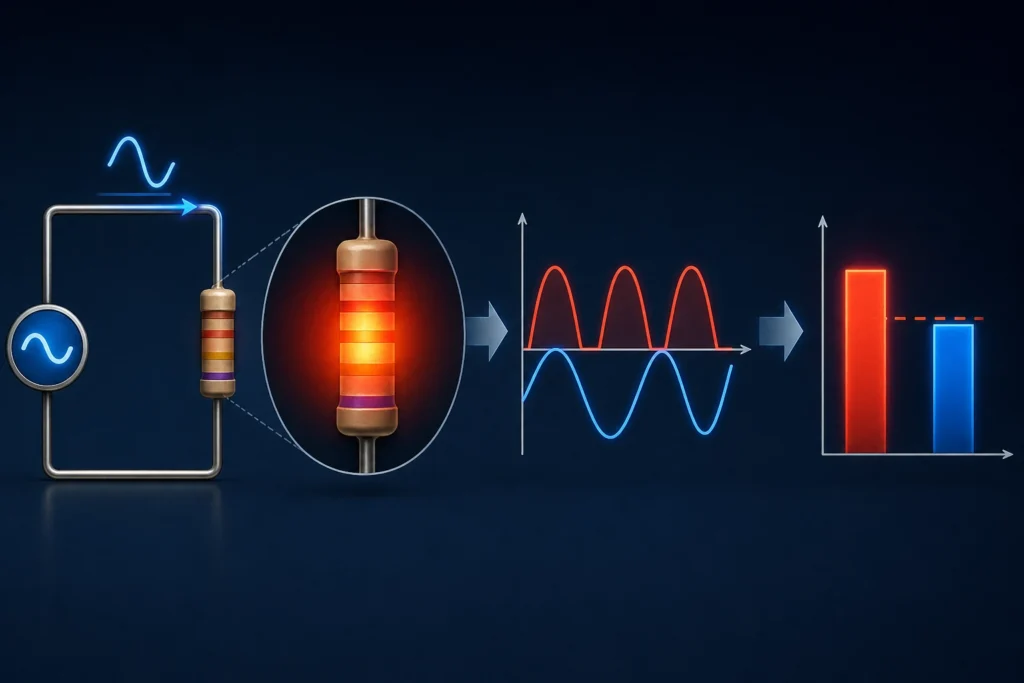
Please note: this article is academically oriented and intended for readers who want a deeper technical explanation.
Level: Advanced
In Part I, we explained the basic difference between RMS and peak. In Part II, we showed both thermal stress and mechanical stress matter in short-circuit current. In this third article, we go one level deeper and answer the more fundamental question:
Why does RMS exist in the first place?
-The answer comes from Joule’s law.
Looking for factory-tested switchgear & Panel board for your project?
Joule’s Law: the physical origin of RMS
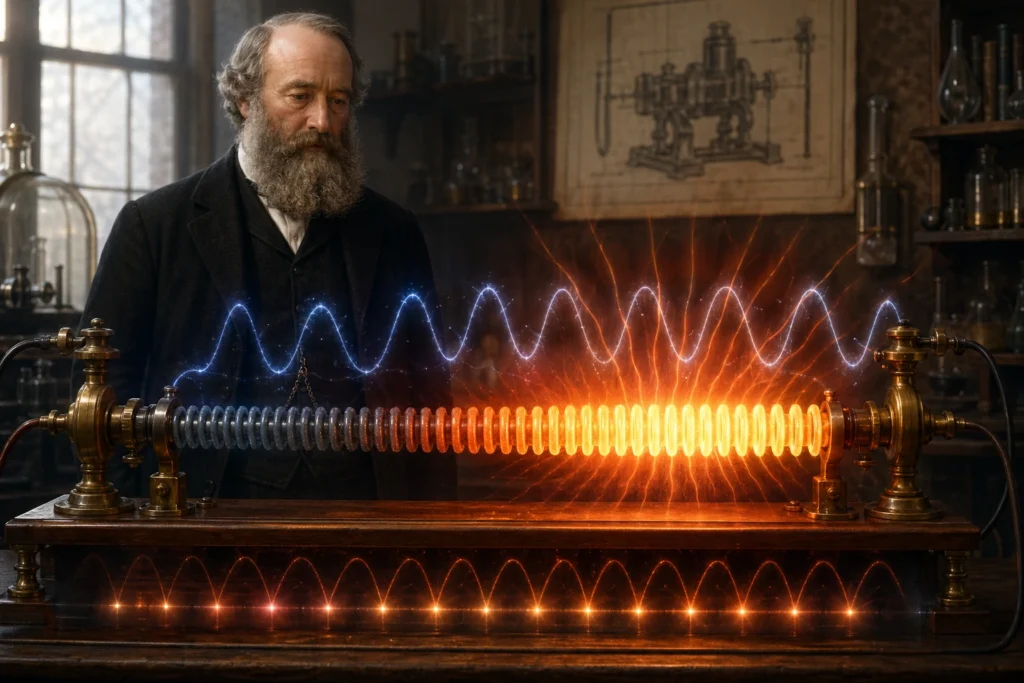
Long before RMS became a standard engineering term, James Prescott Joule showed that electric current produces heat in a conductor, and that this heating depends strongly on the current itself. His work established what we now call Joule’s law: for a resistor, the heat generated over time depends on the resistance, the square of the current, and the duration.
In simplified form:
Heat ∝ I²Rt
In engineering practice, this is usually written in power form as:
P = I²R
Using Ohm’s law, the same relationship can also be written as:
P = V² / R
P = VI
For a purely resistive load, these expressions describe the same physical event: electrical energy is being converted into heat.
This is the key point for RMS.
The heating effect is not proportional to current itself. It is proportional to current squared. Once that square-law behavior is established, the path to RMS begins naturally.
Why RMS is not a normal average
As discussed in Part II, resistor heating depends on current squared, so the thermal effect of an AC waveform cannot be captured by a simple signed average.
From instantaneous resistor heating to the RMS formula
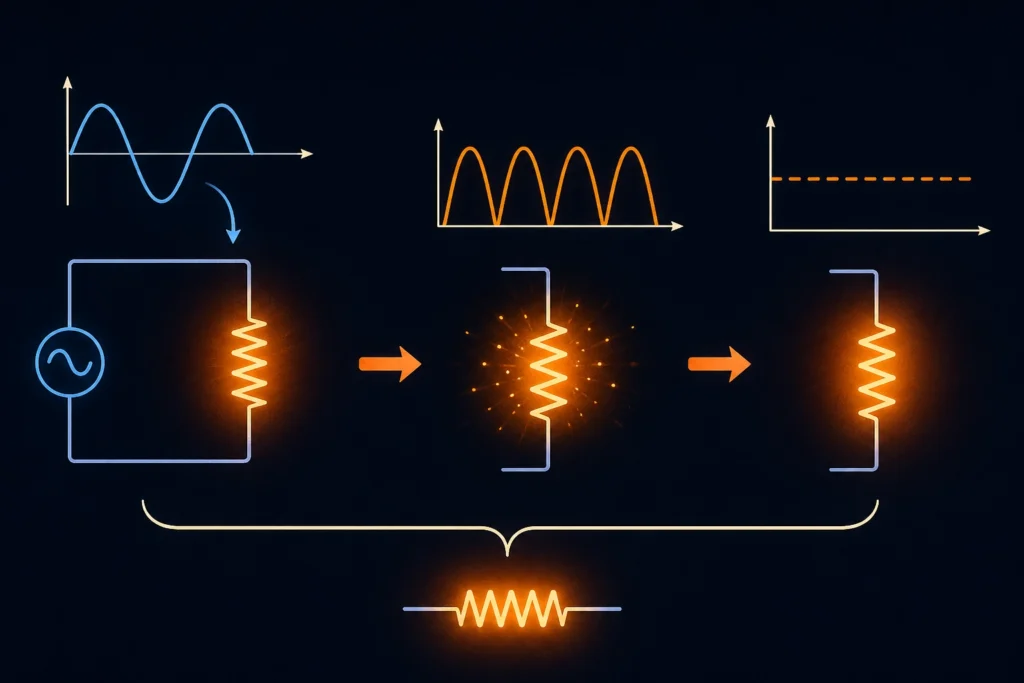
Because resistive heating depends on the square of current, ordinary averaging is not enough. To see why the RMS formula takes its specific form, we need to start from instantaneous resistor heating and then average that effect over time.
Let a resistor carry a time-varying current i(t).
The instantaneous heating power is:
p(t) = i²(t)R
If we want the average heating effect over a time interval T, we average the power:
Pavg = (1/T) ∫ p(t) dt
Substituting p(t) = i²(t)R gives:
Pavg = (1/T) ∫ i²(t)R dt
Since R is constant:
Pavg = R · (1/T) ∫ i²(t) dt
Now define a DC current that would produce the same average heating in the same resistor. Call it IRMS. Then:
Pavg = I²RMS · R
So:
IRMS = √[(1/T) ∫ i²(t) dt]
That is the RMS definition.
Using the same logic for voltage:
VRMS = √[(1/T) ∫ v²(t) dt]
So RMS is not just a waveform description. It is the heating-equivalent DC value.
This is also why the derivation naturally uses calculus. Joule heating is defined at each instant, and the total effect over time is found by accumulating those instantaneous contributions. RMS emerges when that accumulated heating effect is converted into an equivalent DC value.
What this derivation means physically
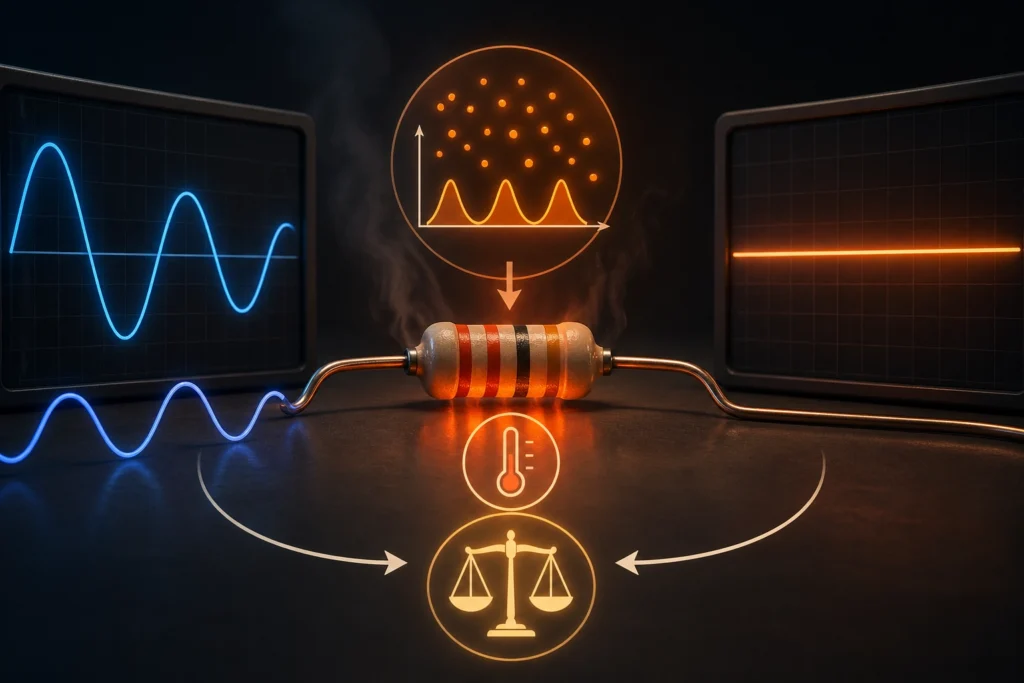
The derivation above gives more than a formula. It gives the physical meaning of RMS.
RMS is the DC value that would produce the same average Joule heating in a resistor as the original time-varying waveform.
That is why RMS is often called the effective value.
Seen this way, the logic is naturally a calculus-based one: we start from the heating at each instant, accumulate that effect over time, and then express the result as an equivalent DC value.
This is also why RMS matters so much in real engineering. When the question is about thermal effect, the quantity that matters is not the signed average and not simply the peak. It is the value that reproduces the same accumulated heating behavior.
A simple comparison: DC, sine, and square wave
A quick example makes this easier to see.
Assume the resistor is 1 Ω, and compare three waveforms with a peak value of 10 V.
| Waveform | Peak value | RMS value | Average heating power in 1 Ω |
|---|---|---|---|
| DC | 10 V | 10 V | 100 W |
| Sine wave | 10 V | 7.07 V | 50 W |
| Square wave | 10 V | 10 V | 100 W |
This comparison reveals the real meaning of RMS.
Note: P = I²R
A 10 V DC source produces 100 W of heating in a 1 Ω resistor.
A 10 V peak sine wave does not produce the same heating, because it only reaches 10 V momentarily. Its RMS value is only 7.07 V, so its average heating power is 50 W.
A ±10 V square wave, however, stays at full magnitude throughout the cycle, so its RMS value is 10 V, the same as DC. That means it produces the same average heating power as 10 V DC.
This is exactly why RMS is more useful than peak when the engineering concern is heating.
Why this matters in practical engineering
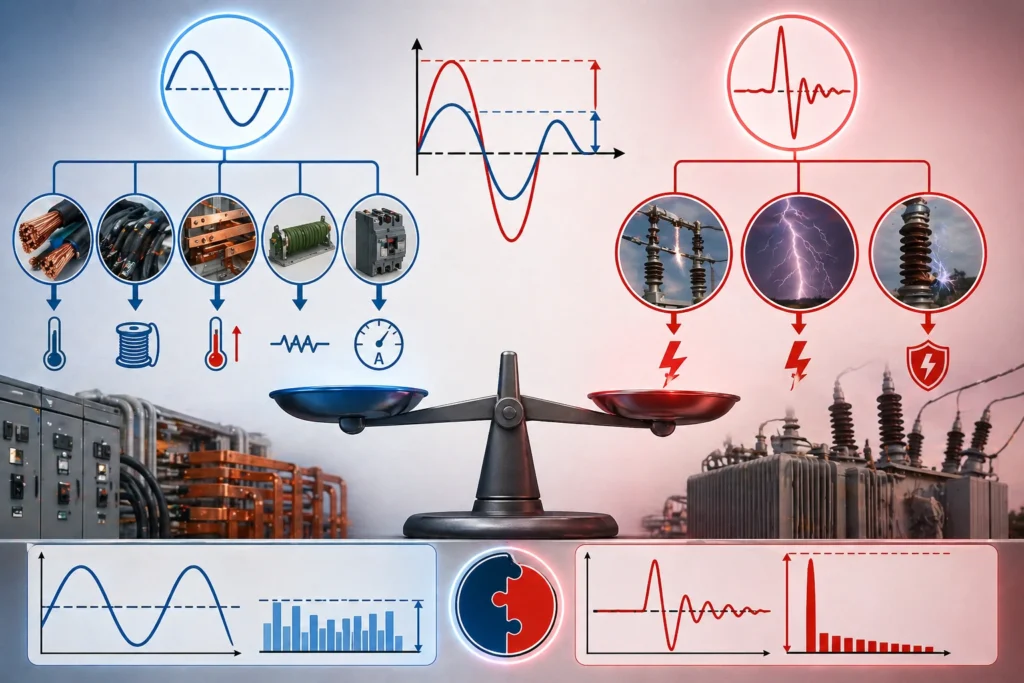
This distinction is not just theoretical.
In electrical engineering, RMS is commonly the more meaningful quantity when evaluating:
- conductor heating
- cable loading
- busbar temperature rise
- resistor dissipation
- continuous current rating
Peak still matters, but for a different reason. Peak is more relevant when the concern is maximum instantaneous stress, such as short-duration mechanical or insulation stress.
So the simplest way to separate them is this:
- Peak tells you how high the waveform goes at one instant
- RMS tells you the effective heating-equivalent value over time
That is why both quantities appear in electrical design, but they are not interchangeable.
Looking for factory-tested switchgear & Panel board for your project?
Final conclusion
RMS does not come from convenience alone. It comes from physics.
Joule’s law shows that resistor heating depends on the square of current or voltage. Once that heating is expressed instant by instant and then accumulated over time, the RMS definition follows naturally.
That is why RMS is not just another way to describe a waveform. It is the heating-equivalent DC value.
So in the comparison between RMS and peak:
- peak describes the maximum instantaneous value
- RMS describes the effective thermal value
And when the question is about heating, continuous loading, or power dissipation, RMS is usually the quantity that matters most.
- For basic difference between RMS and peak, see RMS vs Peak Part I.
- To see how both thermal stress and mechanical stress matter in short-circuit current, see RMS vs Peak Part II.
- For a broader explanation of related electrical terms, see our switchgear parameters definition.
- To see how these concepts apply in electrical standards, see our Icw vs Ipk.
FAQ
Why is RMS called the effective value?
Because it is the DC value that would produce the same average Joule heating in a resistor as the original AC or time-varying waveform.
Why is RMS more useful than average for AC?
Because resistive heating depends on the square of current or voltage, so a simple signed average cannot represent the real thermal effect.
Does peak voltage determine heating?
Not by itself. Peak only shows the highest instantaneous value. Average heating depends on RMS.
Why does a sine wave have lower RMS than peak?
Because it only reaches its peak momentarily and spends most of the cycle below that level.
When does RMS equal peak?
For waveforms that stay at constant magnitude, such as DC or an ideal square wave.
Reference:
https://web.mit.edu/6.013_book/www/chapter11/11.3.html
https://www.nist.gov/sites/default/files/documents/calibrations/sp250-61.pdf


