

Load centers and panelboards are both part of low-voltage electrical distribution systems. For engineered low-voltage switchgear, customized distribution assemblies, or RFQ support, you can refer to our lv switchgear page.
If you are comparing other low-voltage distribution terms, you may also read our guide on:
switchgear vs panel board
switchgear vs switchboard
In low-voltage electrical distribution, load center and panelboard are sometimes used as if they mean the same thing. Both can distribute power to multiple branch circuits, and both usually contain circuit breakers for protection.
However, they are not always used in the same type of project.
A load center is commonly used in residential and light commercial electrical systems. A panelboard is a broader and more configurable distribution assembly, often used in commercial, industrial, and larger building electrical systems.
In simple terms:
A load center is usually a compact and standardized distribution panel for smaller systems, while a panelboard is usually a more flexible distribution assembly for larger or more demanding systems.
Quick Comparison: Load Center vs Panelboard
| Item | Load Center | Panelboard |
|---|---|---|
| Typical use | Residential and light commercial | Commercial, industrial, and larger buildings |
| Main function | Branch circuit distribution | Branch circuit and feeder distribution |
| Design style | Compact and standardized | More configurable |
| Breaker connection | Often plug-on breakers | Plug-on or bolt-on breakers |
| Circuit capacity | Usually more limited | Usually more flexible |
| Customization | Limited | Higher |
| Maintenance | Simple | More structured |
| Typical location | Houses, apartments, small offices | Offices, factories, hospitals, schools, hotels |
| Selection priority | Cost, compact size, easy installation | Capacity, flexibility, reliability, coordination |
What Is a Load Center?
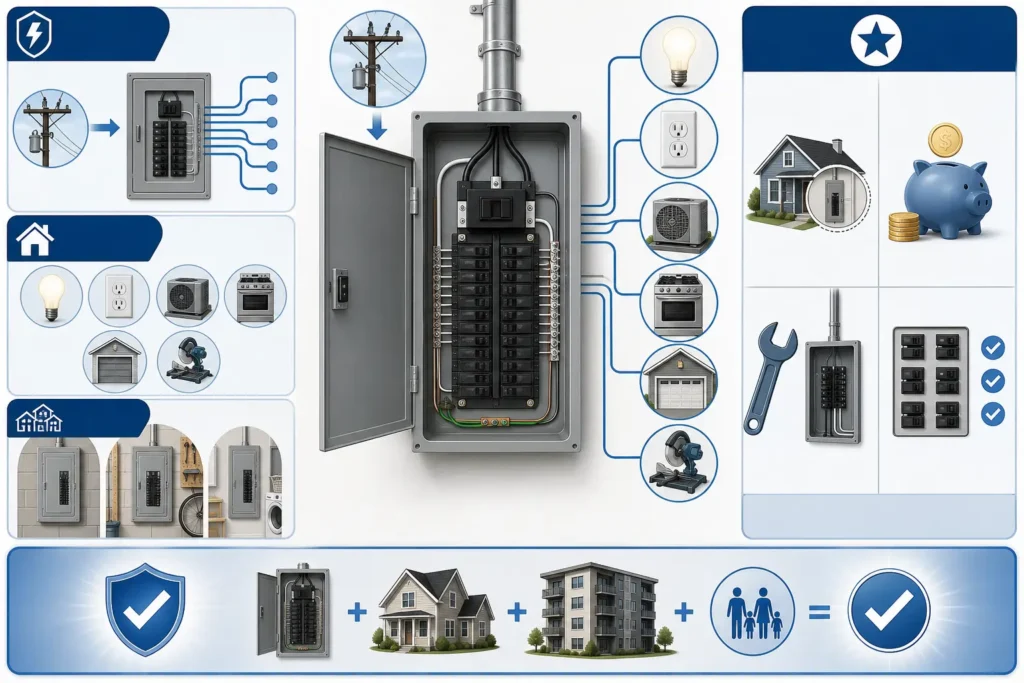
A load center is a compact electrical distribution panel commonly used in houses, apartments, and small buildings. It receives incoming power and distributes it to branch circuits through circuit breakers.
Typical circuits connected to a load center include lighting, receptacles, HVAC equipment, kitchen appliances, garage circuits, and small equipment circuits.
In residential projects, a load center is often called a breaker box, electrical panel, or distribution box.
The main advantages of a load center are:
| Advantage | Meaning |
|---|---|
| Compact size | Suitable for homes and small buildings |
| Lower cost | Practical for standard residential distribution |
| Easy installation | Common design and simple wiring arrangement |
| Standardized structure | Good for ordinary branch circuit protection |
A load center is not a lower-quality product. It is simply designed for simpler and smaller-scale applications.
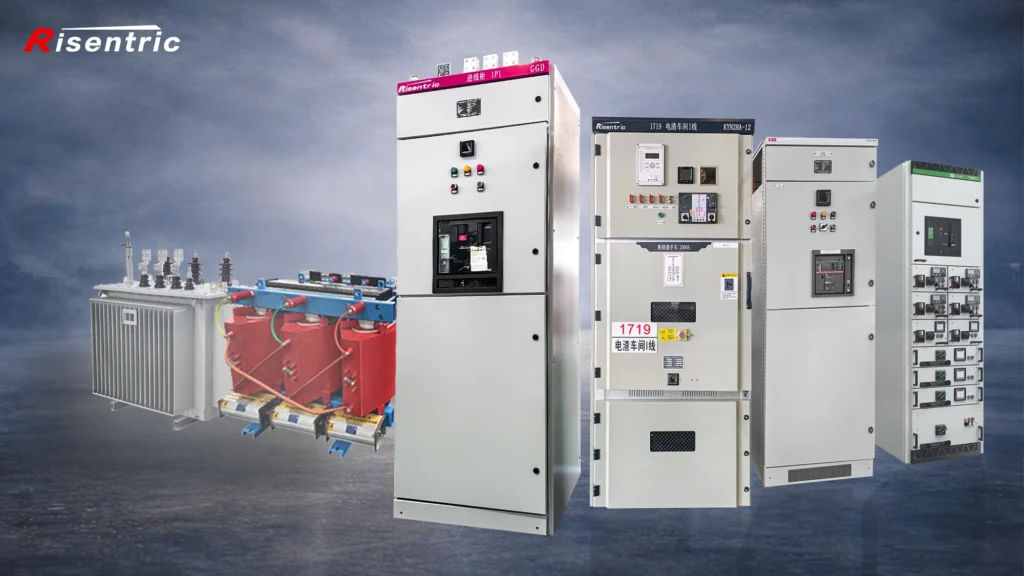
Looking for factory-tested Load Centers& Panelboards for your project?
What Is a Panelboard?
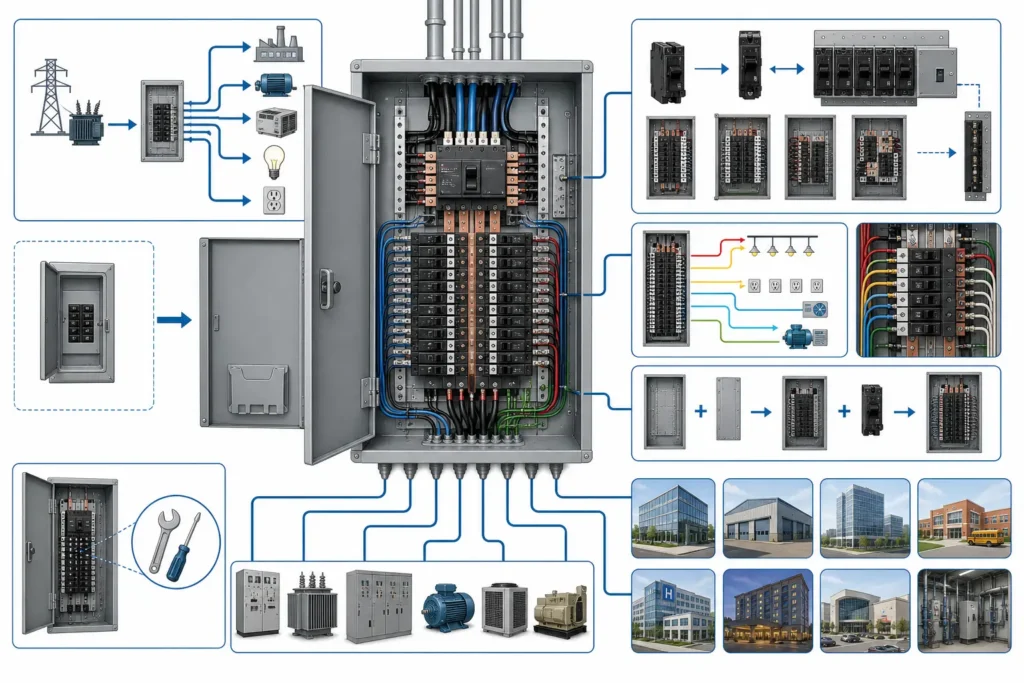
A panelboard is a low-voltage electrical distribution assembly used to divide power into multiple branch circuits or feeders. It usually includes an enclosure, busbars, circuit breakers, terminals, and circuit labeling.
Compared with a typical load center, a panelboard is often more flexible in rating, circuit arrangement, breaker type, and installation configuration.
Panelboards are commonly used in:
- Commercial buildings
- Industrial workshops
- Office buildings
- Schools
- Hospitals
- Hotels
- Shopping centers
- Mechanical and electrical rooms
In these projects, electrical distribution is not only about sending power to several branch circuits. The system may also need better circuit organization, future expansion, stronger maintenance access, and coordination with other electrical equipment.
Main Differences Between Load Center and Panelboard
The biggest difference is the application scale. Load centers are usually selected for smaller and more standardized systems, while panelboards are selected for larger and more flexible systems.
| Difference | Load Center | Panelboard |
|---|---|---|
| Application scale | Smaller systems | Larger systems |
| Typical building type | Residential, apartment, small shop | Commercial, industrial, institutional |
| Circuit arrangement | More standardized | More flexible |
| Breaker type | Commonly plug-on | Plug-on or bolt-on |
| Expansion | More limited | Easier to design with spare capacity |
| Project engineering | Simple distribution | More coordinated electrical distribution |
| Cost | Usually lower | Usually higher |
| Maintenance | Basic | More organized and service-oriented |
This does not mean a panelboard is always better. It only means it is usually designed for more demanding distribution systems.
Looking for factory-tested Load Centers& Panelboards for your project?
Plug-On Breakers vs Bolt-On Breakers
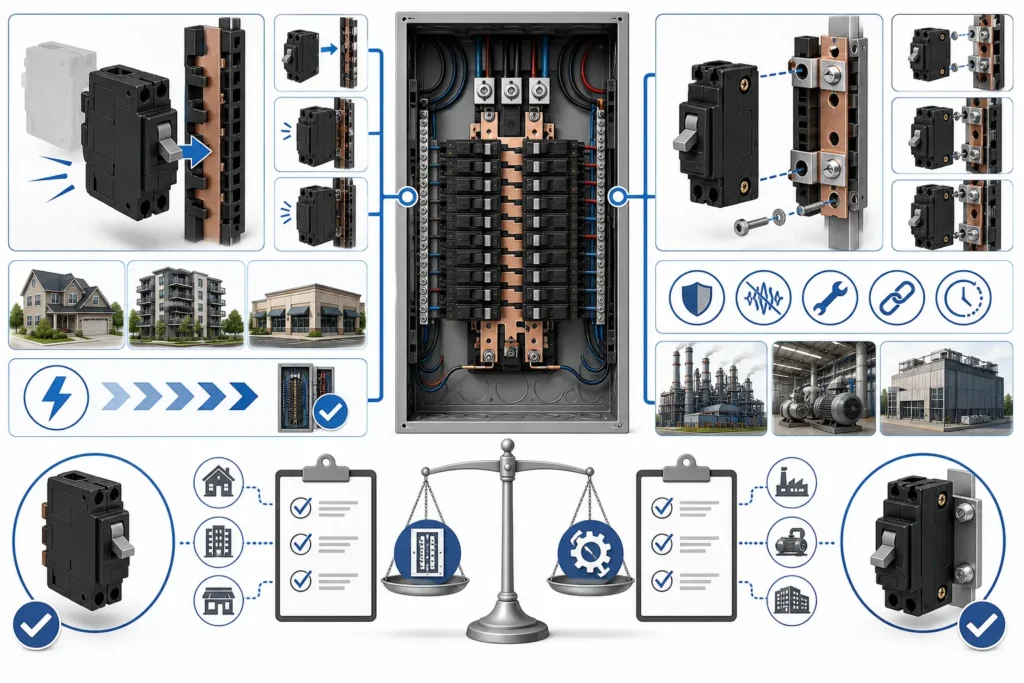
Many load centers use plug-on circuit breakers. These breakers are fast to install and are common in residential and light commercial applications.
Panelboards may also use plug-on breakers, but commercial and industrial panelboards often use bolt-on breakers. A bolt-on breaker has a more secure mechanical connection to the busbar, which can be useful where reliability, vibration resistance, and long-term maintenance are important.
The correct choice depends on the equipment design and project requirements. Plug-on breakers are not automatically unsafe, and bolt-on breakers are not automatically necessary for every project.
Typical Applications
| Application | Common Choice | Reason |
|---|---|---|
| House | Load center | Standard residential branch circuit distribution |
| Apartment | Load center | Compact and economical |
| Small shop | Load center or small panelboard | Depends on circuit quantity and load type |
| Small office | Load center or panelboard | Depends on system scale |
| Office building | Panelboard | More circuits and better organization |
| Hospital | Panelboard | More demanding distribution and reliability requirements |
| Hotel | Panelboard | Many rooms, floors, and service circuits |
| Industrial workshop | Panelboard | Higher load diversity and stronger distribution needs |
| Mechanical room | Panelboard | Often supplies pumps, fans, HVAC, and auxiliary equipment |
Apparently, a load center is more common in small-scale projects, while a panelboard is more common in larger projects. However, this does not mean the market demand for load centers is small. Residential buildings, apartments, small shops, and small offices can create a very large quantity demand, even if each individual project is not large.
How to Choose Between a Load Center and a Panelboard
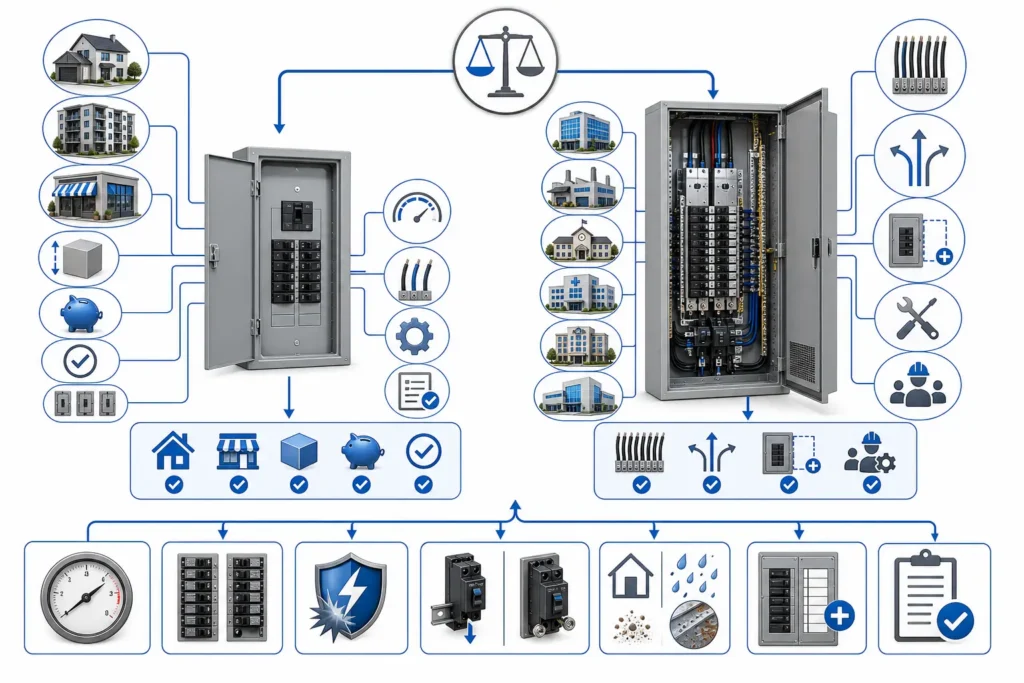
A simple rule is:
Use a load center for simple residential or light commercial distribution. Use a panelboard for larger, more flexible, or more demanding electrical distribution systems.
Before selection, check these factors:
| Factor | Why It Matters |
|---|---|
| Rated current | The panel must match the load demand |
| Number of circuits | More circuits may require a panelboard |
| Short-circuit rating | The equipment must withstand the available fault current |
| Breaker type | Some projects require plug-on or bolt-on breakers |
| Installation environment | Indoor, outdoor, dust, moisture, and corrosion affect enclosure choice |
| Future expansion | Spare capacity may be important in commercial systems |
| Local standards | Selection must follow local electrical codes and project specifications |
If the system is small, standardized, and cost-sensitive, a load center is often enough. If the system needs more outgoing circuits, future expansion, or stronger engineering coordination, a panelboard is usually the better choice.
Conclusion
Load centers and panelboards are both used for electrical distribution, but they are usually selected for different project conditions.
A load center is compact, standardized, and commonly used in residential or light commercial systems. A panelboard is broader, more configurable, and commonly used in commercial, industrial, and larger building electrical systems.
The best choice depends on the project’s rated current, number of circuits, breaker type, short-circuit requirement, installation environment, and future expansion needs.
For small and simple systems, a load center is often the practical choice. For larger and more demanding systems, a panelboard is usually more suitable.
When selecting electrical distribution equipment, parameters such as rated current, short-circuit capacity, and breaker settings should be checked carefully. For more details, see our switchgear parameters definition guide.
For readers who want to understand the broader role of switchgear in power systems, see our guide: What Is a Switchgear?
FAQ
Is a load center the same as a panelboard?
Not exactly. They are similar, but a load center is usually used for residential or light commercial distribution, while a panelboard is a broader and more configurable electrical distribution assembly.
Where is a load center commonly used?
A load center is commonly used in houses, apartments, small shops, garages, and small offices.
Where is a panelboard commonly used?
A panelboard is commonly used in commercial buildings, industrial facilities, schools, hospitals, hotels, shopping centers, and electrical rooms.
Can a panelboard be used in a house?
Yes, but it may not always be necessary. For many residential projects, a load center is more practical and economical.
Which is better, a load center or a panelboard?
A load center is better for simple residential and light commercial systems. A panelboard is better for larger, more flexible, or more demanding electrical distribution systems.


