
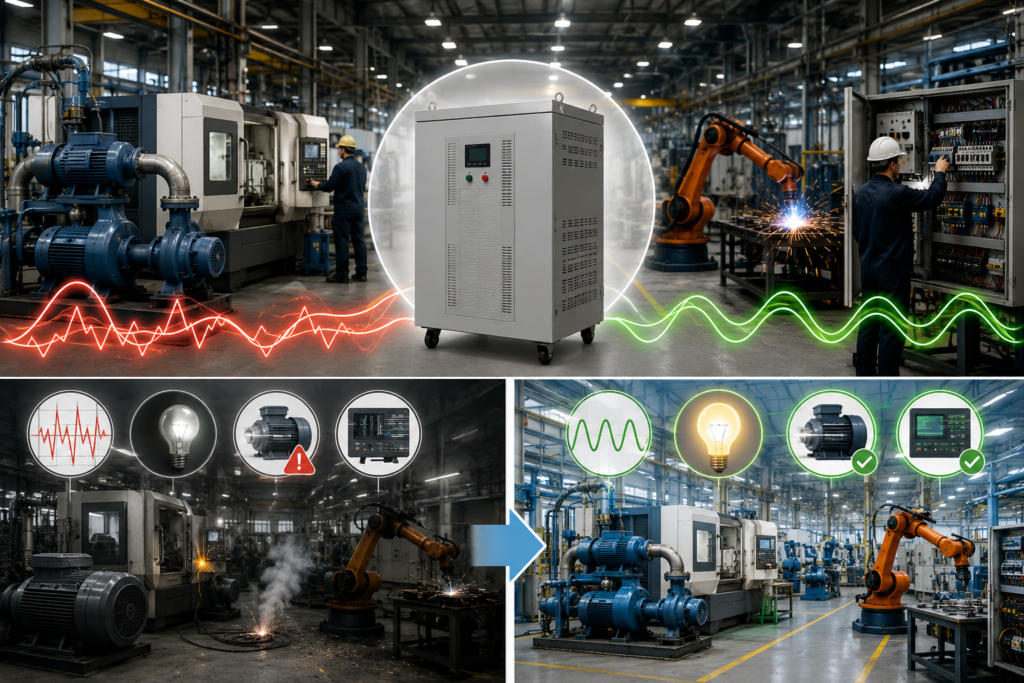
Stable voltage is essential for any factory power distribution system. In industrial facilities, motors, compressors, welding machines, CNC machines, pumps, and control cabinets often operate at the same time. When these loads start, stop, or change suddenly, the voltage inside the factory may fluctuate.
This is where a voltage regulator may be required.
In many markets, a voltage regulator is also called a voltage stabilizer. Technically, “voltage regulator” is the broader engineering term, while “voltage stabilizer” is commonly used for equipment that automatically keeps voltage stable for machines or electrical systems.
For factory applications, both terms usually refer to the same practical purpose: maintaining a stable voltage supply for industrial electrical equipment.
However, not every factory needs a voltage regulator. It is useful only when voltage fluctuation affects production reliability, equipment protection, or power quality.
What Does a Voltage Regulator Do?
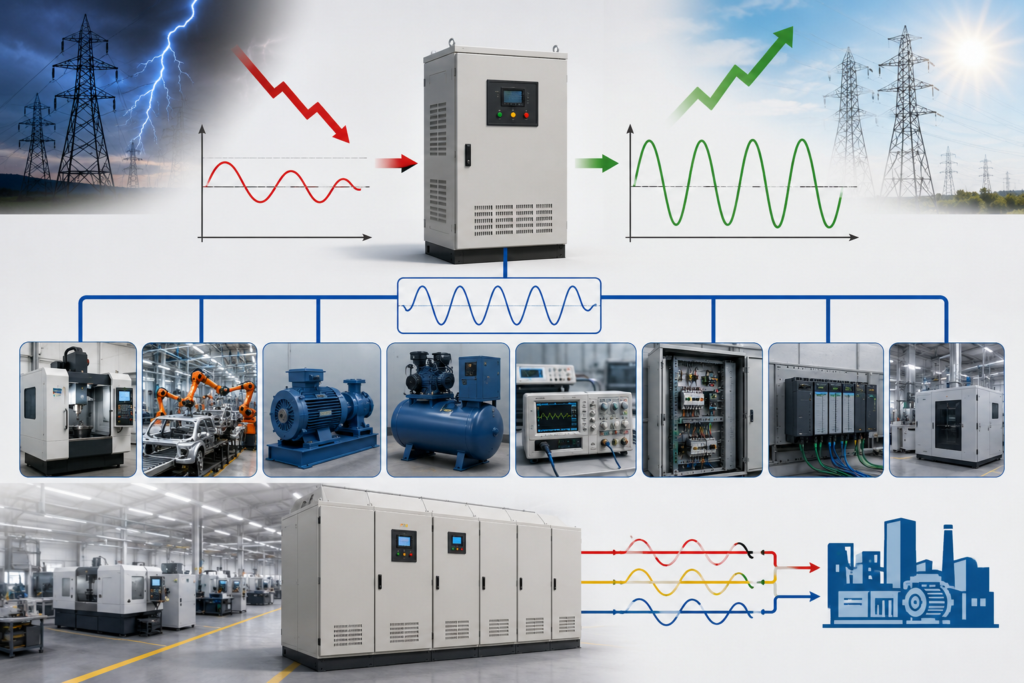
A voltage regulator helps keep output voltage within a controlled range when the input voltage changes.
For example, if the grid voltage drops too low or rises too high, an automatic voltage regulator can adjust the output voltage to provide a more stable supply to the connected load.
In a factory power distribution system, a voltage regulator or industrial voltage stabilizer may be used for:
- CNC machines
- Production lines
- Motors and pumps
- Compressors
- Testing equipment
- Control panels
- PLC and automation systems
- Sensitive industrial equipment
For larger industrial facilities, a three phase voltage stabilizer may be installed to support three-phase loads that require stable power.
Looking for factory-tested Load Centers& Panelboards for your project?
Why Factory Voltage Becomes Unstable
Factory voltage fluctuation can happen for several reasons, including:
- Unstable utility grid supply
- Large motor starting current
- Sudden load changes
- Transformer overload
- Poor load balance between phases
- Welding machines or heavy impact loads
- Long feeder cables
- Poor power factor
- Aging electrical equipment
- Loose connections inside distribution boards
Sometimes voltage is normal during low-load periods but drops during peak production. In other cases, voltage may rise at night when the factory load is lower.
This is why voltage problems should be measured and diagnosed before choosing a voltage regulator.
Common Signs Your Factory May Need a Voltage Regulator
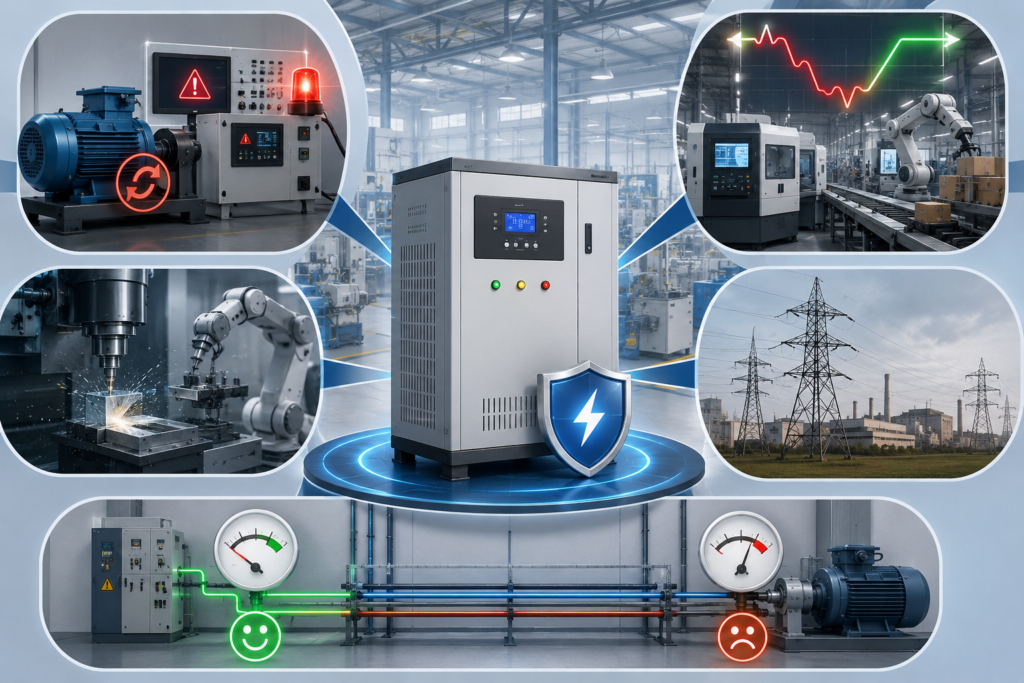
Your factory may need a voltage regulator or voltage stabilizer if you notice the following problems.
Machines Trip or Reset Frequently
If machines stop unexpectedly, PLCs reset, VFDs show undervoltage faults, or control panels shut down without a clear mechanical reason, unstable voltage may be one possible cause.
This is especially common when large motors, compressors, or welding equipment start operating.
Voltage Changes During Production
If voltage drops during peak production or changes significantly when certain machines start, your factory power distribution system may be experiencing voltage fluctuation.
An industrial voltage stabilizer can help when the voltage variation is within its correction range.
Sensitive Equipment Requires Stable Voltage
Some machines are more sensitive to voltage changes than ordinary loads. Examples include CNC machines, robotic systems, testing equipment, packaging machines, and automation control systems.
For these applications, stable voltage is important for accuracy, reliability, and continuous operation.
The Factory Is Located in an Area With Unstable Grid Power
Some industrial areas have weak grid infrastructure or large nearby users that create voltage variation. If the utility supply is unstable, installing an automatic voltage regulator may help protect the factory’s internal distribution system.
Cable Voltage Drop
If voltage is normal at the main distribution board but low at the machine terminal, the issue may be cable voltage drop. This often happens when the cable is too long, too small, or heavily loaded.
In some cases, a voltage regulator installed near the load can help maintain stable operating voltage for the equipment.
Looking for factory-tested Load Centers& Panelboards for your project?
When a Voltage Regulator May Not Solve the Problem
A voltage regulator is useful, but it is not the answer to every electrical issue.
Before installing one, check whether the real problem is caused by another part of the power distribution system.
Transformer Overload
If the transformer is overloaded, a voltage regulator may not solve the root cause. The transformer capacity, actual load demand, and future expansion plan should be reviewed first.
Loose Connections or Aging Switchgear
Loose terminals, poor contacts, old breakers, overheated busbars, or damaged components can also cause voltage problems.
A voltage regulator should not be used to cover unsafe electrical conditions.
Harmonics or Poor Power Factor
If the problem is caused by harmonics, reactive power, or nonlinear loads such as VFDs and rectifiers, the factory may need harmonic filters, power factor correction, or improved distribution design.
A voltage regulator alone may not solve these power quality issues.
What to Check Before Installing a Voltage Regulator
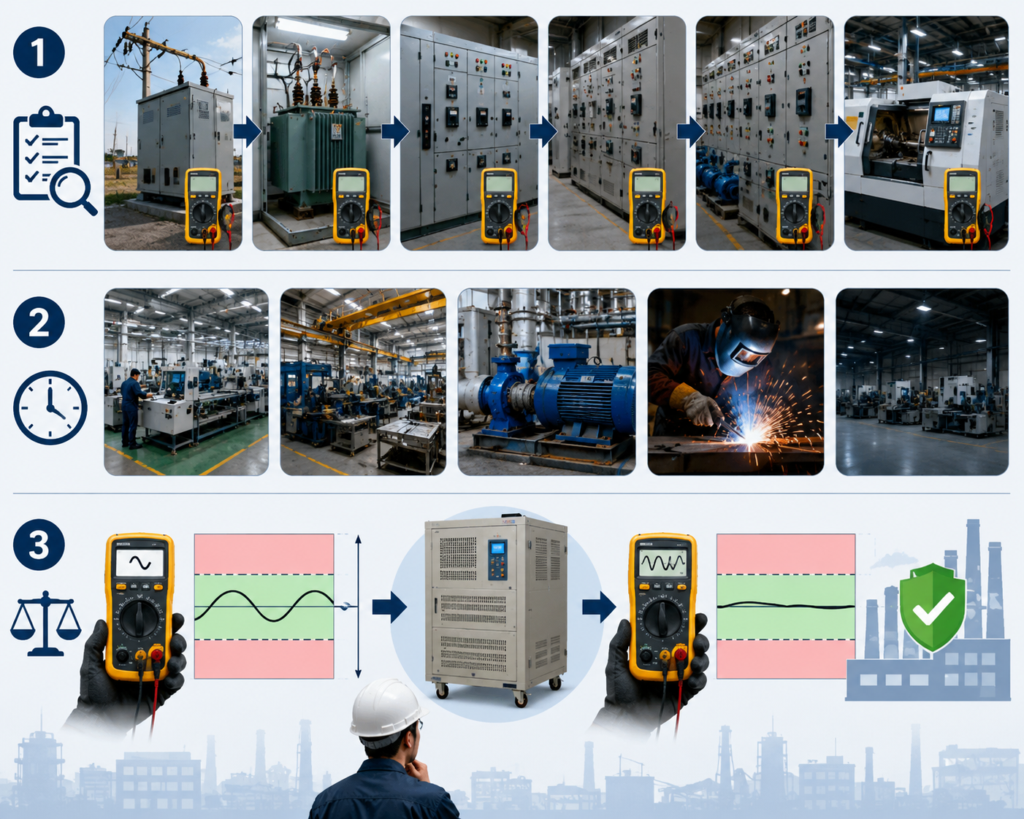
Before choosing a voltage regulator for factory use, follow a basic engineering process.
First, measure voltage at key points:
- Main incoming panel
- Transformer secondary side
- Main distribution board
- Sub-distribution boards
- Motor control center
- Sensitive machine terminals
Second, measure during different operating conditions:
- Normal production
- Peak load
- Large motor startup
- Welding operation
- Night or low-load operation
Third, compare the measured voltage with the equipment’s allowed voltage range.
If the voltage frequently goes outside the acceptable range and affects production, then a voltage regulator or industrial voltage stabilizer may be necessary.
How to Choose a Voltage Regulator for Factory Use
When selecting a voltage regulator, consider the following factors:
- Single-phase or three-phase system
- Rated capacity in kVA
- Input voltage fluctuation range
- Required output voltage accuracy
- Load type
- Motor starting current
- Response speed
- Overload capacity
- Bypass function
- Protection functions
- Installation environment
- Maintenance access
- Future expansion
For factory applications, the voltage regulator should not be selected only according to normal running current. Industrial loads often have high starting current, so enough capacity margin is important.
Voltage Regulator vs Voltage Stabilizer vs UPS
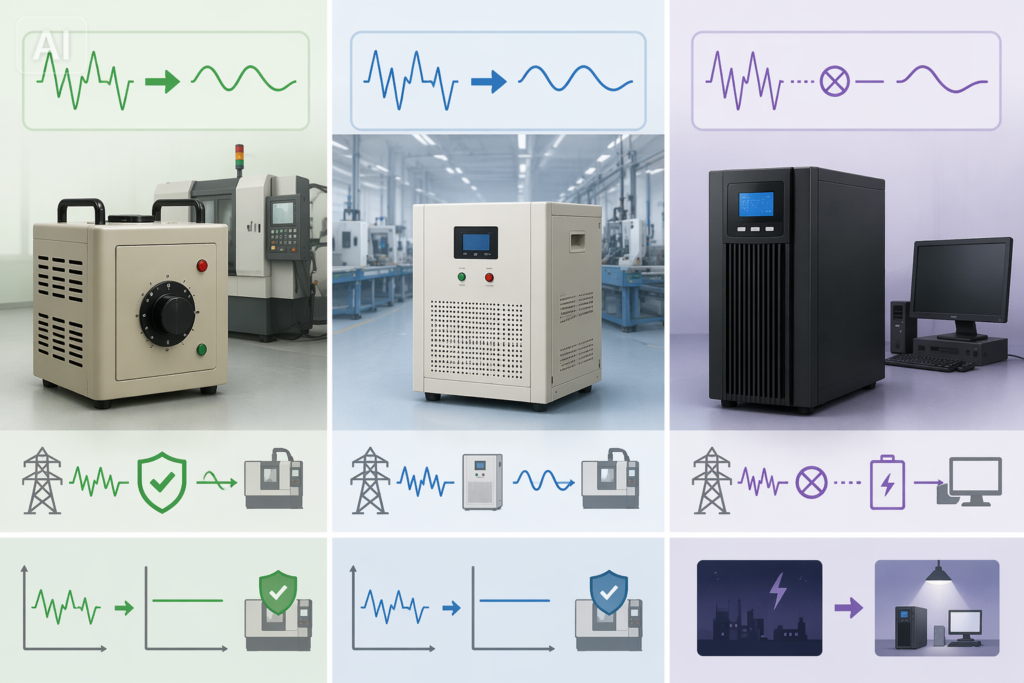
These terms are often confused.
A voltage regulator is the general technical term for equipment that regulates voltage.
A voltage stabilizer is commonly used as a commercial or product term, especially for automatic equipment that keeps output voltage stable.
A UPS provides backup power during a power outage. Some UPS systems also include voltage regulation, but a UPS is mainly used when equipment cannot tolerate power interruption.
For factory production equipment, a voltage regulator or voltage stabilizer is usually considered when the main problem is voltage fluctuation, not power outage.
Do You Really Need a Voltage Regulator?
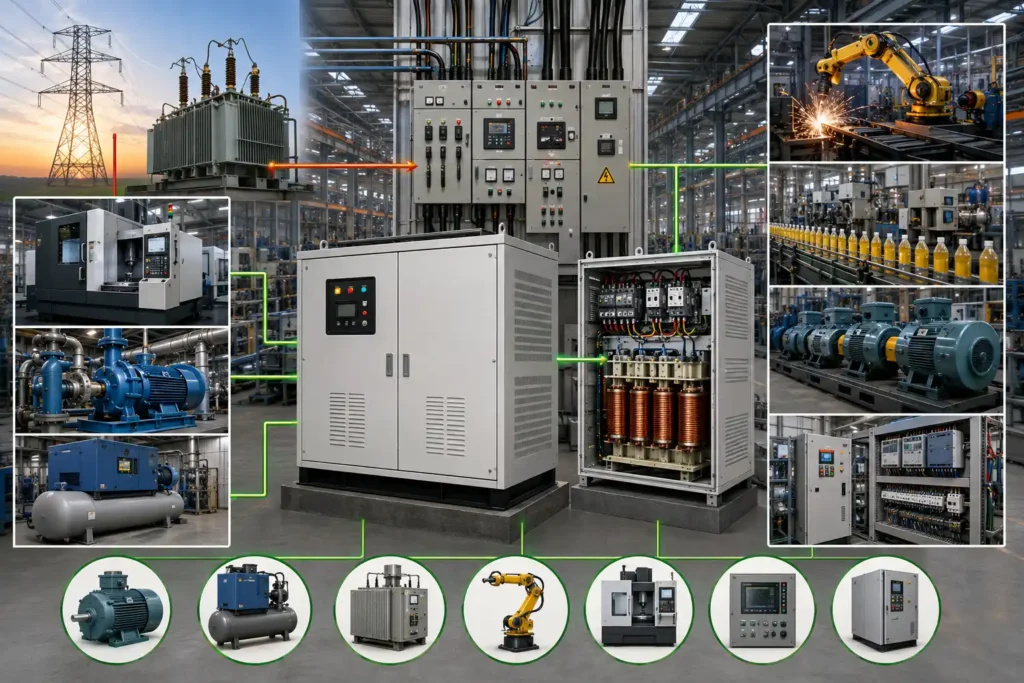
You may need a voltage regulator for your factory power distribution system if:
- Your factory has frequent voltage fluctuation
- Machines trip or reset due to unstable voltage
- Sensitive equipment requires stable power
- Grid voltage is unstable
- Production downtime is linked to voltage problems
- Equipment voltage is often outside the allowed range
You may not need one if the real issue is poor wiring, loose connections, transformer overload, cable voltage drop, harmonics, or incorrect protection settings.
The best approach is to measure first, analyze the root cause, and then choose the correct solution.
Conclusion
A voltage regulator can be an important part of a factory power distribution system. It helps maintain a stable voltage supply and protects industrial electrical equipment from voltage fluctuation.
In many cases, the same equipment may also be called a voltage stabilizer, industrial voltage stabilizer, automatic voltage regulator, or three phase voltage stabilizer.
However, the decision should be based on real site conditions, not assumptions.
If your factory has unstable grid supply, sensitive production equipment, or frequent voltage-related faults, a voltage regulator may improve reliability and reduce downtime.
If the root cause is cable voltage drop, transformer overload, harmonics, poor wiring, or aging switchgear, those problems should be solved directly.
A reliable factory power distribution system is built through proper design, correct equipment selection, and professional manufacturing.
FAQ
Is a voltage stabilizer the same as a voltage regulator?
In many factory applications, the two terms are used almost interchangeably. A voltage regulator is the broader technical term, while voltage stabilizer is commonly used for automatic equipment that keeps voltage stable.
What is a voltage regulator used for in a factory?
It is used to stabilize voltage for industrial equipment, production lines, motors, control systems, CNC machines, and other electrical loads.
Does every factory need a voltage regulator?
No. A factory only needs a voltage regulator if voltage fluctuation affects equipment operation, production reliability, or power quality.
Can a voltage regulator solve cable voltage drop?
It depends. If the voltage drop is caused by unstable supply voltage, a regulator may help. If it is caused by undersized or overly long cables, the cable design should be corrected first.
Is a voltage regulator the same as a UPS?
No. A voltage regulator stabilizes voltage, while a UPS provides backup power during power outages.


