
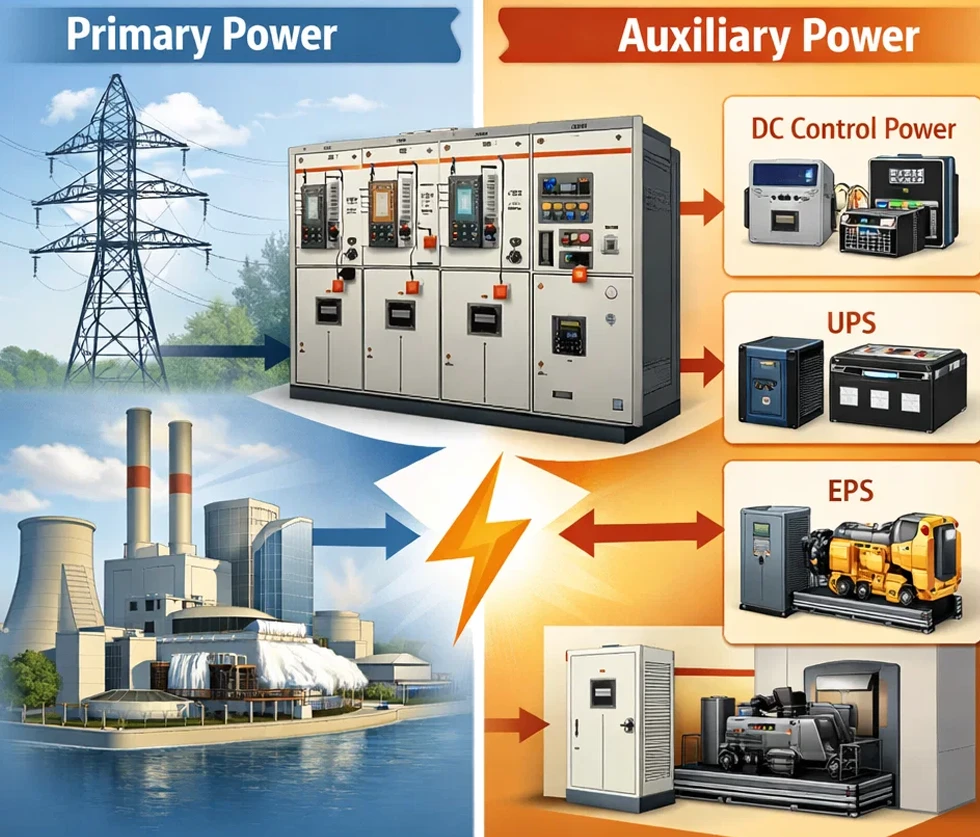
Modern electrical power systems are not just a collection of devices. They are built in functional layers, where each layer has a specific job in energy delivery, control, and safety.
One of the most important distinctions is:
- Primary power: delivers energy to the loads
- Auxiliary power: enables control, protection, continuity, and safety
Understanding this separation is essential for correctly designing, specifying, and operating switchgear-based power systems.
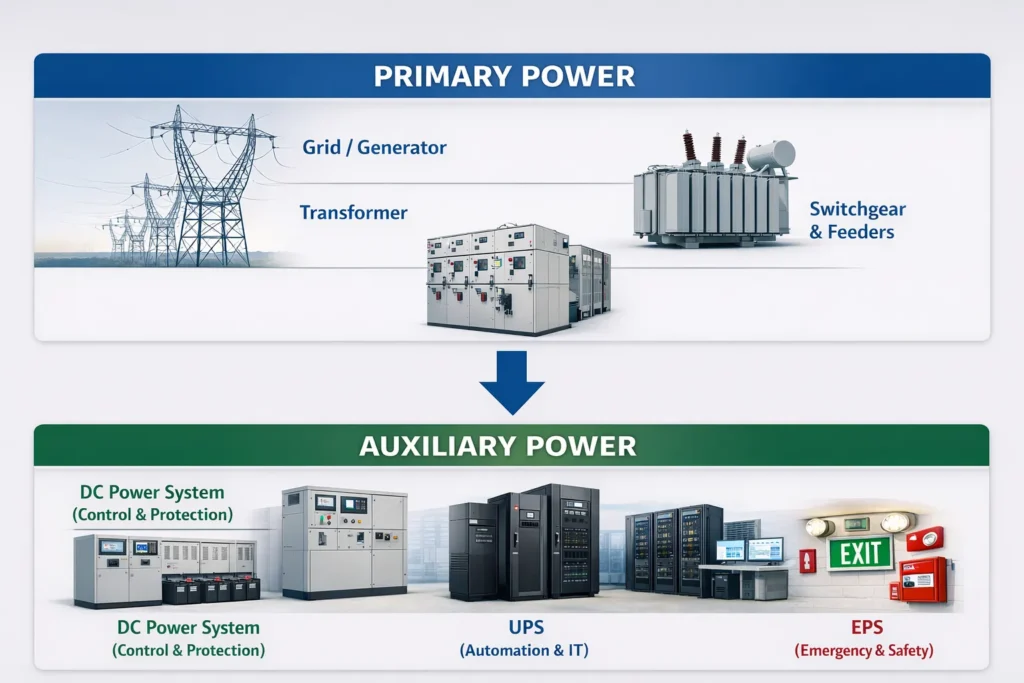
Primary Power vs Auxiliary Power: System Architecture
Think of the system as two layers:
Primary Power (Energy Path)
- Grid / Generator
- Transformer
- Switchgear & Feeders → to loads
Auxiliary Power (Support & Safety Layer)
- DC Power System (control & protection)
- UPS (automation & IT continuity)
- EPS (emergency & life-safety loads)
Key point: Primary and auxiliary power are complementary, not interchangeable.
What Is Primary Power?
Primary power is the part of the system that directly delivers electrical energy to infrastructure and loads during normal operation.
A simple way to define it:
Primary power answers: Where does energy come from, and how does it reach the load?
Typical Primary Power Equipment
- Utility grid or on-site generator
- Transformer (voltage conversion: HV → MV → LV)
- Switchgear and feeders (distribution, isolation, protection)
Role of Key Elements
Transformer
- Converts voltage levels and transfers real power into the downstream network.
Switchgear
- Does not generate energy.
- It switches, isolates, distributes, and protects the energy provided by the source/transformer.
- It is the operational interface between the power source and downstream loads.
Together, transformer + switchgear form the primary power system (the energy delivery path).
What Is Auxiliary Power?
Auxiliary power refers to systems that support the primary power path by enabling the system to operate safely, reliably, and continuously, including during faults and outages.
Auxiliary power answers:
How does the system stay controllable, protective, and safe under normal and abnormal conditions?
Auxiliary power is not “extra.” In many switchgear installations, it is mandatory.
Types of Auxiliary Power Systems
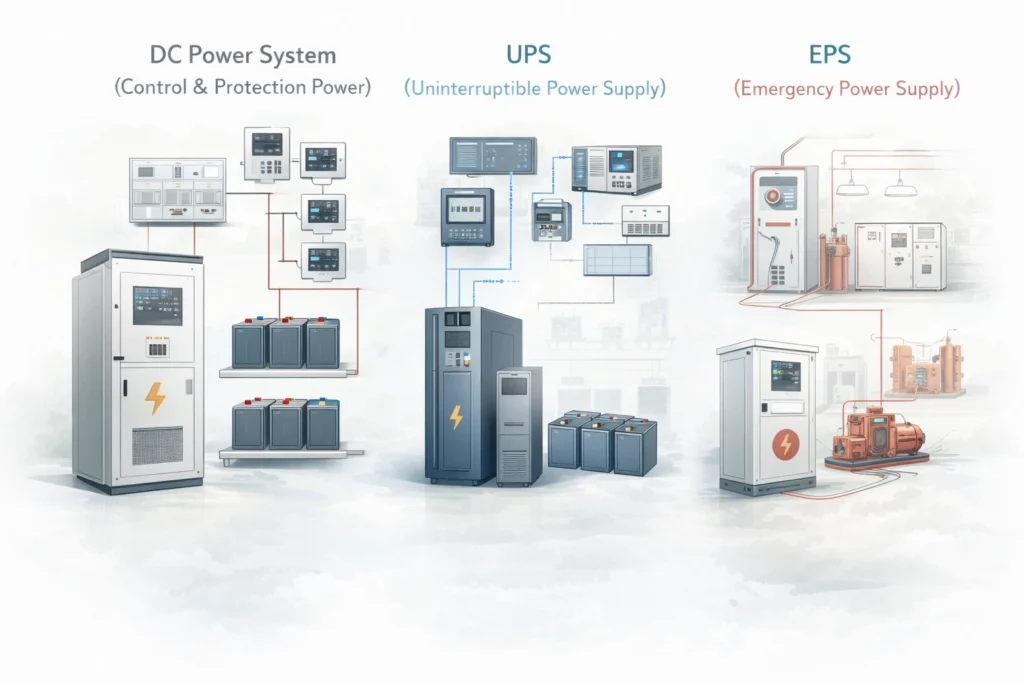
1) DC Power System (Control & Protection Power)
The DC power system supplies stable DC voltage (commonly 110VDC or 220VDC) to critical switchgear functions such as:
- Circuit breaker trip and closing coils
- Protection relays
- Control and interlocking circuits
- Alarm and signaling systems
- SCADA / RTU interfaces (as applicable)
Defining characteristics
- Battery-backed operation
- Independent from AC supply
- Designed for extremely high reliability
Purpose
- Ensures the switchgear can trip and protect the system even during total AC blackout.
Practical example:
If a fault occurs while AC auxiliary supply is lost, the DC battery still allows the protection relay to trip the breaker.
2) UPS (Uninterruptible Power Supply)
A UPS provides continuous, high-quality AC power to sensitive electronics such as:
- SCADA systems
- PLCs and automation controllers
- Communication equipment
- HMI and servers
Defining characteristics
- Zero or near-zero transfer time
- Power quality conditioning
- Short- to medium-duration backup (depending on battery design)
Purpose
- Keeps monitoring, automation, and communication running without interruption (not typically breaker tripping).
3) EPS (Emergency Power Supply)
An EPS provides emergency AC power to life-safety and emergency loads, such as:
- Emergency lighting
- Fire pumps
- Smoke exhaust systems
- Evacuation and critical safety equipment
Defining characteristics
- Transfer/startup delay is allowed (often seconds)
- Longer backup duration (design-dependent)
- Safety and compliance driven
Purpose
- Ensures human safety and regulatory compliance during emergencies.
Quick Comparison: DC System vs UPS vs EPS
| System | Output | Typical Loads | Transfer Time | Main Purpose |
| DC Power System | DC (110/220VDC typical) | Trip/close coils, relays, control circuits | Instant (battery) | Protection + control even in blackout |
| UPS | AC | SCADA, PLC, IT, communications | Zero/near-zero | Continuity for sensitive electronics |
| EPS | AC | Emergency lighting, fire pumps, safety systems | Seconds (allowed) | Life safety + compliance |
Critical Clarification: “Auxiliary” Does Not Mean “Optional”
A common misunderstanding is to treat “auxiliary” as non-essential. In real switchgear systems, that is incorrect.
For medium- and high-voltage switchgear, the DC control & protection supply is often mandatory.
Without auxiliary power:
- Breakers may not trip
- Protection may not operate
- The primary system can become unsafe (faults may persist)
So although auxiliary systems do not serve the main process loads, they can be more critical than those loads because they determine whether the system can protect itself.
Key Takeaway
- Primary power (grid/generator → transformer → switchgear/feeders) delivers energy to loads.
- Auxiliary power (DC system, UPS, EPS) ensures the system remains controllable, protective, continuous, and safe.
If you are designing or specifying switchgear, always define auxiliary power requirements early—especially DC control power and UPS/EPS boundaries.
FAQ
Is auxiliary power the same as emergency power?
No. Auxiliary power includes DC control power and UPS supplies used for control/protection/automation. Emergency power (EPS) is mainly for life-safety loads and usually allows short startup delays.
Does switchgear need a DC power system?
In many MV/HV installations, yes. DC batteries provide the reliability required for breaker tripping and protection operation during AC loss.
What is the difference between UPS and EPS?
UPS provides no-break power to sensitive electronics (SCADA/PLC/IT). EPS provides power to life-safety loads and typically allows seconds of transfer delay.


