

Why We Created the Circuit Breaker Series
Circuit breakers are among the most important devices in electrical power distribution. In the age of AI search, it is easier than ever to ask for the meaning of a single electrical term. But circuit breaker knowledge cannot be fully understood through isolated definitions alone. A real electrical project requires system thinking.
This series begins with practical questions from switchgear quotation and real project applications, then gradually develops toward academic-level understanding. Instead of treating each breaker parameter as an isolated term, we aim to explain circuit breakers as a complete protection system in electrical power distribution.
–Risentric: where the brightness rises
Breaker Specification Importance Guide
When selecting circuit breakers for switchgear quotation, not every parameter affects the quotation in the same way.
Some parameters are related to safety.
Some are related to project approval.
Some mainly affect price, cabinet layout, and delivery time.
The tables below give a practical importance guide for quotation and technical review.
Critical Electrical Parameters
These items directly affect safety, basic compatibility, or project approval.
| Parameter | Importance | Main Risk If Wrong |
|---|---|---|
| Breaking capacity | ★★★★★ | Breaker may not safely interrupt short-circuit current |
| Rated current | ★★★★★ | Breaker may overload, trip incorrectly, or fail to match the load |
| Rated voltage | ★★★★★ | Breaker may not be suitable for the electrical system |
| Pole number | ★★★★★ | Neutral switching or isolation requirement may not be met |
| Standard / certification | ★★★★★ | Project may be rejected during technical review |
| Breaker type | ★★★★★ | MCB, MCCB, and ACB cannot be freely replaced |
Protection and Design Parameters
These items affect protection performance, coordination, and panel design.
| Parameter | Importance | Main Risk If Wrong |
|---|---|---|
| Trip unit type | ★★★★☆ | Protection function may not meet project requirement |
| Icu / Ics value | ★★★★☆ | Short-circuit performance level may be insufficient |
| Load type | ★★★★☆ | Motor, transformer, capacitor, lighting, and socket circuits need different protection logic |
| Selectivity | ★★★★☆ | Upstream breaker may trip unnecessarily and affect more circuits |
| Earth leakage / ground fault protection | ★★★★☆ | Safety or project protection requirement may not be satisfied |
| Frame size | ★★★★☆ | Panel layout, busbar connection, and future expansion may be affected |
Commercial and Installation Parameters
These items may not always change the core protection function, but they strongly affect quotation accuracy, cabinet structure, and delivery.
| Parameter | Importance | Main Risk If Wrong |
|---|---|---|
| Brand | ★★★☆☆ | Price, approval, delivery, and substitution risk may change |
| Accessories | ★★★☆☆ | Quotation may miss important cost items |
| Fixed / plug-in / withdrawable type | ★★★☆☆ | Cabinet structure and maintenance method may change |
| Manual / motorized operation | ★★★☆☆ | Control logic and panel cost may be affected |
| Communication function | ★★☆☆☆ | Smart panel, BMS, or SCADA connection may not work |
| Lead time | ★★☆☆☆ | Delivery schedule may be delayed by special models |
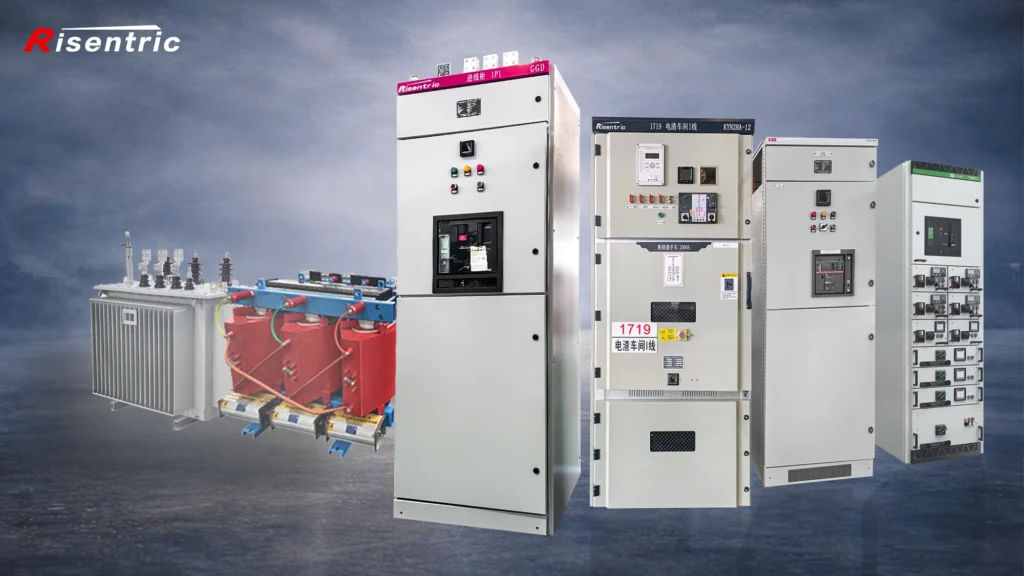
Looking for factory-tested switchgear & Panel boards for your project?
What Information Can Be Read from the SLD
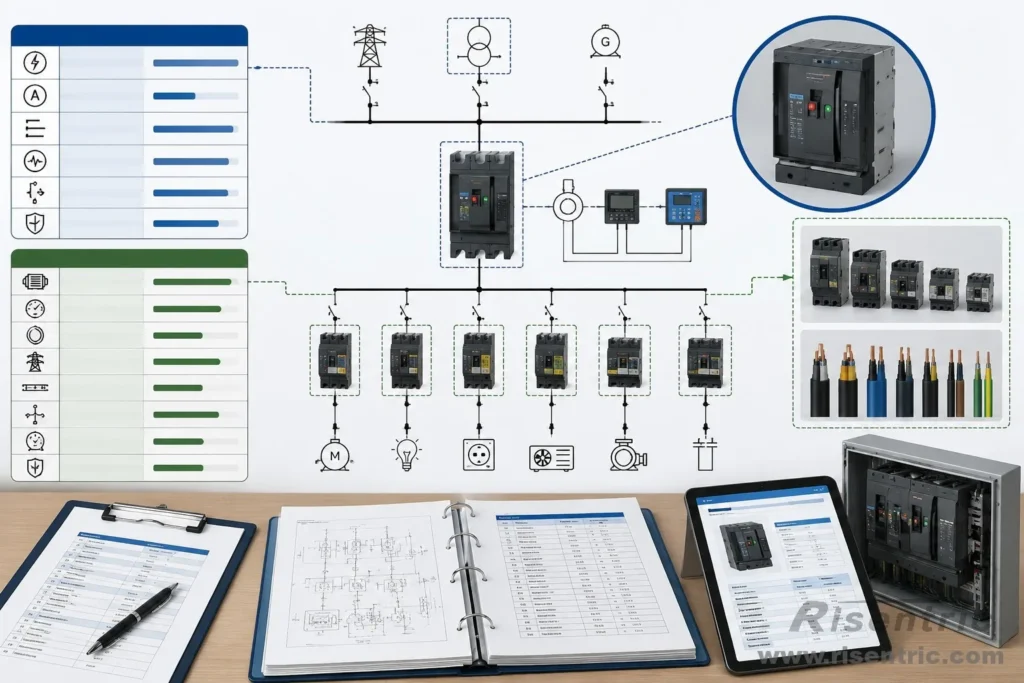
The SLD, or single-line diagram, shows the basic electrical structure of the system.
It is usually the first document used for breaker selection.
From an SLD, you can often read the following information:
Table 1: Direct Breaker Information from the SLD
Use this table first. These items are directly related to breaker model selection.
| Information from SLD | How It Helps Breaker Selection |
|---|---|
| System voltage | Confirms breaker rated voltage |
| Rated current / breaker rating | Helps select the breaker current rating |
| Pole number | Confirms 1P, 2P, 3P, or 4P breaker |
| Short-circuit level | Determines required breaking capacity |
| Breaker type shown on SLD | Confirms whether MCB, MCCB, ACB, RCCB, RCBO, etc. is required |
| Trip unit / protection note | May indicate thermal-magnetic, electronic trip, LSI, LSIG, earth leakage, or relay protection |
Table 2: Supporting Information from the SLD
These are not always breaker model parameters, but they help verify whether the selection is reasonable.
| Information from SLD | How It Helps Quotation Review |
|---|---|
| Load name | Helps judge whether the feeder is for motor, lighting, socket, transformer, capacitor, HVAC, pump, etc. |
| Load power or current | Helps verify whether the breaker rating is reasonable |
| Cable size | Helps check whether the breaker can properly protect the cable |
| Incoming source | Transformer, generator, or grid source may affect short-circuit level and protection coordination |
| Busbar rating | Helps check whether the main breaker and busbar rating are consistent |
| Feeder quantity | Helps count outgoing breakers and panel circuits for quotation |
| Metering symbols | More related to CT, meter, relay, and panel metering design |
| Protection relay symbols | May affect breaker trip method, CT requirement, and protection scheme |
For example, an SLD may show:
ACB 4P 2500A, 65kA, LSIG
From this, you can already identify:
- Breaker type: ACB
- Pole number: 4P
- Rated current: 2500A
- Breaking capacity: 65kA
- Trip unit requirement: LSIG
- Application: probably main incomer or bus coupler
Another SLD may show:
MCCB 3P 250A, 36kA
This gives:
- Breaker type: MCCB
- Pole number: 3P
- Rated current: 250A
- Breaking capacity: 36kA
- Application: likely outgoing feeder
However, the SLD is not always complete. Many SLDs only show the electrical structure and main ratings. They may not fully explain the project standard, brand requirement, trip unit, accessories, or certification requirements.
That is why the technical file must also be checked.
What Information Must Be Confirmed from the Technical File

The SLD usually shows the basic breaker position and rating, but it may not give enough information to select the exact breaker model.
For breaker selection, the technical file is used to confirm the requirements that are not fully shown on the SLD.
For example, the SLD may only show:
MCCB 3P 250A
But the technical file may require:
MCCB shall comply with IEC 60947-2, minimum breaking capacity 50kA, adjustable electronic trip unit, with auxiliary contact and shunt trip.
These two descriptions are not the same for quotation.
The first one only gives basic breaker information.
The second one affects the exact breaker model, quotation price, required accessories, and whether the selection can pass technical approval.
If the required breaker is a special model, high breaking capacity type, electronic trip version, motorized type, or uncommon certified model, it may also affect delivery time.
Basic Breaker Type Selection: MCB, MCCB, ACB
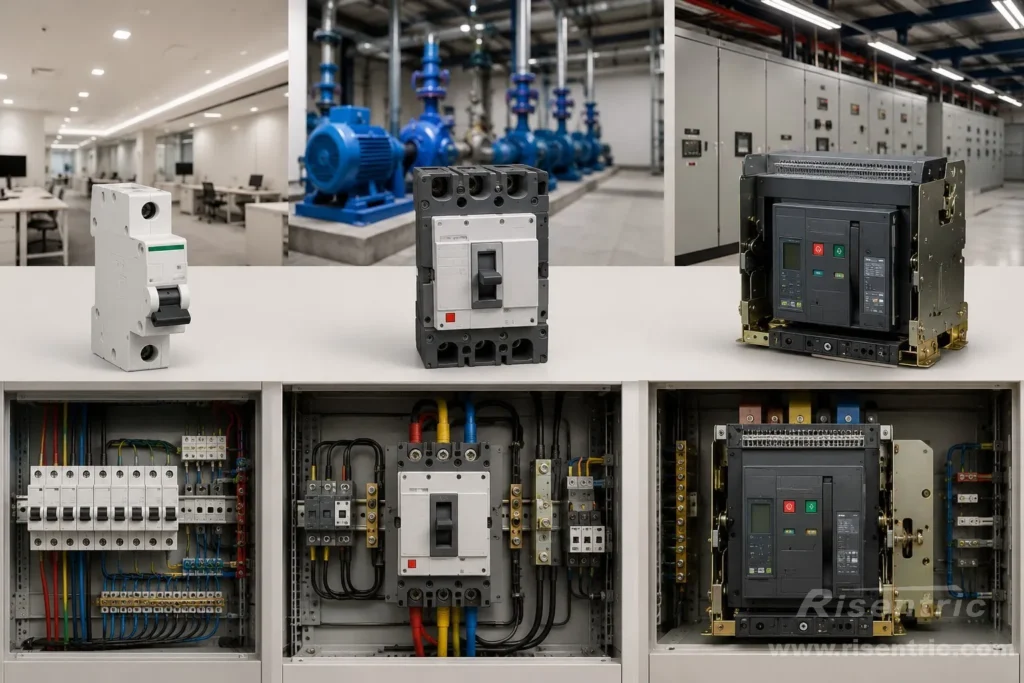
After confirming the key breaker parameters, the next step is to select the correct breaker type.
In low-voltage switchgear quotation, the most common breaker types are MCB, MCCB, and ACB. They are not selected only by current rating. Their application depends on circuit position, load type, breaking capacity, protection function, and panel structure.
MCB: Miniature Circuit Breaker
MCBs are usually used for small final circuits or auxiliary circuits.
Common applications include lighting circuits, socket circuits, small control circuits, auxiliary power inside the panel, and small distribution board outgoing circuits.
MCBs are compact and economical, but they are normally not used as main breakers for large switchgear panels.
Typical examples:
MCB 1P 16A for lighting
MCB 1P 20A for socket circuit
MCB 3P 32A for small three-phase load
MCCB: Molded Case Circuit Breaker
MCCBs are widely used in switchgear quotation because they cover many medium-current feeders.
Common applications include outgoing feeders in LV switchgear, sub-main distribution circuits, motor feeders, HVAC feeders, pump feeders, transformer outgoing feeders, and distribution panels.
Compared with MCBs, MCCBs usually offer higher current ratings, higher breaking capacity options, and more accessory choices.
Typical examples:
MCCB 3P 250A, 36kA
MCCB 4P 400A, 50kA, electronic trip
ACB: Air Circuit Breaker
ACBs are usually used for high-current main circuits.
Common applications include main incomers, bus couplers, main outgoing feeders, generator incomers, and large LV switchgear sections.
ACBs are often selected when the project requires high current, high breaking capacity, adjustable protection, withdrawable structure, or better selectivity coordination.
Typical examples:
ACB 4P 1600A, 65kA, LSIG
ACB 4P 3200A, 100kA, withdrawable type
Simple Type Selection Guide
| Application Position | Common Breaker Type | Notes |
|---|---|---|
| Lighting / socket final circuit | MCB / RCBO | Often used in distribution boards or final circuits |
| Small outgoing feeder | MCB or MCCB | Depends on current, breaking capacity, and project requirement |
| Medium outgoing feeder | MCCB | Common choice for LV switchgear outgoing circuits |
| Large outgoing feeder | MCCB or ACB | Depends on current, protection function, and panel design |
| Main incomer | ACB or large MCCB | ACB is common for high-current main switchgear |
| Bus coupler | ACB | Often requires interlocking and adjustable protection |
| Critical power system | ACB / MCCB with proper coordination | Selectivity and trip unit settings become important |
This table is only a practical guide. The final breaker type should always follow the SLD, technical file, and project approval requirements.
What to Check When Changing from One Brand to Another
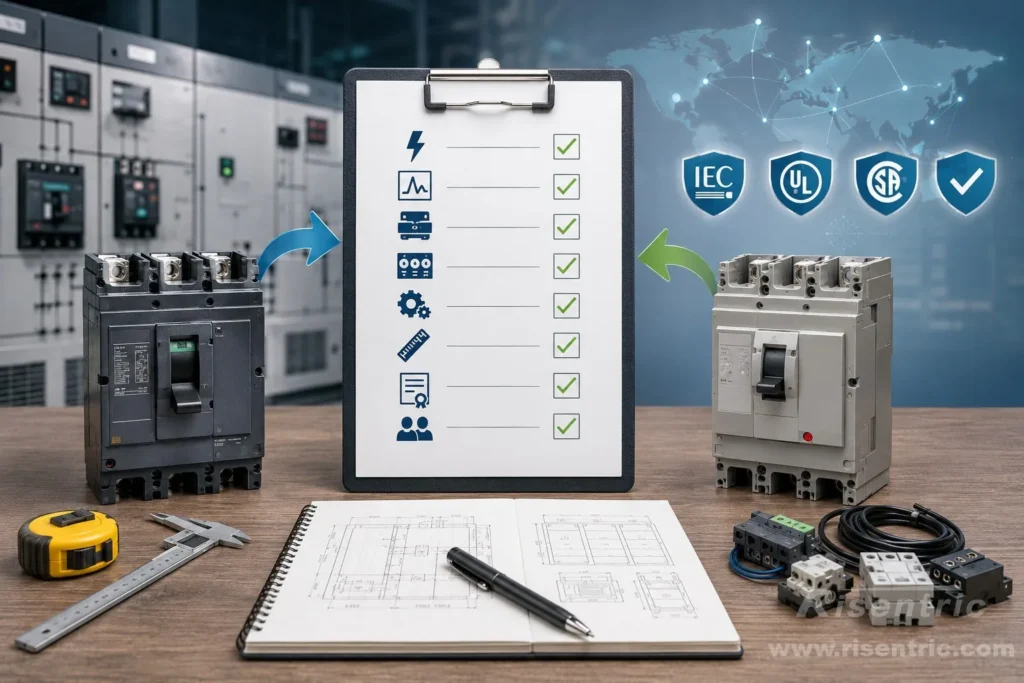
Brand substitution is common in switchgear quotation.
For example, the technical file may specify Schneider, ABB, Siemens, Eaton, LS, Chint, or another approved brand. Sometimes the customer allows alternative brands. Sometimes the brand is fixed and cannot be changed.
However, changing from one brand to another is not simply replacing the brand name.
A breaker can have the same current rating but different breaking capacity, trip unit, accessories, dimensions, certificates, and installation structure.
For example:
Schneider MCCB 3P 250A
cannot be safely replaced only by:
Any MCCB 3P 250A
Before offering an alternative brand, the new breaker should be checked against the original requirement.
Brand Substitution Checklist
| Item to Check | Why It Matters |
|---|---|
| Rated current and voltage | The alternative breaker must match the required electrical system |
| Breaking capacity and Icu / Ics | The alternative should meet the required short-circuit performance |
| Pole number | 3P, 4P, and switched neutral requirements cannot be changed casually |
| Trip unit type | Thermal-magnetic, electronic, LSI, and LSIG are not equivalent |
| Accessories | Shunt trip, UVT, auxiliary contact, alarm contact, and motor mechanism must be matched if required |
| Installation type and dimensions | Different brands may need different mounting space and busbar arrangement |
| Certification | The alternative brand must meet the required IEC, UL, CSA, or local certification |
| Approved vendor list | The alternative brand must be acceptable to the client or consultant |
Can We Select a Higher Specification?
In some cases, selecting a higher specification is acceptable. But “higher” does not mean every parameter can be changed freely.
For example, if the original requirement is:
MCCB 3P 250A, 36kA, IEC 60947-2
Then an alternative breaker such as:
MCCB 3P 250A, 50kA, IEC 60947-2
is usually acceptable from the breaking-capacity point of view, because the kA rating is higher.
However, the other key parameters still need to match, including rated voltage, pole number, trip unit type, installation type, accessories, standard, and brand approval.
A higher breaking capacity is usually easier to accept. But a higher rated current is not automatically acceptable.
For example:
MCCB 3P 250A, 36kA
should not be casually replaced by:
MCCB 3P 400A, 50kA
Even though the breaking capacity is higher, the rated current has changed from 250A to 400A. This may affect cable protection, load protection, and the original design logic.
Can We Select a Lower Specification?
Selecting a lower specification is much riskier.
In most switchgear quotations, a lower specification should not be offered as an equivalent replacement unless the client, consultant, or designer gives confirmation.
For example, if the original requirement is:
MCCB 3P 250A, 50kA, IEC 60947-2
Then changing it to:
MCCB 3P 250A, 36kA, IEC 60947-2
is usually not acceptable, because the breaking capacity is lower.
Even though the current rating is still 250A, the breaker may no longer meet the short-circuit requirement.
The same logic applies to trip units and accessories. If the original requirement is electronic trip with LSIG protection, a thermal-magnetic breaker should not be treated as an equivalent replacement. If the original requirement includes shunt trip, auxiliary contact, or motorized operation, these accessories should not be removed without confirmation.
Practical Rule for Brand Substitution
A useful rule is:
Upgrading breaking capacity may be acceptable after checking compatibility. Downgrading breaking capacity, trip unit, pole number, accessories, certification, or approved brand should be treated as a deviation.
For quotation, do not present a lower specification as a direct equivalent.
A safe quotation note is:
Alternative brand is offered based on equivalent main electrical parameters. Any deviation from the specified breaker rating, breaking capacity, trip unit, pole number, accessories, certification, or brand requirement shall be subject to client or consultant approval.
Looking for factory-tested switchgear & Panel boards for your project?
Conclusion
Circuit breaker selection from SLD and technical files is not only a product naming task. It is a technical review process for switchgear quotation.
The SLD helps identify the breaker position, current rating, pole number, circuit type, and sometimes the breaking capacity or trip unit. The technical file confirms the project rules, such as breaker standard, approved brand, Icu/Ics requirement, accessories, certification documents, and coordination requirements.
For a reliable quotation, do not select the breaker only by current rating. Confirm the critical breaker parameters first, then check protection functions, accessories, brand approval, and installation requirements.
A good working rule is:
Use the SLD to understand the circuit. Use the technical file to confirm the breaker requirement. Use quotation notes to state assumptions when information is incomplete.
This helps reduce technical rejection, underpricing, redesign, and misunderstanding after order confirmation.
FAQ
Q1: Can I select a breaker only from the SLD?
Usually, no.
The SLD gives the basic electrical structure and may show breaker type, current, pole number, and breaking capacity. But it may not show all requirements, such as approved brand, trip unit, accessories, certification, Icu/Ics requirement, or selectivity requirement.
The technical file should always be checked before final breaker selection.
Q2: Is rated current the most important breaker parameter?
Rated current is important, but it is not enough.
For quotation and technical approval, breaking capacity, rated voltage, pole number, breaker type, standard, and trip unit can be equally important.
A breaker with the correct current rating but wrong breaking capacity may still be rejected or unsafe.
Q3: Why can two 250A MCCBs have very different prices?
Because “250A” only describes the rated current.
The price may change because of breaking capacity, frame size, trip unit type, brand, accessories, certification, installation type, and operation method.
So “MCCB 3P 250A” is not a complete quotation description.
Q4: Why is breaking capacity important?
Breaking capacity shows whether the breaker can safely interrupt the short-circuit current at its installation point.
For quotation, the key point is not only to choose the correct current rating, but also to confirm the required kA rating from the SLD, technical file, or short-circuit calculation.
For example, a 250A breaker with 25kA breaking capacity is not the same as a 250A breaker with 50kA or 65kA breaking capacity.
A deeper explanation of Icu, Ics, Icn, and short-circuit current can be covered in Part II of this Circuit Breaker Series.
Q5: Can I replace a 4P breaker with a 3P breaker?
Not without confirmation.
A 4P breaker may be required for neutral switching, isolation, earthing system requirements, or project design rules. If the SLD or technical file requires 4P, replacing it with 3P may cause technical rejection.
Q6: Can I replace an ACB with an MCCB?
Sometimes it may be possible, but it should not be done only for cost reduction.
ACBs are often used for main incomers, bus couplers, high-current circuits, withdrawable operation, and selectivity coordination. Replacing an ACB with an MCCB may affect protection design, maintenance method, cabinet structure, and approval result.
Always confirm with the client or consultant before changing breaker type.
Q7: What is the difference between Icu and Ics?
Icu is the ultimate short-circuit breaking capacity.
Ics is the service short-circuit breaking capacity.
In simple terms, Icu shows the maximum short-circuit current the breaker can interrupt under specified test conditions. Ics is related to the breaker’s service performance after interrupting a short circuit.
If the technical file gives both Icu and Ics requirements, both should be checked.
Q8: What should I do if the BOQ only says “MCCB 250A”?
You can prepare a preliminary quotation, but you should clearly state your assumptions.
You should ask for or confirm the pole number, breaking capacity, voltage, trip unit type, brand requirement, standard or certification, accessories, load type, SLD, and technical specification.
A safe quotation note is:
Breaker selection is quoted based on currently available information. Final model shall be confirmed according to approved SLD, technical specification, and project requirements.
Q9: Is brand substitution acceptable?
It depends on the project.
If the technical file has an approved brand list, the offered brand should be on that list. If alternative brands are allowed, the replacement breaker should match the main electrical parameters, protection functions, accessories, certification, and installation requirements.
Brand substitution should be clearly stated in the quotation.
Q10: What is the biggest mistake in breaker selection for quotation?
The biggest mistake is selecting the breaker only by current rating.
For example:
MCCB 3P 250A
This is not enough.
A complete breaker selection should also check breaking capacity, trip unit, voltage, pole number, standard, accessories, brand, load type, and technical-file requirements.


