
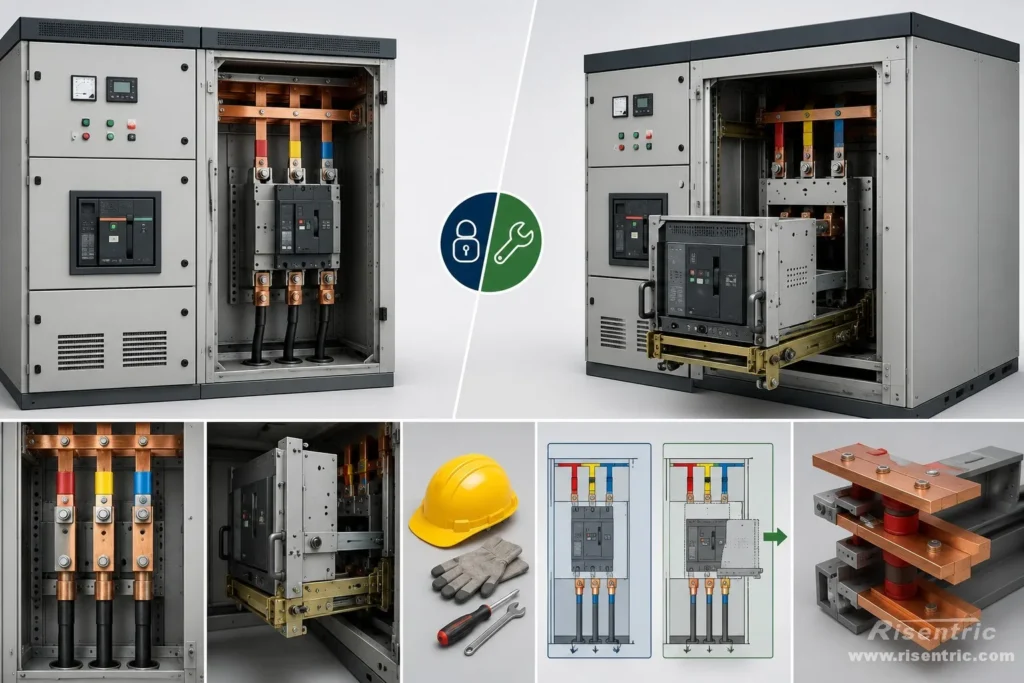
Switchgear can be designed in different ways. One common difference is whether the main switching device is fixed or withdrawable.
At first, this sounds like a simple mechanical difference. A fixed breaker stays inside the cabinet. A withdrawable breaker or drawer can be moved out.
But in real switchgear design, this difference affects much more than movement. It affects cabinet size, busbar arrangement, cable connection, maintenance method, isolation, safety interlocks, and project cost.
This article explains the difference between fixed and withdrawable switchgear from a practical design point of view.
Fixed vs Withdrawable Switchgear: Simple Summary
| Item | Fixed Type | Withdrawable Type |
|---|---|---|
| Main idea | Device is fixed inside the cabinet | Device can be moved or withdrawn |
| Space | More compact | Larger |
| Cost | Lower | Higher |
| Maintenance | Less convenient | More convenient |
| Replacement | Slower | Faster |
| Busbar connection | Bolted / fixed | Plug-in / moving contacts |
| Mechanical parts | Fewer | More |
| Retrofit projects | Often easier | More site constraints |
| Best for | Cost, compactness, simple structure | Maintenance, testing, fast replacement |
What Is Fixed Switchgear?
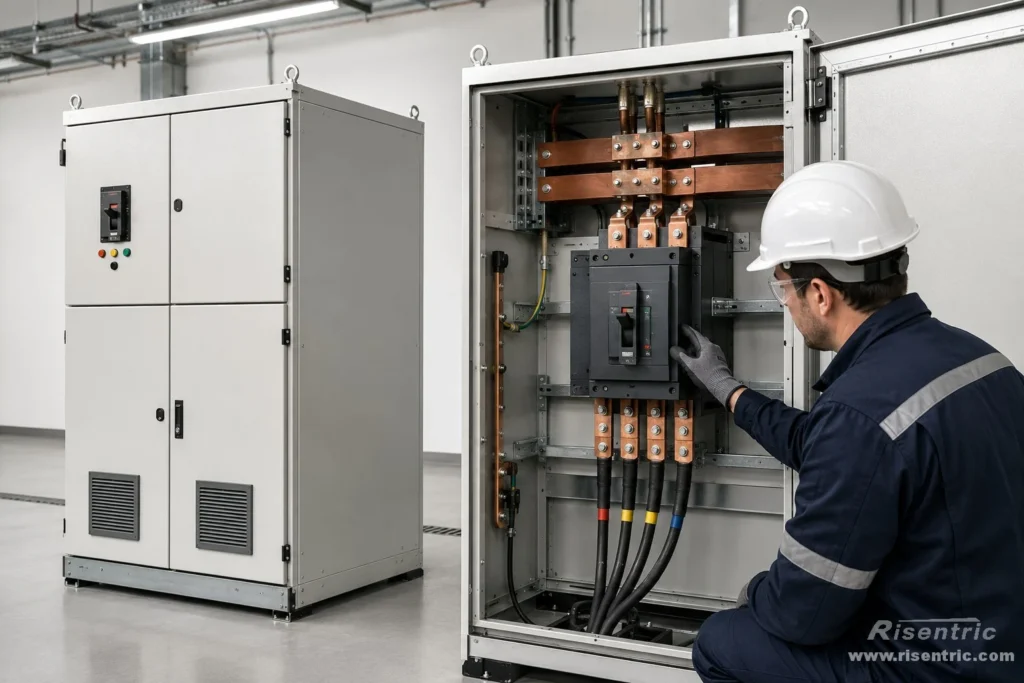
Fixed switchgear means the main switching device is installed in a fixed position inside the panel.
For example, the circuit breaker, switch-disconnector, contactor, or VFD is mounted directly inside the cabinet. The power connection is usually made by bolted busbar, cable, or fixed terminals.
In a fixed design, the device does not move between service, test, and isolated positions. If maintenance is required, the circuit usually needs to be safely isolated first, and then the device can be inspected, repaired, or replaced.
Fixed switchgear is common in both low-voltage and medium-voltage applications.
Typical advantages include:
- simpler structure
- lower cost
- more compact cabinet size
- easier customized arrangement
However, maintenance and replacement may take more time because the device is fixed inside the cabinet.
What Is Withdrawable Switchgear?
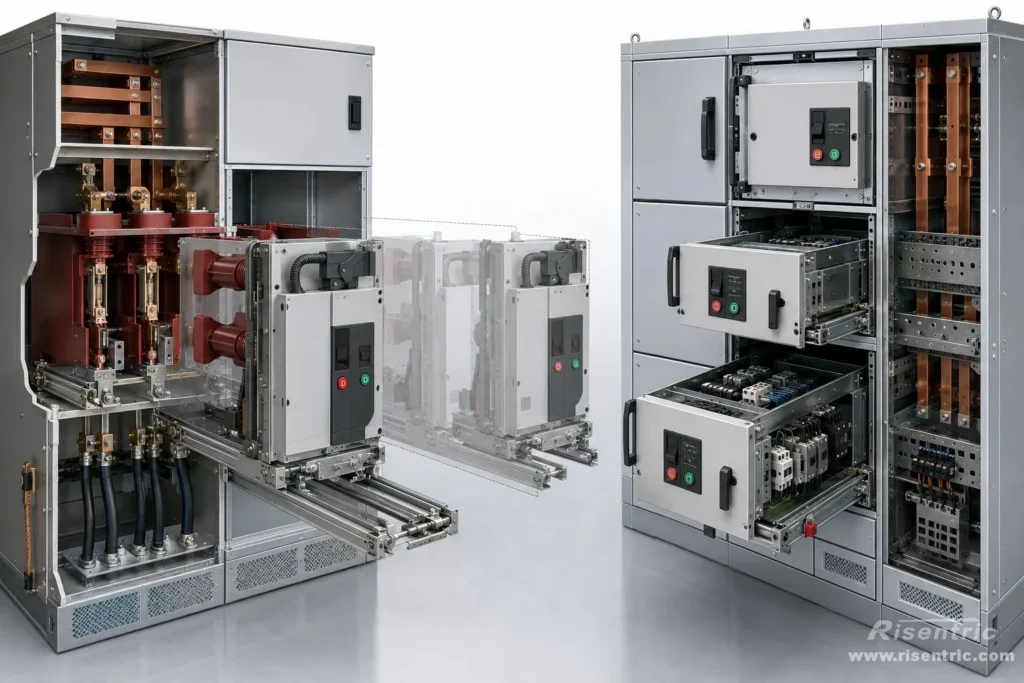
Withdrawable switchgear uses a movable breaker truck, drawer, or functional unit.
In medium-voltage switchgear, the vacuum circuit breaker may be installed on a withdrawable truck. The breaker can usually move between positions such as:
- service position
- test position
- isolated / disconnected position
Concept of “Unit” in Withdrawable Switchgear
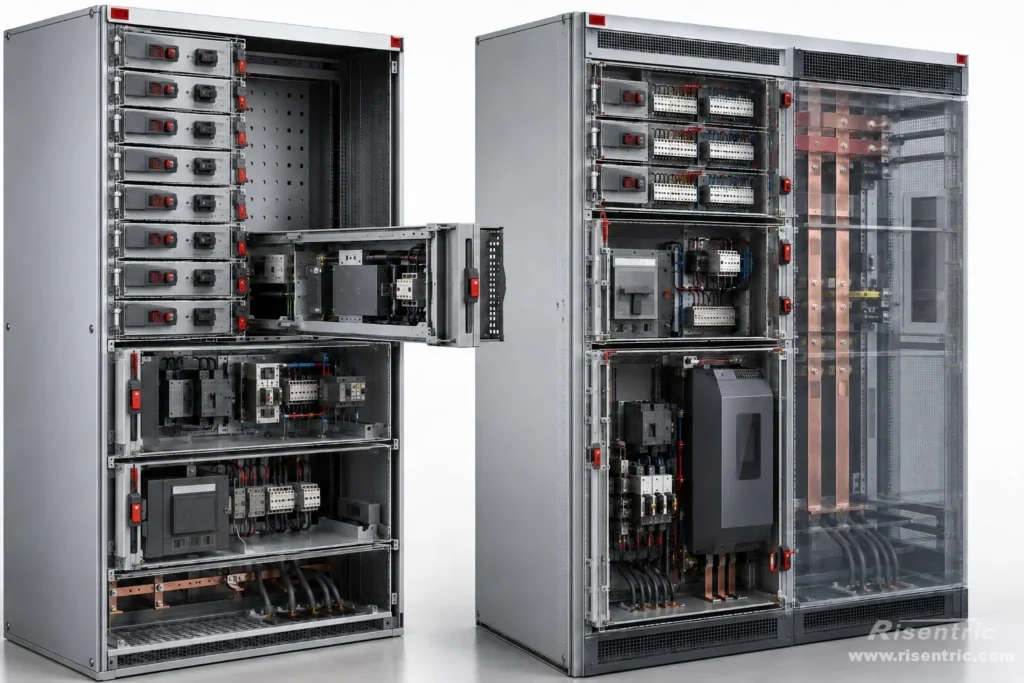
In low-voltage withdrawable switchgear or MCC panels, each drawer is not designed randomly. The cabinet is usually divided by a modular height system.
This modular space may be called a unit, module, drawer size, or compartment size, depending on the manufacturer.
For example, a small motor feeder may only need a small drawer. A larger motor starter, feeder breaker, soft starter, or VFD circuit may need a taller drawer.
The drawer size depends on the components inside, such as:
- MCCB or fuse switch
- contactor
- overload relay
- control transformer
- auxiliary relays
- terminals
- control wiring
- cable connection space
- heat dissipation requirement
This is why a withdrawable MCC often looks like a stack of drawers. Each drawer is one functional unit.
Several small feeders can be installed in one vertical section. Larger feeders may occupy more units or even require a separate full-height compartment.
The modular unit concept makes design, manufacturing, maintenance, and replacement easier. But it also creates a space cost. The cabinet must reserve enough room for drawer movement, plug-in contacts, guide rails, interlocks, terminals, and cable connection.
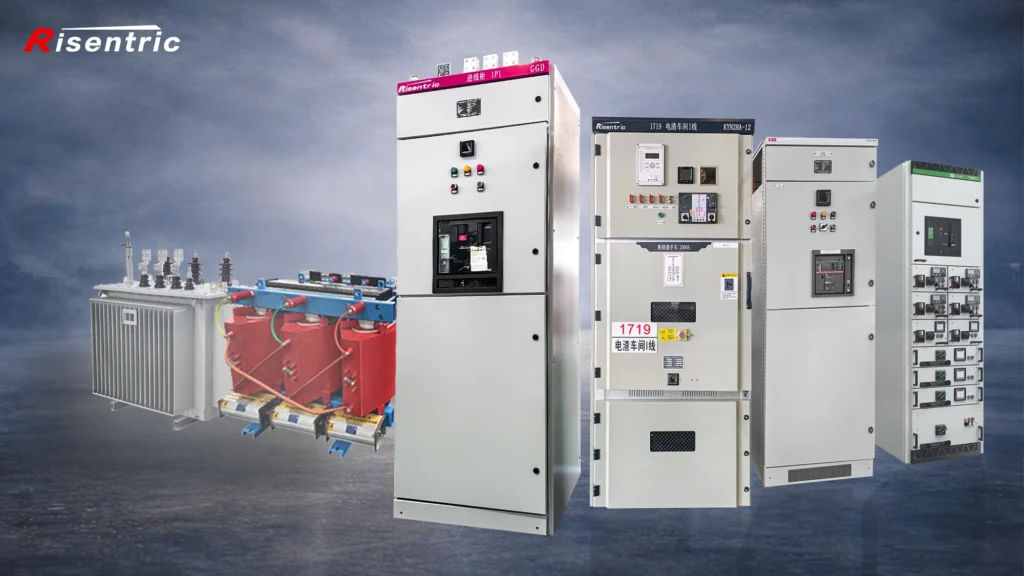
Looking for factory-tested 3-Phase switchgear & Panel boards for your project?
Busbar Arrangement: Fixed vs Withdrawable Switchgear
The biggest difference between fixed and withdrawable switchgear is not only where the busbar is placed.
The real difference is how the busbar connects to the switching device.
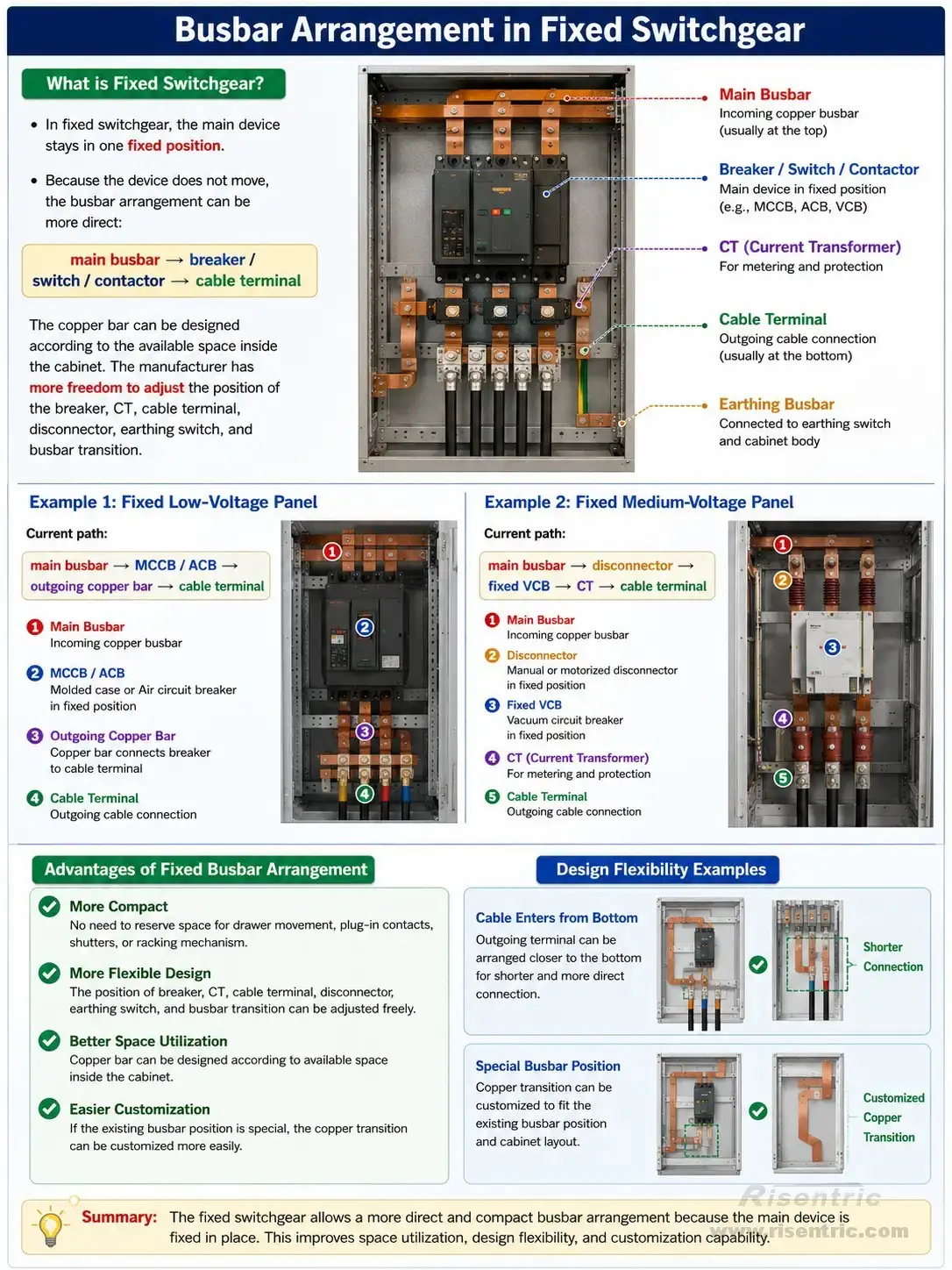
In fixed switchgear, the busbar can be directly connected to the breaker, disconnector, contactor, or outgoing terminals by copper bars, cables, or bolted connections.
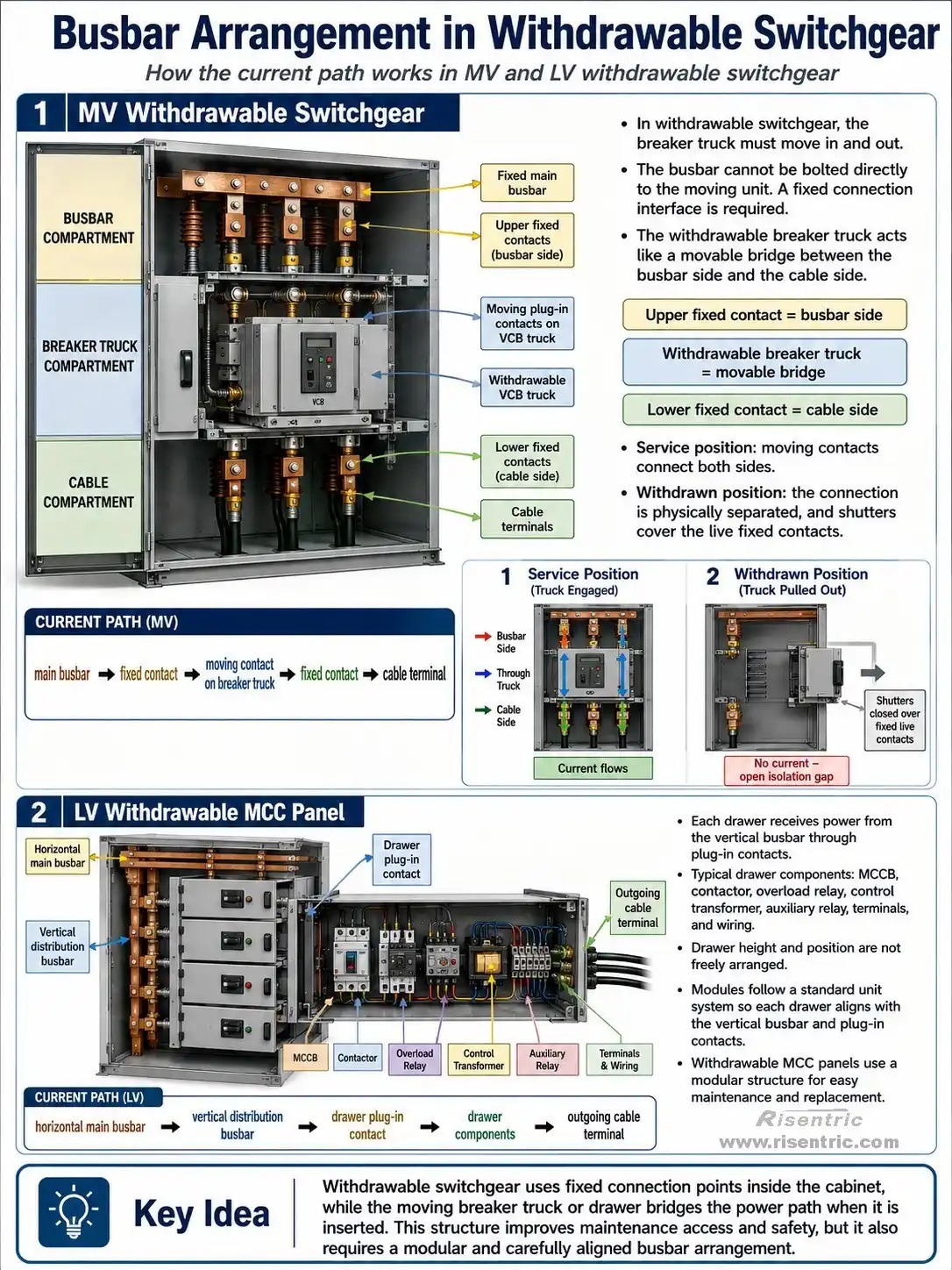
In withdrawable switchgear, the busbar cannot be directly bolted to the drawer or breaker truck, because the drawer or breaker must be able to move. Therefore, the busbar must connect to fixed contacts inside the cabinet, and the movable unit plugs into these fixed contacts.
This makes the whole arrangement different.
This is why fixed switchgear is often easier to adapt in retrofit projects.
Why Withdrawable Busbar Arrangement Takes More Space
Withdrawable switchgear needs more space because the busbar arrangement must support movement and safe isolation.
It needs space for:
- fixed contacts
- moving plug-in contacts
- shutters
- guide rails
- drawer or breaker truck movement
- service / test / isolated positions
- secondary plug
- mechanical interlocks
- separated cable compartment
- cable bending and termination space
In fixed switchgear, the busbar can go directly to the device.
In withdrawable switchgear, the busbar must stop at a fixed contact system, wait for the movable unit to plug in, and then transfer power to the cable side.
That extra interface is the reason the structure becomes larger and less flexible.
Simple Summary
Fixed switchgear has a more direct current path:
busbar → fixed device → cable
Withdrawable switchgear has an extra plug-in interface:
busbar → fixed contact → movable unit → fixed contact → cable
This is the real busbar arrangement difference.
Fixed switchgear gives more freedom to arrange copper bars, terminals, and cable entry.
Withdrawable switchgear gives better maintenance convenience, but the busbar, contacts, drawer position, and cable compartment must follow a stricter structure.
Maintenance and Retrofit Considerations
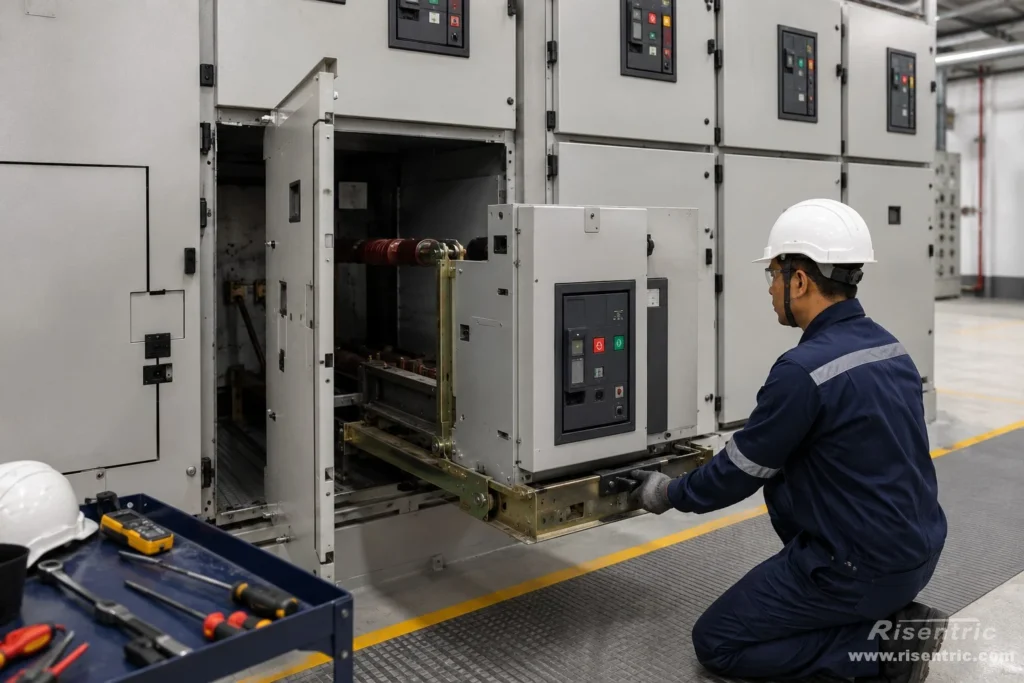
One important reason for the existence of withdrawable switchgear is easier maintenance.
In normal operation, a withdrawable breaker, drawer, or functional unit can be moved to a test or isolated position. In some designs, the unit can also be removed and replaced with a spare unit.
This is useful when:
- downtime must be reduced
- feeder replacement must be fast
- regular testing is required
For example, in an LV MCC, a motor starter drawer can be withdrawn for inspection or replacement. In MV metal-clad switchgear, a withdrawable VCB truck can be racked out to create isolation and allow testing.
So for maintenance, withdrawable switchgear has a clear advantage.
However, maintenance does not solve every problem.
Retrofit project
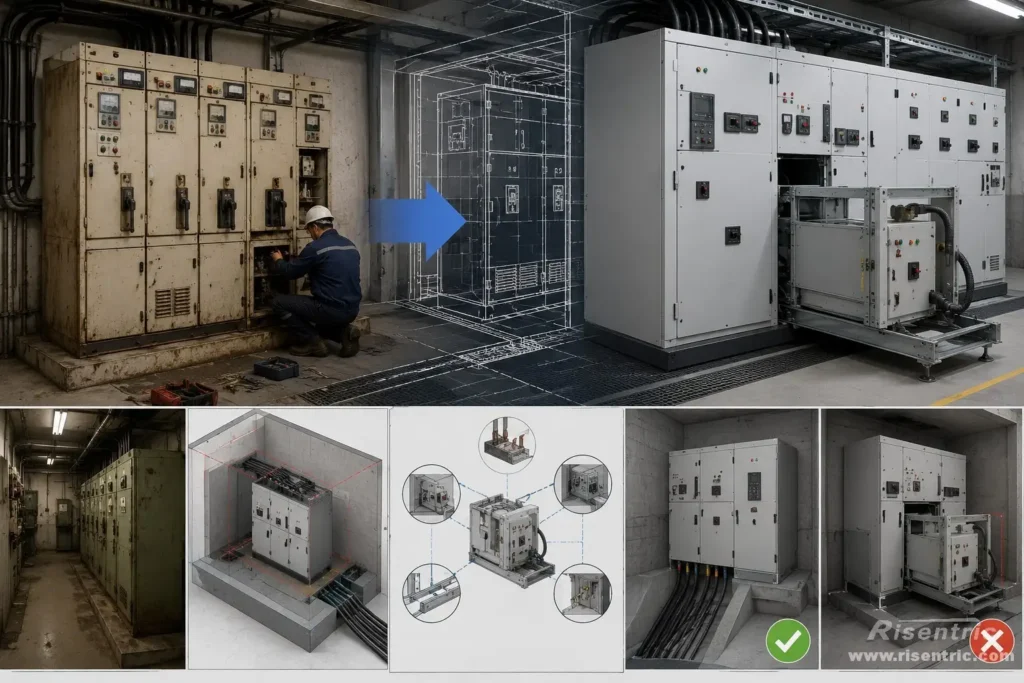
Sometimes the project demand changes. For example, the user may need to add more feeders, increase the current rating, change the outgoing cable direction, replace old equipment, or connect the new panel with an existing switchboard. In this case, the work is no longer simple maintenance. It becomes a retrofit project.
For retrofit projects, the situation can be different.
A retrofit project must fit the existing switchroom, cable trench, foundation, cable route, and available maintenance space. These site conditions are often already fixed.
Withdrawable switchgear has stricter structure requirements. It may need more cabinet depth, more front clearance, more rear access, and a more fixed cable connection arrangement. The drawer or breaker truck must align correctly with the busbar contacts, secondary plugs, shutters, guide rails, and interlocks.
Fixed switchgear may be easier to adapt because the internal arrangement is more flexible. The manufacturer may have more freedom to adjust the breaker position, busbar transition, terminal location, and cable entry.
Conclusion
Fixed switchgear has a simpler structure, more compact size, lower cost, and more flexible internal arrangement. It is often suitable for projects where space, cost, and retrofit conditions are important.
Withdrawable switchgear is better for maintenance, testing, and fast replacement. But it needs more cabinet space because each functional unit must be movable, guided, interlocked, connected, disconnected, and safely isolated.
The best choice depends on the voltage level, maintenance requirement, available space, cable arrangement, project budget, and site conditions.
Looking for factory-tested 3-Phase switchgear & Panel boards for your project?
FAQ
Is withdrawable switchgear better than fixed switchgear?
Not always. Withdrawable switchgear is better for maintenance, testing, and fast replacement of functional units. Fixed switchgear is usually better for compact size, lower cost, simpler structure, and retrofit flexibility.
Why does withdrawable switchgear take more space?
Withdrawable switchgear needs extra space for drawer or breaker truck movement, plug-in contacts, guide rails, shutters, interlocks, secondary plugs, and cable compartments. Fixed switchgear can connect the busbar directly to the device, so the structure is usually more compact.
Is fixed switchgear outdated?
No. Fixed switchgear is still widely used in both low-voltage and medium-voltage systems. It is often a practical choice when the project needs simple structure, lower cost, compact size, or easier adaptation to an existing site.
Why is withdrawable switchgear easier to maintain?
The breaker, drawer, or functional unit can be moved to a test or isolated position. In some designs, it can also be removed and replaced with a spare unit. This can reduce downtime and make inspection or replacement easier.
Which type is better for retrofit projects?
Fixed switchgear is often easier for retrofit projects because the internal arrangement is more flexible. Withdrawable switchgear can be more difficult to apply when the existing switchroom, cable trench, cable length, foundation, or busbar position cannot be changed.


