
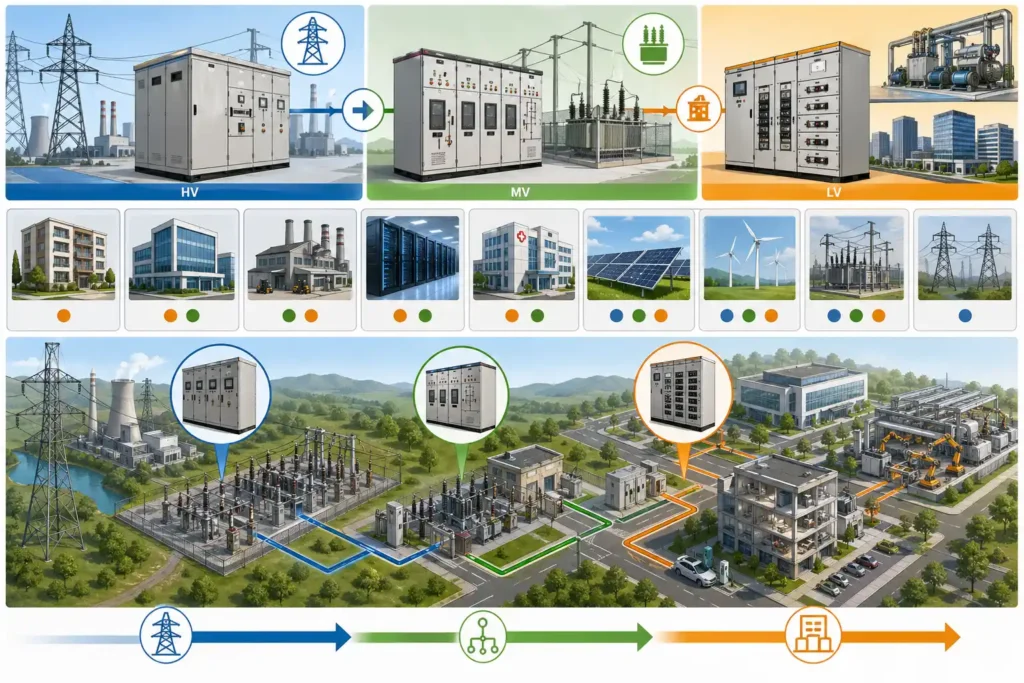
Switchgear can be classified in many ways, but one of the most important starting points is the voltage level of the power system.
In practical electrical projects, switchgear is often grouped into three broad categories:
- LV switchgear: low-voltage switchgear
- MV switchgear: medium-voltage switchgear
- HV switchgear: high-voltage switchgear
The purpose of this article is not to introduce every product type or every switchgear model. Instead, it gives a practical application map: where LV, MV and HV switchgear are usually used in real projects.
A simple rule is:
LV switchgear is usually close to the load. MV switchgear distributes power across sites or networks. HV switchgear is used at transmission and grid level.
Quick Comparison: LV vs MV vs HV Switchgear
| Type | Typical system position | Typical applications | Simple explanation |
|---|---|---|---|
| LV switchgear | Load-side distribution | Buildings, factories, MCC panels, MDBs, ATS panels, distribution boards | Usually distributes power to final loads |
| MV switchgear | Primary distribution / site distribution | Industrial substations, commercial complexes, data centers, renewable energy plants | Usually receives and distributes power across a site |
| HV switchgear | Transmission / grid-level switching | Utility substations, power plants, transmission systems, grid interconnection | Usually controls large power flow at high voltage |
Note: Voltage-class terms can vary by region and standard system. In many IEC-based projects, low voltage is commonly associated with systems up to 1,000 V AC, while switchgear above 1,000 V is often discussed under the IEC 62271 series. In practical project communication, MV usually refers to distribution-level systems, while HV is more commonly associated with transmission, grid substations, and large interconnection systems.
This article focuses on the application difference, not on selling a specific product series. For project-based product selection, you can later refer to dedicated pages for low-voltage switchgear, medium-voltage switchgear, or the full switchgear category page.
LV Switchgear Applications
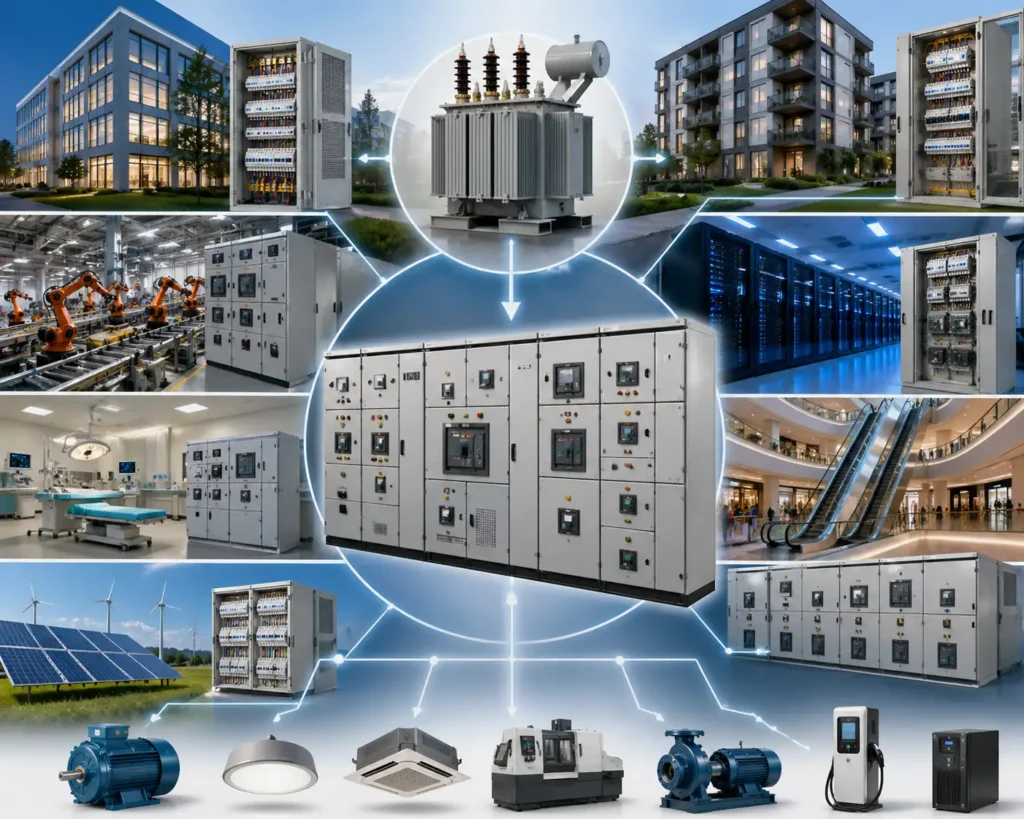
LV switchgear is usually used on the low-voltage side of the distribution system, commonly close to final electrical loads.
In many IEC-oriented projects, low voltage is commonly understood as systems up to 1,000 V AC. In real projects, LV switchgear is often found after the transformer secondary side. It distributes power to motors, lighting systems, HVAC equipment, production machines, pumps, chargers, UPS systems, and other electrical loads.
Common LV Switchgear Applications
| Application area | Typical LV switchgear role |
|---|---|
| Commercial buildings | Main distribution boards, floor distribution, lighting and HVAC distribution |
| Residential buildings | Main low-voltage distribution and branch distribution |
| Factories | Motor control centers, production line distribution, machine power supply |
| Data centers | UPS output distribution, ATS panels, low-voltage critical load distribution |
| Hospitals | Essential power distribution, backup power transfer, medical building loads |
| Shopping malls | Tenant distribution, lighting, HVAC, escalators, and general services |
| Renewable energy projects | Auxiliary power, inverter-side distribution, local low-voltage loads |
Practical Meaning
LV switchgear is usually the most visible and repeated switchgear type in many buildings and factories.
A project may only have a few MV panels, but it can have many LV panels distributed across different floors, workshops, machine areas, or functional zones.
So although LV switchgear is “low voltage,” it is not low importance. It directly affects daily operation, load distribution, maintenance convenience, and safety at the user side.
MV Switchgear Applications
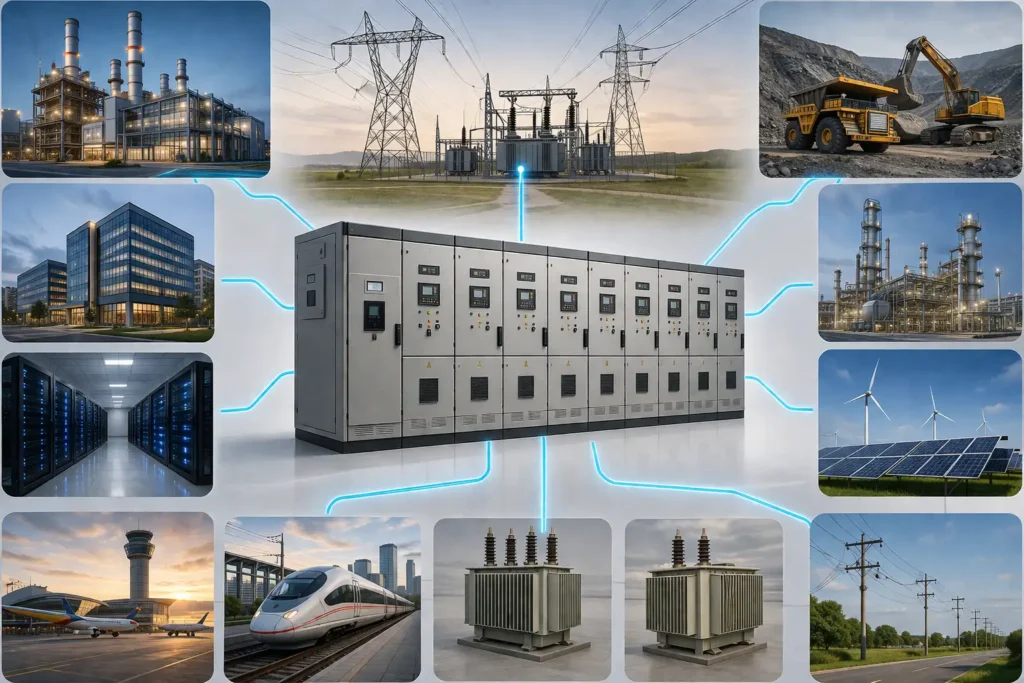
MV switchgear is usually used between the high-voltage transmission side and the low-voltage load side.
In many projects, MV switchgear appears at the point where power is received from the utility, divided into feeders, sent to transformers, or distributed across a large site.
Typical MV voltage levels may include 6.6 kV, 10 kV, 11 kV, 13.8 kV, 20 kV, 24 kV, 33 kV, or 35 kV, depending on the country, utility system, and project standard.
Common MV Switchgear Applications
| Application area | Typical MV switchgear role |
|---|---|
| Industrial plants | Main power receiving, transformer feeders, large motor feeders |
| Commercial complexes | Utility incoming power, transformer distribution |
| Data centers | Utility incoming switchgear, transformer feeders, redundant power architecture |
| Mining projects | Distribution to substations, heavy equipment, and remote load centers |
| Oil and gas facilities | Process power distribution, motor feeders, substation distribution |
| Wind farms | Collector network and substation distribution |
| Solar plants | Inverter station collection and medium-voltage grid connection |
| Airports and rail systems | Infrastructure power distribution |
| Utility distribution networks | Feeder control, ring networks, sectionalizing |
Practical Meaning
MV switchgear is often the site-level distribution layer.
It is usually not used for small branch loads directly. Instead, it manages larger blocks of power. For example, in an industrial plant, MV switchgear may feed several transformers, and those transformers then supply LV switchgear for final distribution.
This is why MV switchgear is common in projects where power demand is large, distribution distance is longer, or system reliability is more critical.
HV Switchgear Applications
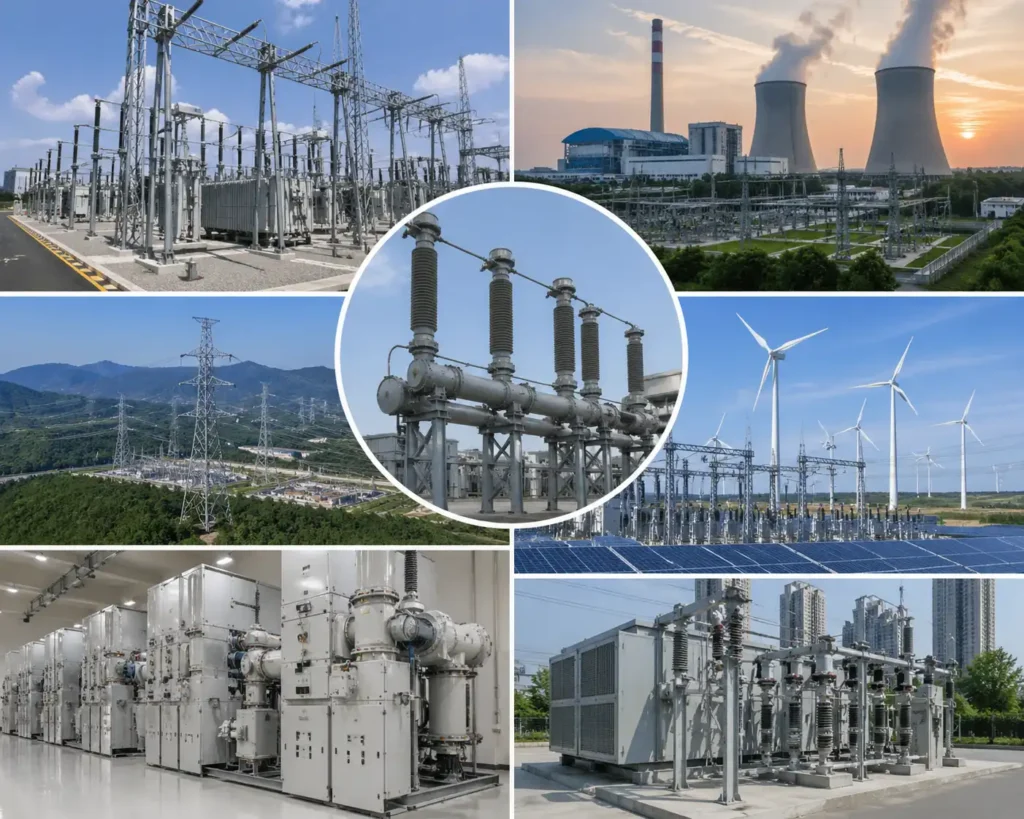
HV switchgear is mainly used in transmission networks, power plants, grid substations, and large interconnection points.
Compared with LV and MV switchgear, HV switchgear is less likely to be seen inside ordinary buildings or small industrial facilities. It is more common in utility-side or very large-scale power systems.
Common HV Switchgear Applications
| Application area | Typical HV switchgear role |
|---|---|
| Utility transmission substations | Switching, protection, and isolation of transmission lines |
| Power plants | Generator step-up substation switching and grid connection |
| Grid interconnection stations | Connecting large power sources or regional networks |
| Large renewable energy bases | High-voltage export and grid integration |
| Heavy industrial substations | High-capacity incoming power systems |
| Urban substations | Compact high-voltage switching, often with GIS where space is limited |
Practical Meaning
HV switchgear is usually part of the grid-level power system.
Its role is not ordinary building distribution. It is used where large amounts of power must be switched, isolated, protected, and controlled at high voltage.
For many commercial and industrial buyers, HV switchgear may be outside the normal project scope unless the project includes a dedicated high-voltage substation or grid interconnection.
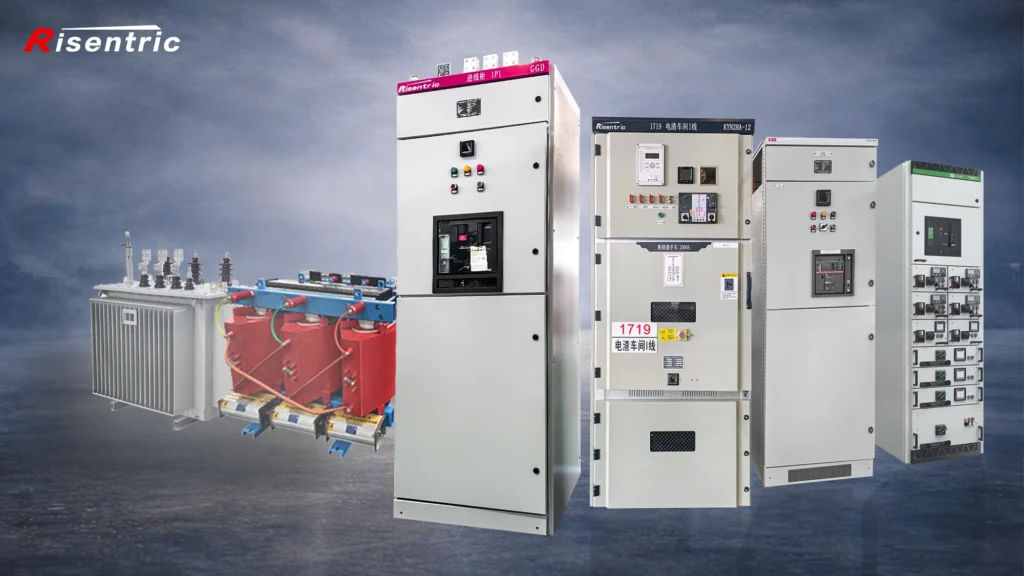
Looking for factory-tested switchgear & Panel boards for your project?
Application Map by Project Type
The easiest way to understand LV, MV and HV switchgear is to map them to project types.
| Project type | LV switchgear | MV switchgear | HV switchgear |
|---|---|---|---|
| Residential buildings | Main distribution, floor panels, lighting and socket circuits | Used in large compounds with dedicated transformer rooms | Rare inside the building project |
| Commercial buildings | MDB, ATS, HVAC distribution, tenant power distribution | Utility incoming, transformer feeders | Rare except very large developments |
| Factories | MCC, production lines, auxiliary systems, machine power | Main receiving, transformer feeders, large motors | Used in very large industrial bases |
| Data centers | UPS output, ATS, PDU feeders, critical LV distribution | Utility incoming, transformer feeders, redundant power architecture | Used in hyperscale or utility-level supply arrangements |
| Solar or wind projects | Auxiliary power, inverter-side distribution, local loads | Collector system, transformer feeders, plant-level distribution | Export substation and grid connection |
| Utility substations | Station service, control power, auxiliary power | Distribution feeders, transformer secondary side | Transmission line switching and grid protection |
This table is the core of the article.
It helps us to understand the system position quickly:
- In a building, LV switchgear is usually dominant.
- In a factory, both LV and MV switchgear are common.
- In a data center, LV and MV switchgear are both important because power continuity matters.
- In a renewable energy project, LV may appear near inverters or auxiliary systems, MV often collects and distributes power, and HV may appear at the export substation.
- In a utility substation, HV and MV switchgear are usually the main power-system equipment, while LV switchgear supports auxiliary systems.
Simple Rule: LV Serves Loads, MV Distributes Sites, HV Connects the Grid
A useful way to remember the difference is:
| Voltage level | System role | Practical meaning |
|---|---|---|
| LV | Load-side distribution | Used near equipment, motors, lighting, HVAC, and final loads |
| MV | Site or network distribution | Used to receive, divide, and distribute larger blocks of power |
| HV | Transmission and grid connection | Used to control power flow at utility or grid level |
This does not mean every project follows the same structure. Some projects use only LV switchgear. Some use LV and MV. Large infrastructure or utility projects may use LV, MV, and HV together.
But the general logic is clear:
The closer the system is to final loads, the more likely it is LV.
The more it distributes power across a site, the more likely it is MV.
The more it connects to transmission or grid infrastructure, the more likely it is HV.
How to Use This Map in Project Selection
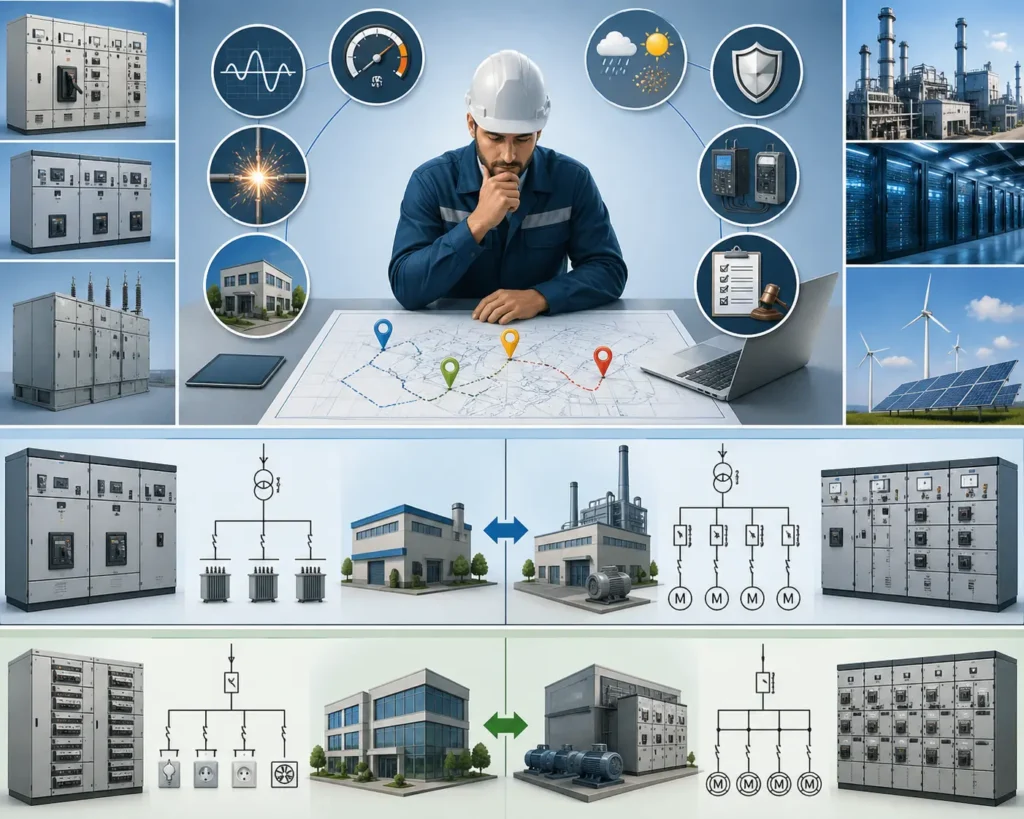
When engineers or buyers select switchgear, voltage level is only the first step. The correct switchgear solution also depends on technical and project conditions.
| Selection factor | Why it matters |
|---|---|
| System voltage | Determines whether LV, MV, or HV switchgear is required |
| Rated current | Affects busbar size, breaker selection, temperature rise, and enclosure design |
| Short-circuit level | Determines breaking capacity and withstand requirements |
| Application type | Building, factory, data center, renewable plant, utility network, etc. |
| Installation environment | Indoor, outdoor, dusty, humid, corrosive, high altitude, or space-limited conditions |
| Protection requirement | Affects breaker, relay, CT, VT, metering, and control configuration |
| Maintenance strategy | Influences compartmentalization, withdrawable design, isolation, and accessibility |
| Applicable standards | Determines design, testing, and verification requirements |
For example, two factories may both require MV switchgear, but the final configuration can be very different. One may need simple transformer feeders, while another may need large motor feeders, complex protection relays, higher short-circuit withstand, or special environmental protection.
Similarly, two LV systems may both operate at low voltage, but one may be a basic distribution board while another may be a large motor control center or a main switchboard with high rated current.
Avoiding a Common Misunderstanding
It is easy to think that LV, MV and HV switchgear are just different sizes of the same product.
That is not accurate.
The engineering focus changes as voltage level increases.
| Type | Main engineering focus |
|---|---|
| LV switchgear | Current capacity, load distribution, short-circuit protection, functional arrangement |
| MV switchgear | Insulation, arc safety, protection coordination, safe switching and isolation |
| HV switchgear | Insulation coordination, switching transients, grid reliability, transmission-level isolation |
In simple terms:
- LV switchgear focuses strongly on distribution and load control.
- MV switchgear focuses strongly on site-level power distribution and protection.
- HV switchgear focuses strongly on grid-level switching, isolation, and reliability.
This is why switchgear selection should not be based only on voltage name. It should be based on the full electrical system design.
When Should You Check LV, MV or General Switchgear Product Pages?
This article helps identify the general application position of LV, MV and HV switchgear.
After that, the next step is product selection.
Use the following direction:
| User need | Recommended next step |
|---|---|
| You need main distribution boards, MCCs, ATS panels, LV panels, or low-voltage switchboards | Check the low-voltage switchgear product page |
| You need MV incoming panels, transformer feeders, RMU, MV panels, or industrial substation equipment | Check the medium-voltage switchgear product page |
| You are comparing different switchgear categories before selecting a product direction | Check the switchgear category page |
Looking for factory-tested switchgear & Panel boards for your project?
Conclusion
LV, MV and HV switchgear are used at different positions in the electrical power system.
LV switchgear is usually closest to final loads. It is common in buildings, factories, MCCs, ATS panels, distribution boards, and low-voltage power rooms.
MV switchgear is usually used for site-level or network-level distribution. It is common in industrial substations, commercial complexes, data centers, renewable energy plants, and utility distribution systems.
HV switchgear is usually used at transmission and grid level. It is common in utility substations, power plants, grid interconnection stations, and large energy infrastructure projects.
A practical summary is:
LV serves loads. MV distributes power across sites or networks. HV connects and controls power at grid level.
Understanding this application map helps project teams choose the right switchgear category before moving into detailed product selection, technical configuration, and quotation.
FAQ
What is the difference between LV, MV and HV switchgear?
LV switchgear is usually used for low-voltage load-side distribution. MV switchgear is used for medium-voltage site or network distribution. HV switchgear is used for high-voltage transmission, grid substations, and large power interconnection points.
Where is LV switchgear usually used?
LV switchgear is commonly used in buildings, factories, commercial facilities, MCC panels, ATS panels, main distribution boards, and final low-voltage distribution systems.
Where is MV switchgear usually used?
MV switchgear is commonly used in industrial substations, utility distribution networks, data centers, renewable energy plants, large commercial buildings, and infrastructure projects.
Where is HV switchgear usually used?
HV switchgear is mainly used in transmission substations, power plants, grid interconnection stations, large renewable energy bases, and utility power systems.
Can one project use LV, MV and HV switchgear together?
Yes. Large projects may use all three. For example, a utility substation may use HV switchgear for transmission lines, MV switchgear for distribution feeders, and LV switchgear for auxiliary power and control systems.
Reference:
https://www.productinfo.schneider-electric.com/0100db2301_elecdistfunddesignguide/0100db2301-electrical-distribution-fundamentals-design-guide/English/0100DB2301%20Electrical%20Distribution%20Fundamentals%20Design%20Guide%20%28bookmap%29_DD00648155.xml/%24/PowerDistributionEquipment-A630D34D
https://webstore.iec.ch/en/publication/32982
https://www.eaton.com/us/en-us/products/medium-voltage-power-distribution-control-systems/switchgear/fundamentals-of-medium-voltage-switchgear.html


