
In North American projects, NEC and UL are different.
NEC is about safe electrical installation.
UL is about product construction, testing, and certification.
Chinese low-voltage standards are generally closer to the IEC system.
So when comparing standards for panels and MCCs, the real comparison is not only NEC vs Chinese standards. It is:
NEC + UL vs GB / GB/T + IEC-style practice.
North American Electrical Requirements: NEC and UL
NEC vs UL: Simple Comparison
| Item | NEC / NFPA 70 | UL Standards |
|---|---|---|
| Main nature | Installation code | Product construction and certification standard |
| Main focus | Safe electrical installation | Safe product construction and evaluation |
| Main user | Designer, installer, inspector, AHJ | Manufacturer, panel builder, certifier |
| Applies to | The electrical installation | The product or assembly |
| Example | Wiring method, grounding, overcurrent protection, field installation | UL 508A panel, UL 845 MCC, UL-listed components |
| Certification mark | No | Yes, if formally listed by UL / NRTL |
This is the first point suppliers must understand:
NEC and UL are related, but they are not the same.
A project may follow NEC but not require UL-certified equipment. Another project may require both NEC compliance and UL / NRTL listing.
What Is NEC?
NFPA 70, also known as the National Electrical Code or NEC, is mainly an electrical installation code.
It focuses on whether the electrical installation is safe and acceptable.
However, NEC does not fully define how a panel or MCC must be manufactured internally.
NEC may affect:
- wiring methods
- grounding and bonding
- conductor identification
- overcurrent protection
- equipment suitability
- available fault current
- field installation
- working space
- inspection and approval
It does not give every detail for:
- cabinet size
- busbar layout
- wire duct arrangement
- component mounting distance
- VFD thermal clearance
- fixed or withdrawable structure
- detailed production process
In simple terms:
NEC tells the project team how the electrical installation should be safe and acceptable.
What Is UL?
UL standards are more related to product construction, testing, listing, and certification.
For panels and MCCs, common UL standards include:
| Standard | Main Application |
|---|---|
| UL 508A | Industrial control panels |
| UL 845 | Motor control centers |
| UL 891 | Switchboards |
| UL 1558 | Low-voltage power switchgear |
| UL 67 | Panelboards |
| UL 1008 | Transfer switch equipment |
UL standards are closer to product manufacturing and certification than NEC.
They may affect:
- internal panel construction
- component selection
- spacing
- wiring
- marking
- SCCR determination
- testing
- listing and labeling
In simple terms:
UL tells the manufacturer how a product should be constructed and evaluated if UL listing or certification is required.
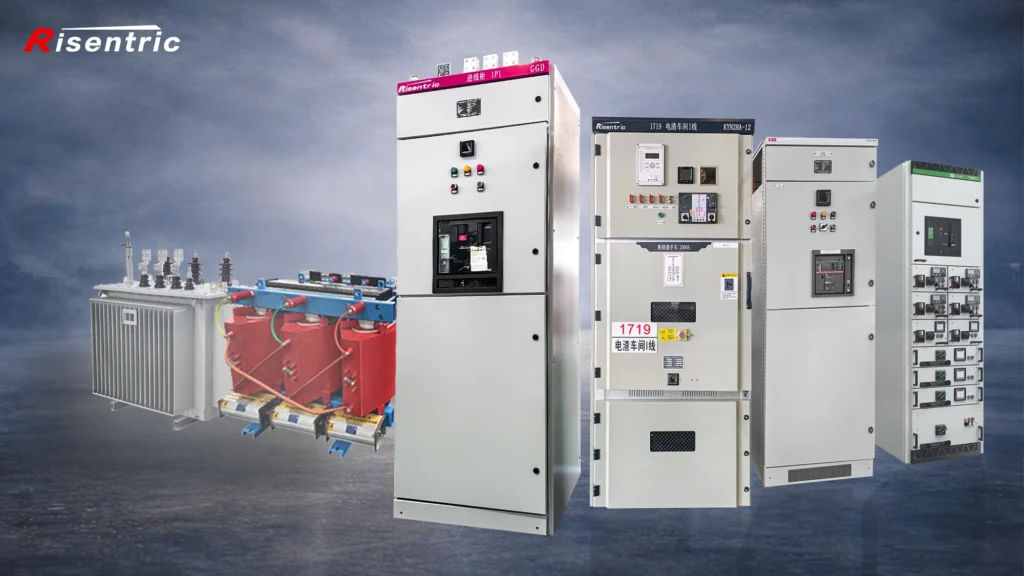
Looking for factory-tested 3-Phase switchgear & Panel boards for your project?
North American System vs Chinese / IEC-Style System
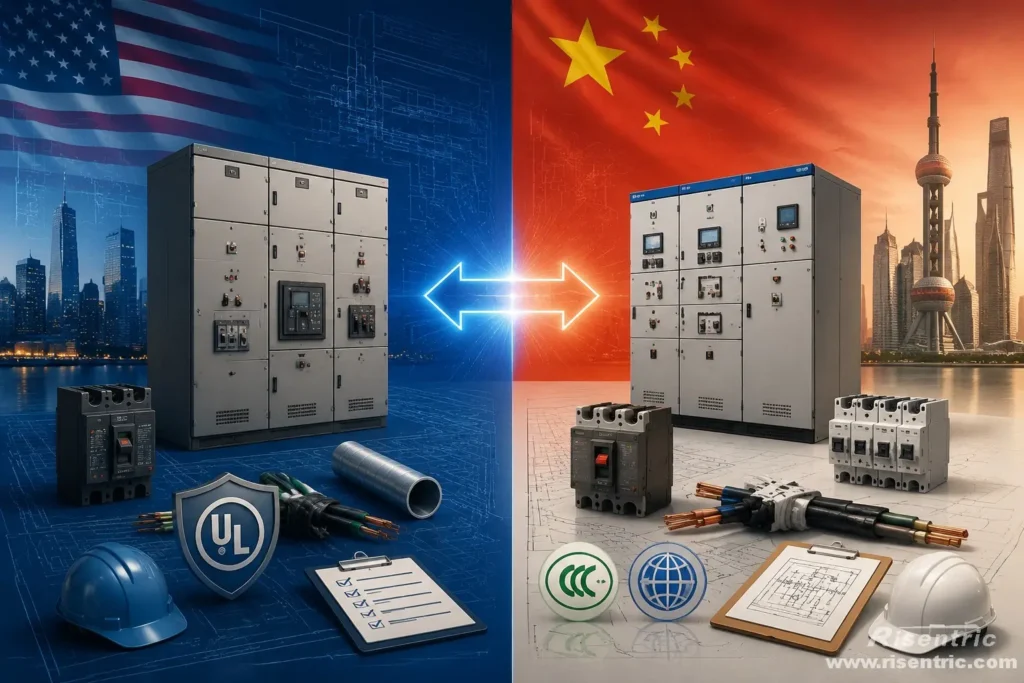
Chinese electrical requirements are not concentrated in one NEC-equivalent document.
They are distributed across:
- design codes
- product standards
- component standards
- installation standards
- certification requirements
- type test reports
- project acceptance procedures
For low-voltage panels and switchgear, Chinese projects may involve standards such as GB/T 7251, GB/T 14048, GB/T 4026, GB 50054, CCC / CQC requirements, and project-specific acceptance documents.
A simplified comparison is:
| Item | North American System | Chinese / IEC-Style System |
|---|---|---|
| Code logic | NEC installation code + UL product standards | GB / GB/T standards, often IEC-aligned in low-voltage areas |
| Installation focus | NEC / AHJ / local inspection | Design code, installation code, owner, utility, acceptance authority |
| Product focus | UL 508A, UL 845, UL 891, etc. | GB/T 7251, GB/T 14048, project specifications |
| Certification | UL / NRTL may be required | CCC / CQC / type test may be required |
| Enclosure language | NEMA Types often used | IP ratings often used |
| Short-circuit language | SCCR, interrupting rating, available fault current | Icw, Ipk, Icu, Ics |
| Common electrical practice | 480 V / 60 Hz, AWG / kcmil, conduit, THHN | 400 V / 50 Hz, mm², cable tray, cable trench |
The key point is:
North American projects often combine NEC installation logic with UL product logic. Chinese projects are generally closer to IEC-style product and installation logic, implemented through Chinese GB / GB/T standards.
Key Practical Differences
1. Voltage and Frequency
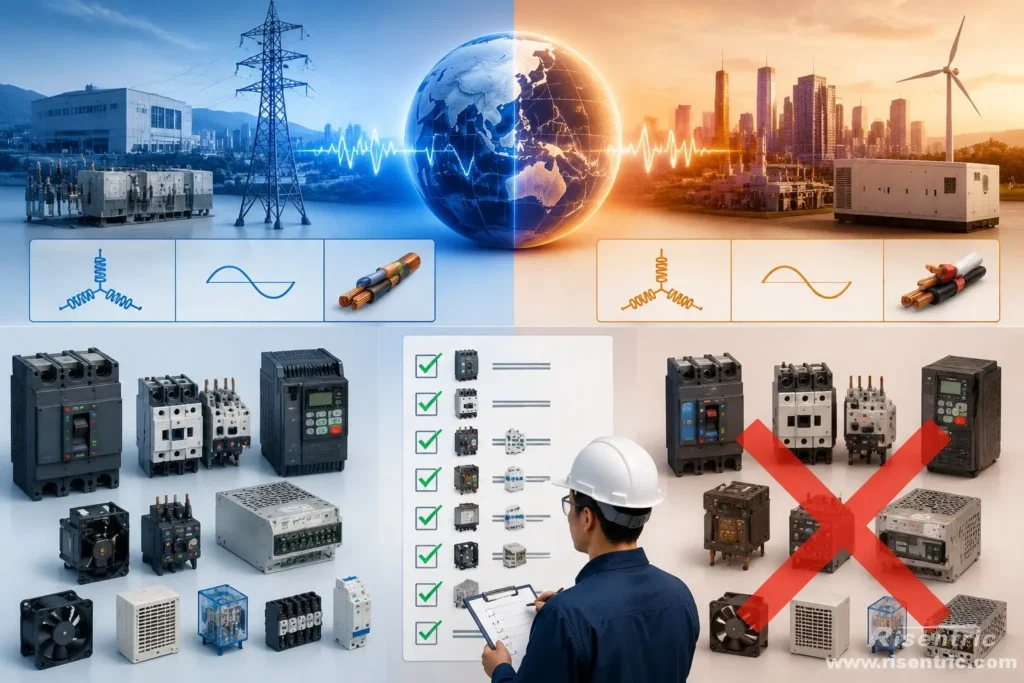
Chinese domestic low-voltage projects commonly use 380 / 220 V or 400 / 230 V, 50 Hz.
North American-style industrial projects often use 480Y/277 V, 480 V, 208Y/120 V, or 120/240 V, 60 Hz. In motor applications, 460 V is commonly used as the motor utilization voltage.
| Item | Chinese / IEC-Style Project | North American-Style Project |
|---|---|---|
| Common low-voltage system | 380 / 220 V or 400 / 230 V | 480Y/277 V, 480 V, 208Y/120 V, 120/240 V |
| Frequency | 50 Hz | 60 Hz |
| Common motor voltage | 380 V or 400 V | 460 V motor rating |
| Control voltage | Often 220 VAC or 24 VDC | Often 120 VAC or 24 VDC |
| Conductor size | mm² | AWG / kcmil |
For a 460 V / 60 Hz project, the supplier must check all related components, including breakers, contactors, overload relays, VFDs, transformers, meters, SPDs, terminal blocks, fans, heaters, relays, and control power supplies.
A device suitable for 400 V / 50 Hz should not be assumed suitable for 460 V / 60 Hz.
2. Wiring Color and Conductor Identification
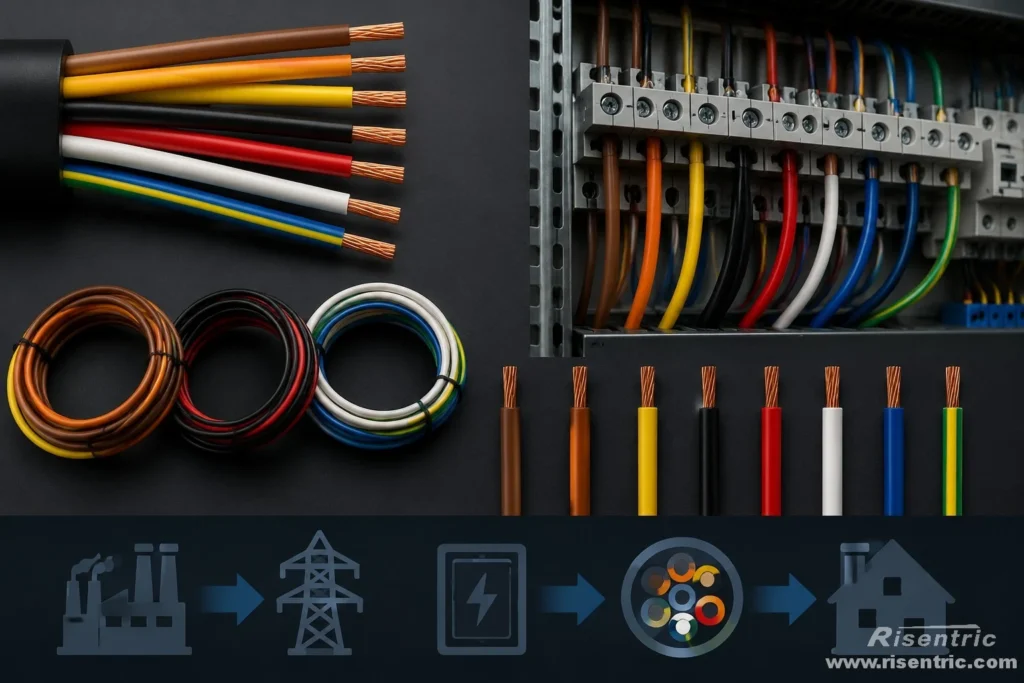
Wiring color is one of the most visible differences.
In Chinese domestic practice, some projects may still use yellow, green, and red for three-phase conductors. Modern Chinese / IEC-aligned identification may use brown, black, and grey for line conductors, blue for neutral, and green-yellow for protective earth.
In NEC-based projects, neutral conductors are commonly white or gray. Grounding conductors are commonly green, green-yellow, or bare copper. Phase conductor colors may depend on voltage system, local practice, and project specification.
Example of a NEC-based project color convention:
| Circuit | Color |
|---|---|
| 3-phase 460 VAC L1 | Brown |
| 3-phase 460 VAC L2 | Orange |
| 3-phase 460 VAC L3 | Yellow |
| Ground | Green |
| 1-phase 230 VAC L1 | Black |
| 1-phase 230 VAC L2 | Red |
| Neutral | White |
The key point is simple:
Do not assume phase colors are universal. Always follow the project color convention.
3. Cable Entry and Field Wiring Method
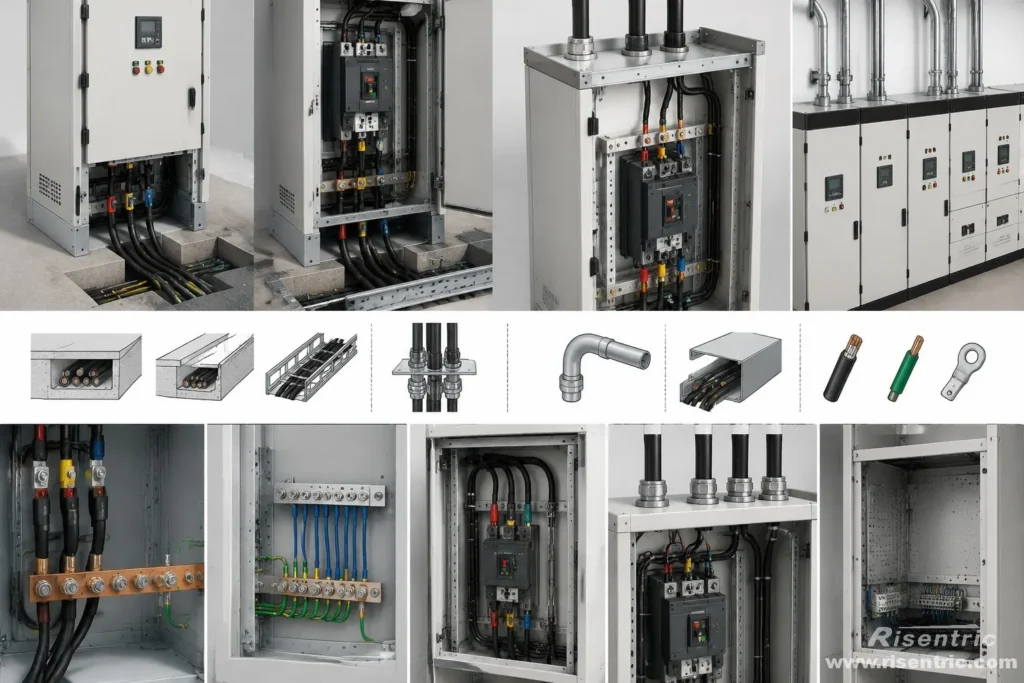
Cable entry is project-dependent, not fixed by one standard system.
In many Chinese domestic low-voltage switchgear projects, bottom entry is common because electrical rooms may use cable trenches, floor openings, or bottom cable routes. However, top entry can also be used when the site requires it.
In North American-style projects, the field wiring method may be different. The project may use conduit, wireway, THHN conductors, AWG / kcmil conductor sizes, and top or bottom entry depending on the installation.
| Item | Chinese / IEC-Style Project Practice | North American-Style Project Practice |
|---|---|---|
| Cable entry | Often bottom entry in indoor LV switchgear rooms, but project-dependent | Top, bottom, side, conduit, or wireway entry, depending on site |
| Conductor notation | mm² cable | AWG / kcmil conductor |
| Field wiring | Cable trench, cable tray, cable gland, copper lugs | Conduit, wireway, THHN conductors, lugs |
| Cabinet impact | Cable compartment, lug space, bottom-entry arrangement | Wire bending space, conduit/gland plate, field terminal area |
The key point is:
Cable entry direction and field wiring method must be confirmed before cabinet design.
If the customer requires top cable entry, the cabinet should not simply have holes drilled on the roof. The supplier should consider cable bending space, terminal position, PE bar location, neutral bar location, conduit or gland plate design, and separation between power and control wiring.
4. Short-Circuit Rating: Icw / Ipk / Icu / Ics vs SCCR
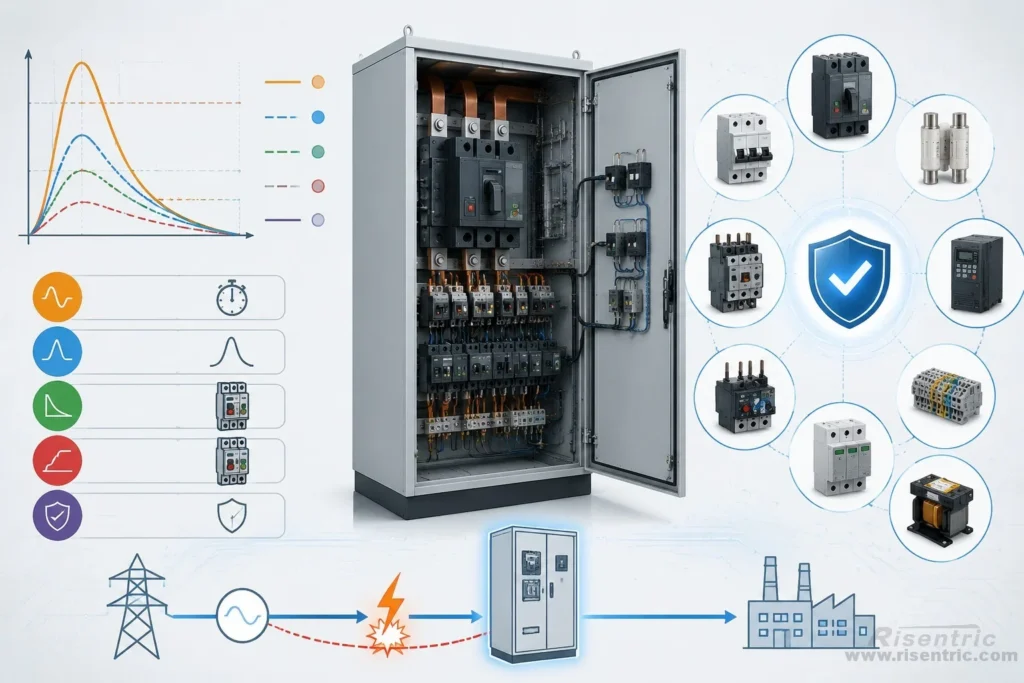
Chinese and IEC-style projects often discuss Icw, Ipk, Icu, and Ics.
North American-style panel projects often emphasize SCCR, or short-circuit current rating.
| Term | General Meaning |
|---|---|
| Icw | Short-time withstand current |
| Ipk | Peak withstand current |
| Icu | Ultimate short-circuit breaking capacity |
| Ics | Service short-circuit breaking capacity |
| SCCR | Short-circuit current rating of equipment or assembly |
SCCR is not only about busbar strength. The final assembly rating may be affected by the main breaker, feeder breakers, fuses, contactors, overload relays, VFDs, terminal blocks, SPDs, control transformer protection, and other branch circuit components.
For North American-style RFQs, the supplier should ask:
What is the required SCCR or available fault current at the incoming terminals?
Without this information, the quotation may be incomplete.
5. Enclosure Rating: IP vs NEMA / UL
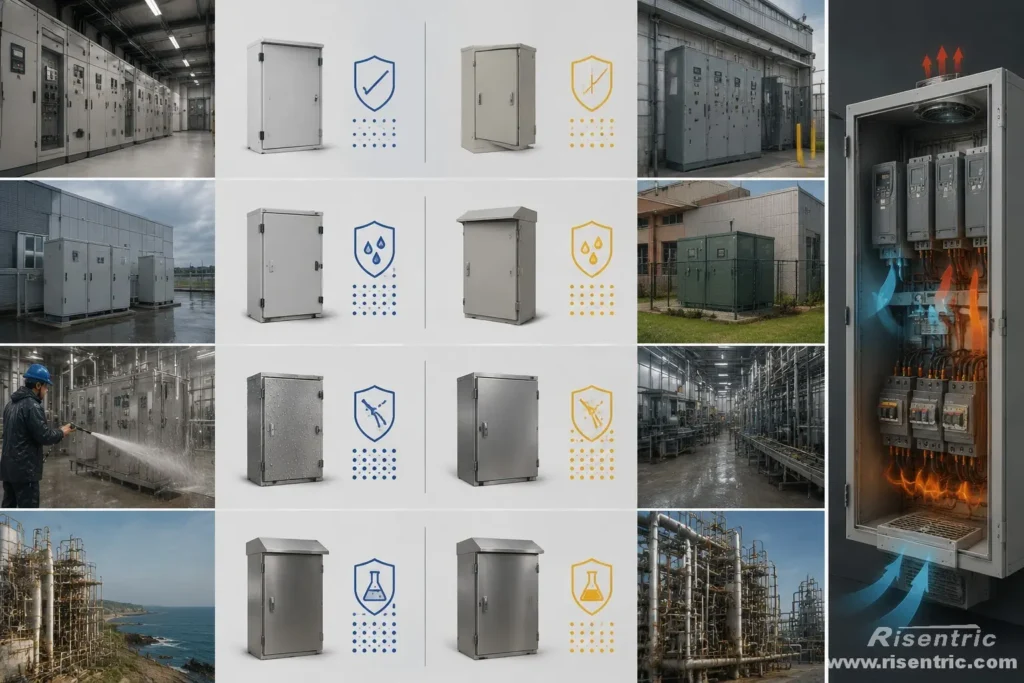
Chinese and IEC-style projects often use IP ratings, such as IP30, IP40, IP54, IP55, IP65, or IP66.
North American-style projects often use NEMA enclosure Types, such as NEMA 1, NEMA 3R, NEMA 4, NEMA 4X, or NEMA 12.
This topic is more related to NEMA, UL, IEC, GB, and product standards than to NEC itself. NEC mainly requires equipment to be suitable for the installation environment.
| Application | IEC / China-Style Description | North American-Style Description |
|---|---|---|
| Indoor electrical room | IP30 / IP40 | NEMA 1 may be specified |
| Outdoor general use | IP54 / IP55 | NEMA 3R may be specified |
| Washdown or wet industrial area | IP65 / IP66 | NEMA 4 may be specified |
| Corrosive area | Stainless steel enclosure with suitable IP rating | NEMA 4X may be specified |
Do not simply say “IP66 equals NEMA 4X.” IP ratings and NEMA Types are not exactly interchangeable. The project should specify which enclosure rating system is required.
For sealed enclosures, thermal design is also important. If VFDs, transformers, power supplies, or many contactors are installed inside an IP66 cabinet, heat may accumulate.
Does NEC Define the Internal Structure of a Panel or MCC?
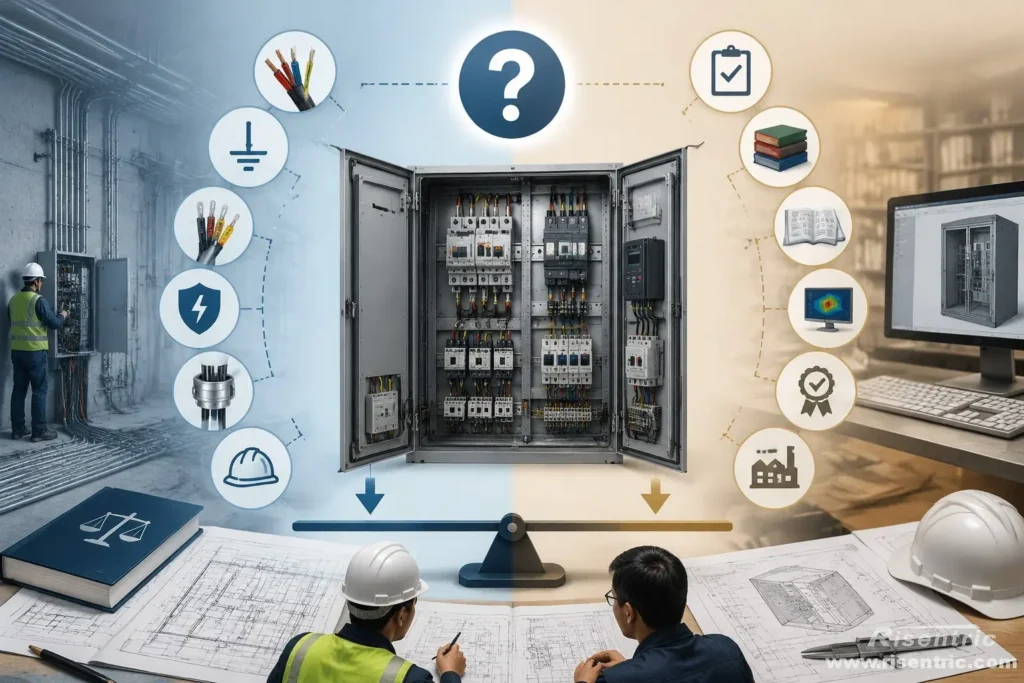
No. NEC does not fully define the internal structure of a panel, switchboard, or motor control center.
NEC may affect important design assumptions, such as wiring method, grounding, conductor identification, short-circuit rating, field cable entry, equipment suitability, and installation safety.
However, internal construction details usually come from other sources, such as:
- UL 508A, UL 845, UL 891, or other product standards
- GB/T 7251 or other Chinese product standards
- customer specifications
- component installation manuals
- thermal calculation
- certification requirements
- manufacturer design practice
A practical rule is:
NEC tells the project team how the electrical installation should be safe and acceptable. Product standards and engineering practice tell the manufacturer how to construct the equipment.
Looking for factory-tested 3-Phase switchgear & Panel boards for your project?
Conclusion
In practice, North American panel and MCC projects usually involve both NEC and UL. NEC focuses on safe installation. UL focuses on product construction, testing, and certification. Chinese low-voltage projects usually follow GB / GB/T standards, many of which are closer to IEC-style practice.
For panel and MCC projects, the difference becomes visible in voltage, frequency, wiring color, field wiring method, short-circuit rating, enclosure rating, certification logic, and documentation.
Before manufacturing, the supplier should confirm the standard system, voltage, frequency, wiring color, cable entry, SCCR, enclosure rating, component requirements, and certification scope.
This prevents a common export problem: a cabinet may look correct according to domestic 400 V / 50 Hz practice, but may not fit a 460 V / 60 Hz North American-style project.
FAQ
Is NFPA 70 the same as NEC?
Yes. NFPA 70 is the formal standard number, and NEC means National Electrical Code.
Is NEC the same as UL?
No. NEC is an installation code. UL standards are product construction, testing, and listing standards.
Is NEC equal to a Chinese GB standard?
No. Chinese electrical requirements are spread across several GB / GB/T standards, certification systems, and project acceptance requirements.
Are Chinese electrical standards close to IEC?
Many Chinese low-voltage standards are IEC-aligned or based on IEC concepts, especially for switchgear assemblies, components, conductor identification, and installation concepts. However, they are still Chinese standards and may include national differences.
Does NEC define the full internal structure of a panel?
No. NEC affects installation safety, wiring, protection, field wiring, and inspection. Internal construction details usually come from product standards, component manuals, customer specifications, and manufacturer engineering practice.
Does an NEC-based project always require UL certification?
No. Some NEC-based projects require UL / NRTL certification, while others do not. This must be confirmed in the RFQ.


