
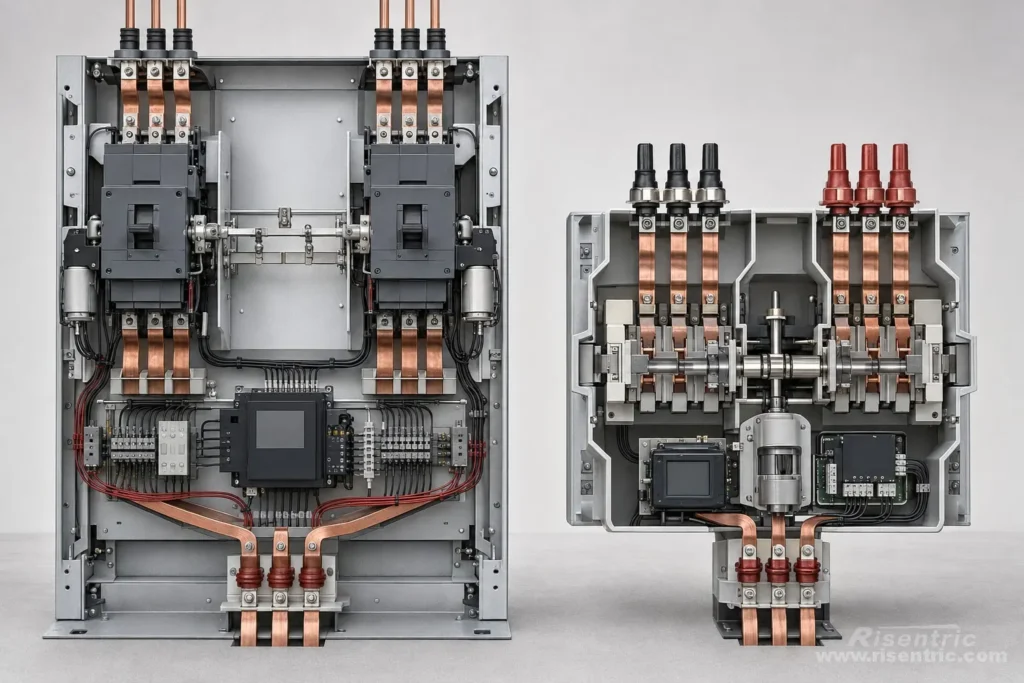
This article focuses on the difference between breaker-based mechanical-interlock systems and integrated ATS designs.
For a closer look at ATS contacts, mechanisms and internal interlocking, see Dive into ATS: The Internal Structure of an Automatic Transfer Switch.
Looking for a factory-built ATS panel for your project? Explore our ATS panel solutions.
Not every ATS is built in the same way.
One solution uses two separate circuit breakers connected by a mechanical interlock. Another uses an integrated or all-in-one ATS, where both source positions are coordinated inside one purpose-built transfer device.
Both solutions can perform automatic source transfer, but their structure, protection, wiring, panel size and price can be very different.
The Simple Difference
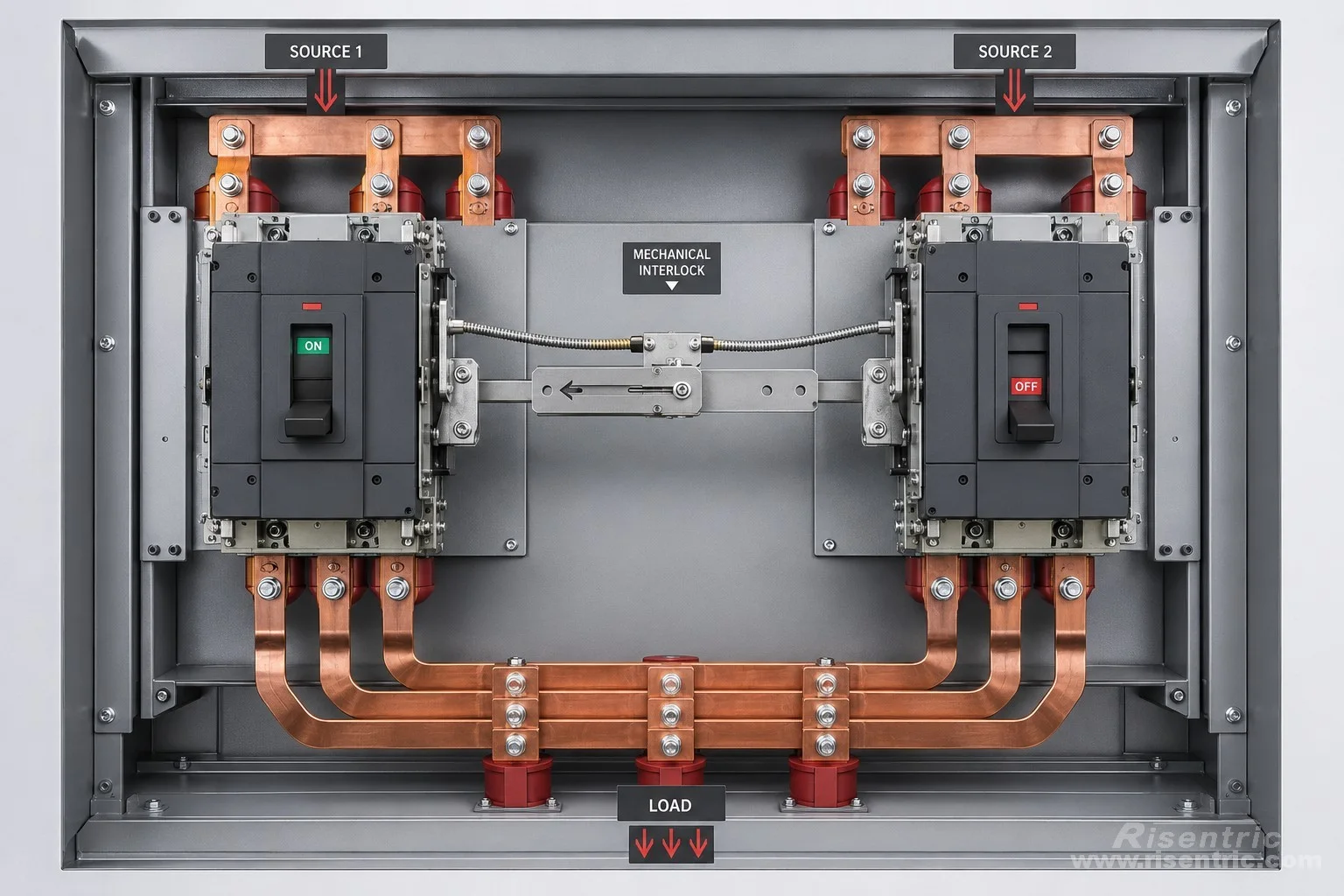
A mechanically interlocked breaker ATS system is built from several separate devices:
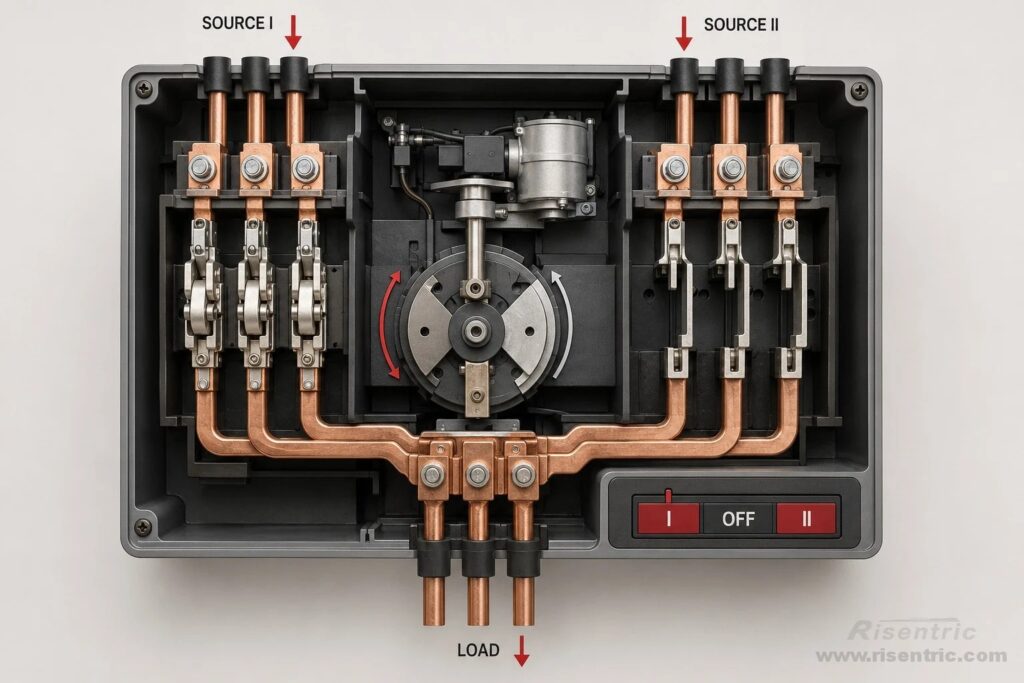
An integrated ATS places the two source connections and transfer mechanism into one coordinated device:
The simplest way to understand the difference is:
A breaker-based ATS builds the transfer system from separate components.
An integrated ATS combines most of these functions into one purpose-built device.
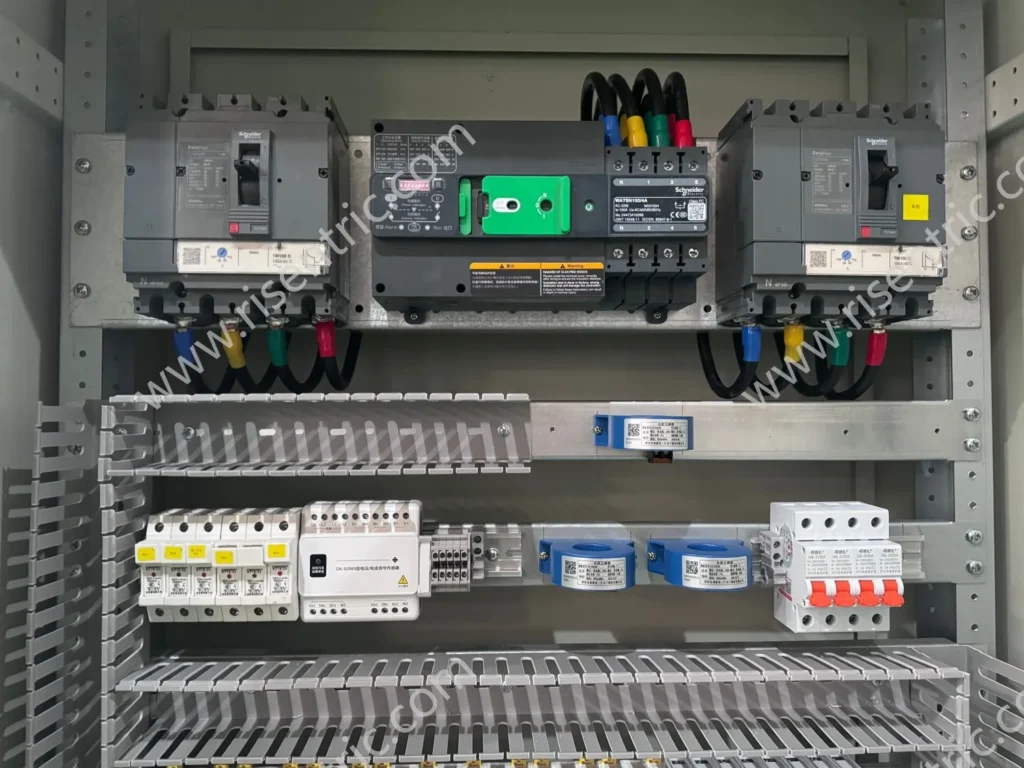
Looking for factory-tested ATS Switchgear & Panelboards for your project?
Mechanical-Interlock ATS vs Integrated ATS
| Item | Mechanical-Interlock ATS | Integrated ATS |
|---|---|---|
| Structure | Two separate switching devices with external interlocking | One coordinated transfer device |
| Control system | Motor operators, controller and interlocks are normally separate | Motor mechanism and controller are often integrated |
| Panel construction | More wiring, more components and more panel space | Simpler wiring and more compact construction |
| Protection | Circuit breakers can provide overload and short-circuit protection | Often requires coordinated upstream protection |
| Flexibility | Easier to customize and integrate into complex switchboards | Better suited to standardized two-source transfer |
| Total panel price | Usually higher for a complete automatic system | Usually lower for standard applications |
| Typical use | High-current, customized or protection-intensive systems | Standard utility-generator or utility-utility systems |
What Does the Mechanical Interlock Actually Do?
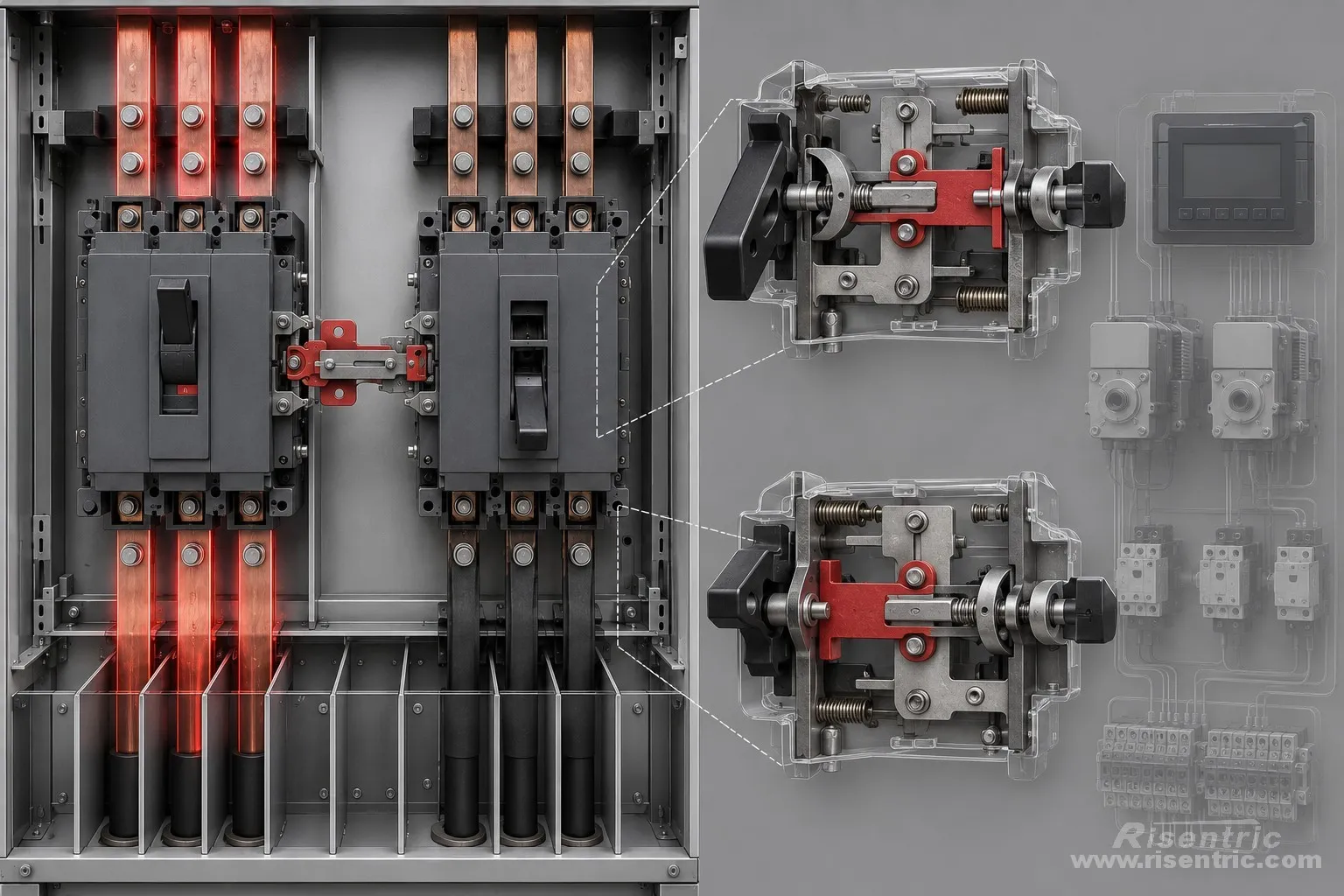
A mechanical interlock prevents the two source-switching devices from closing at the same time.
For example, when Breaker 1 is closed, the mechanical mechanism physically blocks Breaker 2 from closing. When Breaker 2 is closed, Breaker 1 is blocked.
This prevents two independent power sources from being connected together unintentionally.
However, the mechanical interlock cannot perform the whole transfer by itself. It only ensures:
When one breaker is closed, the other breaker is physically prevented from closing.
It does not know whether either power source is healthy.
A mechanical interlock alone is not a complete automatic transfer system.
What Does a Mechanical-Interlock ATS Contain?
Think of the system as having a brain, muscles, and a physical safety lock:
| Part | Function |
|---|---|
| ATS controller or relay logic | Detects source failure and decides when to transfer |
| Motor operators or opening/closing coils | Physically operate the breakers |
| Mechanical interlock | Prevents both breakers from closing together |
A complete mechanical-interlock ATS is not simply two breakers connected by a cable, rod or metal interlocking mechanism.
To operate automatically, it must combine switching devices, motor operators, source monitoring, control logic, electrical interlocking and mechanical interlocking into one coordinated system.
The following image shows an illustrative cost breakdown for a typical low-voltage breaker-based ATS panel, with the complete panel cost treated as 100%.
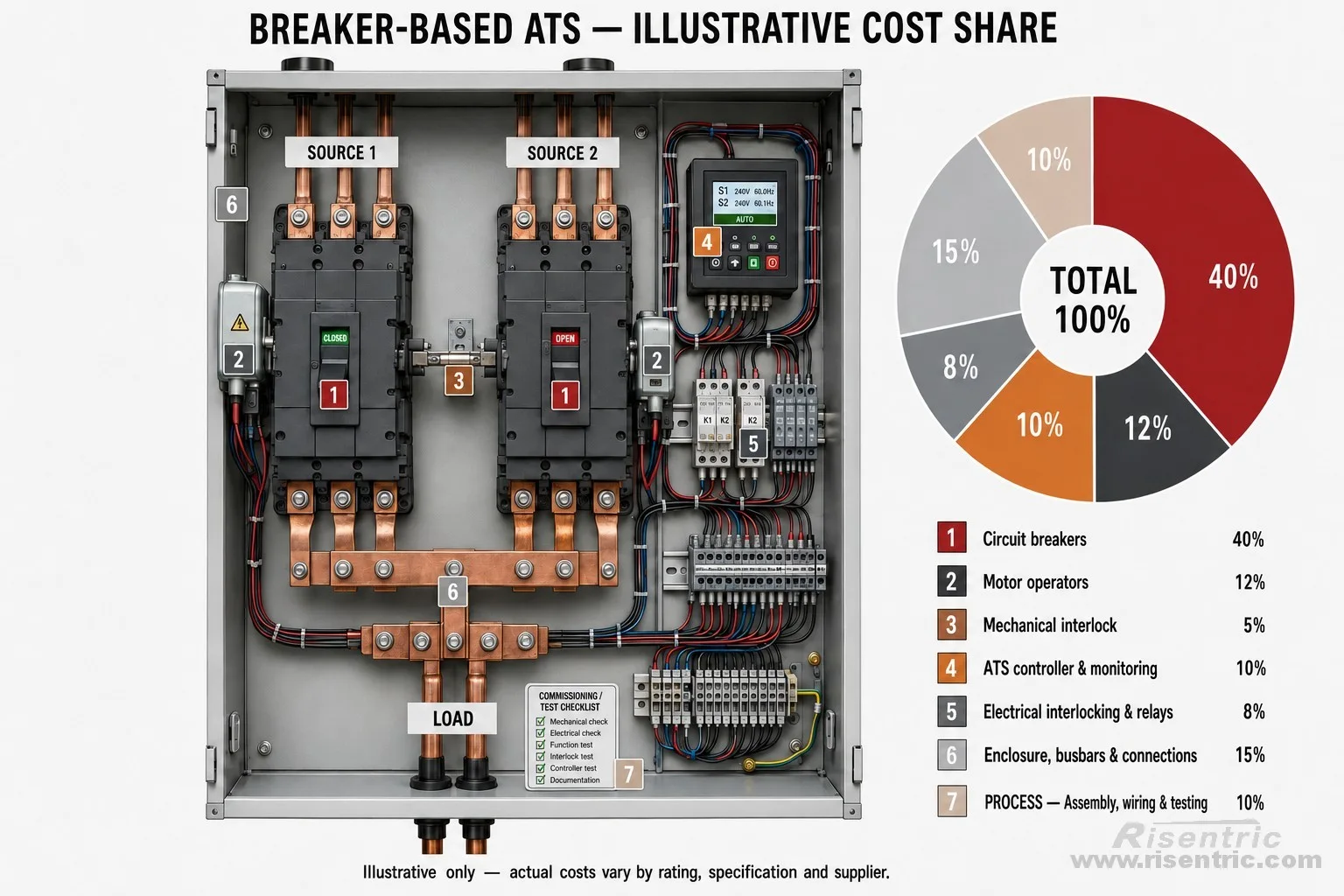
| Component | Main Function |
|---|---|
| Two circuit breakers | Connect and disconnect the two sources and may provide overload and short-circuit protection |
| Two motor operators | Open and close the breakers electrically |
| Mechanical interlock | Physically prevents both breakers from closing at the same time |
| ATS controller and source monitoring | Monitor source conditions and determine when transfer should occur |
| Electrical interlocking, auxiliary contacts and relays | Confirm breaker positions and prevent conflicting commands |
| Enclosure, busbars and power connections | House the equipment and carry current between the sources and load |
| Assembly, wiring, commissioning and testing | Connect and verify the complete transfer system |
These percentages are only an illustrative cost model. The actual breakdown depends on:
- Rated current
- Breaker type
- Short-circuit rating
- Number of poles
- Busbar size
- Controller functions
- Communication requirements
- Enclosure construction
- Local component and labour costs
In a small or medium MCCB-based ATS, the two breakers may represent approximately 35–45% of the complete panel cost.
In a high-current ACB-based system, the breakers and their operating mechanisms may account for more than half of the total cost.
The important point is:
The mechanical interlock itself is usually only a small part of the price. Most of the cost comes from the switching devices, motor operators, control system, busbars and panel construction.
How the System Works
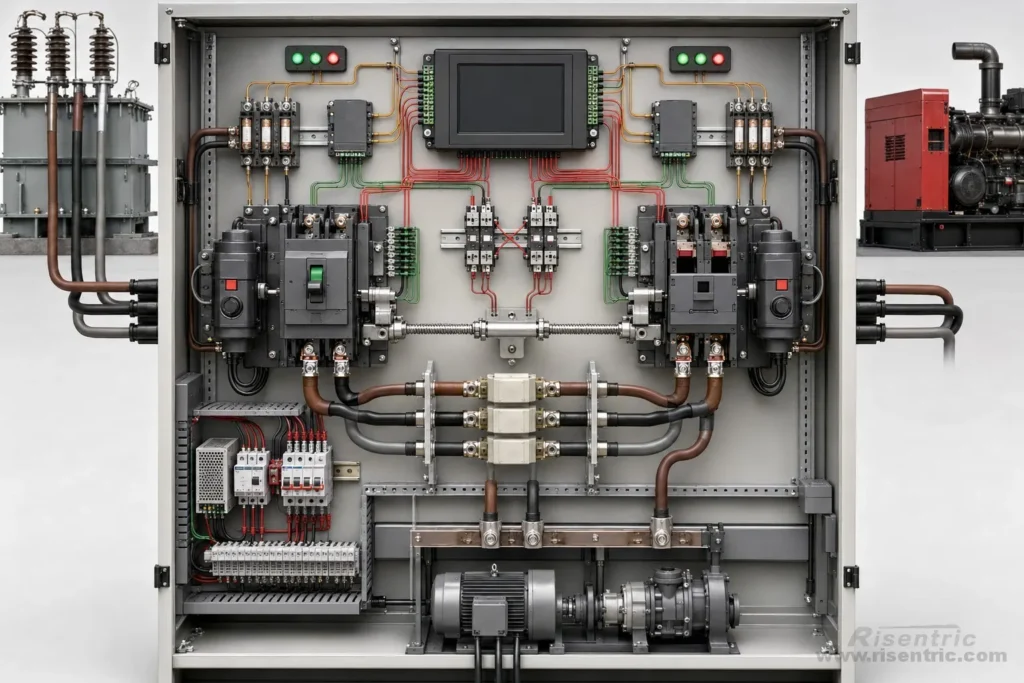
The ATS controller monitors both power sources and commands the breakers to open or close when transfer is required.
Auxiliary contacts confirm the breaker positions. Electrical interlocking blocks conflicting commands, while the mechanical interlock physically prevents both breakers from closing at the same time.
Together, these components turn two separate breakers into a complete automatic transfer system.
What Is an Integrated or All-in-One ATS?
An integrated ATS is designed specifically for source transfer.
Instead of installing two independent breakers and connecting them with an external interlock, the Source I contacts, Source II contacts and transfer mechanism are designed as one coordinated assembly.
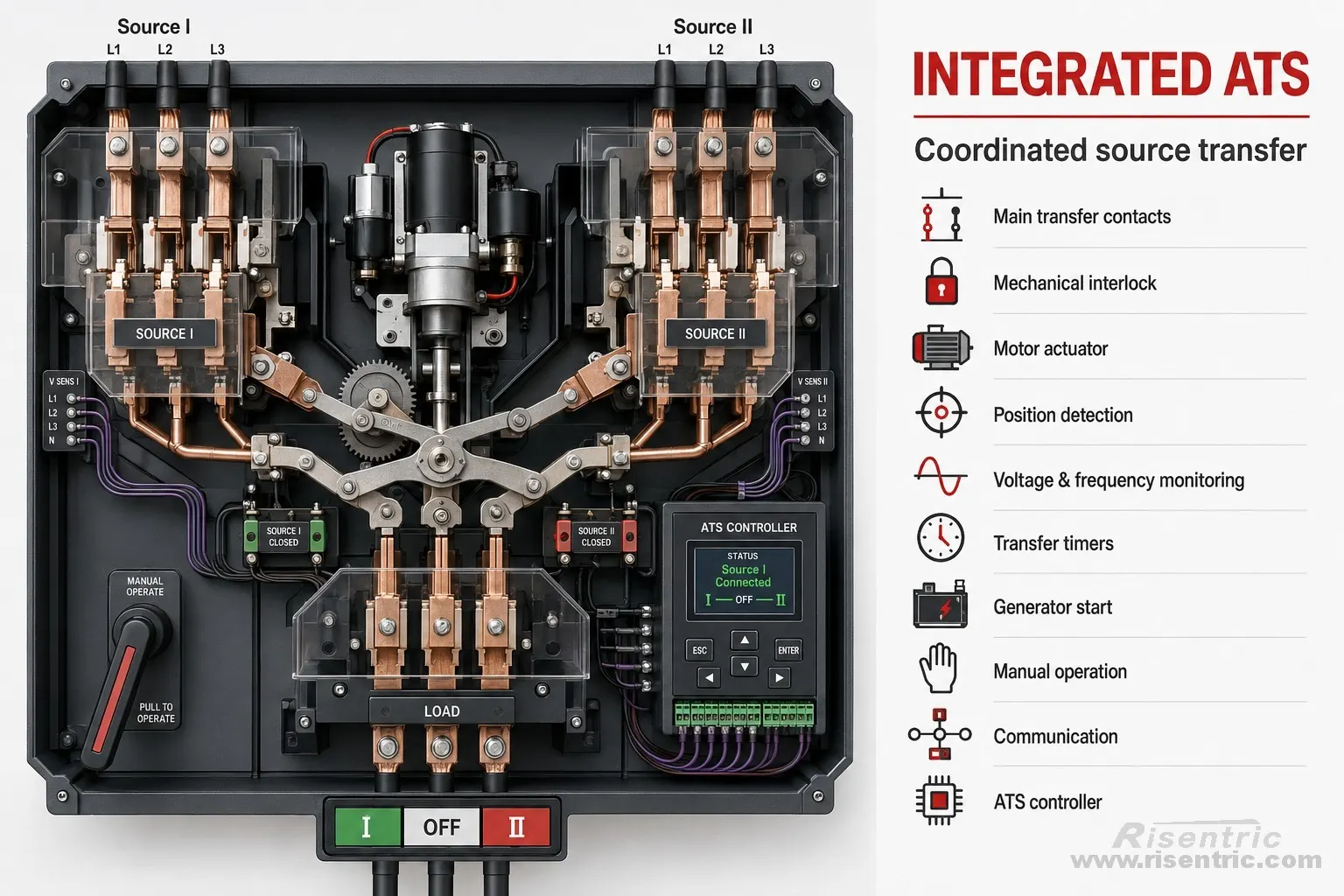
This arrangement normally reduces the number of separate components, control wires and mechanical adjustment points inside the panel.
However, not every integrated ATS contains every control function. Some units include the complete automatic controller, while others require an external controller or additional monitoring device.
Mechanical Interlocking ATS vs Integrated ATS: Price Comparison
A mechanically interlocked breaker system may appear cheaper when only two breakers and the interlocking mechanism are considered. However, a complete automatic system also requires motor operators, an ATS controller, auxiliary contacts, electrical interlocking, additional wiring and usually a larger enclosure. For this reason, a breaker-based ATS is often more expensive as a complete automatic panel.
| Configuration | Typical Relative Cost |
|---|---|
| Manual breakers with mechanical interlock | 60–90% |
| Integrated automatic ATS | 100% |
| Basic automatic breaker-based ATS | 120–180% |
| Customized or withdrawable ACB system | Usually above 180%, depending on ACB rating, protection, communication, busbar size and switchboard construction |
These figures are illustrative budgeting ranges rather than fixed market prices. The actual comparison depends on rated current, short-circuit capacity, protection requirements, enclosure construction and whether separate incoming breakers are already required.
The mechanical interlock itself is normally only a small part of the total price. Most of the additional cost comes from the two switching devices, motorized operation, control system, busbars, wiring, assembly and testing.
Lowest-Cost Configuration
The cheapest mechanical arrangement includes:
- Two manually operated breakers or switches
- One mechanical interlock
- Manual handles
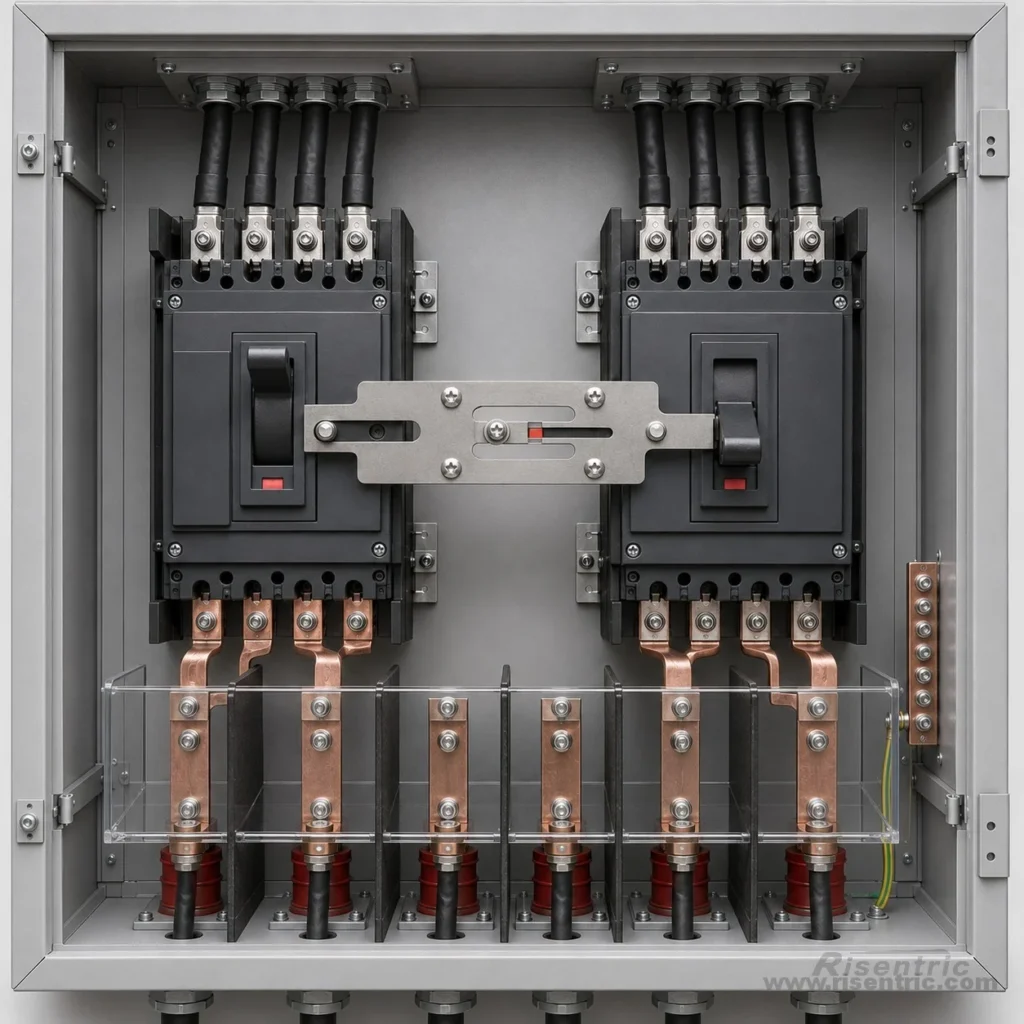
It may be cheaper than an integrated ATS, but it is only a manual changeover system, not an automatic ATS.
Lowest Practical Automatic Configuration
A basic automatic breaker-based ATS requires:
- Two motor-operated breakers
- Mechanical interlock
- Auxiliary contacts
- ATS controller
- Voltage monitoring
- Control wiring and protection
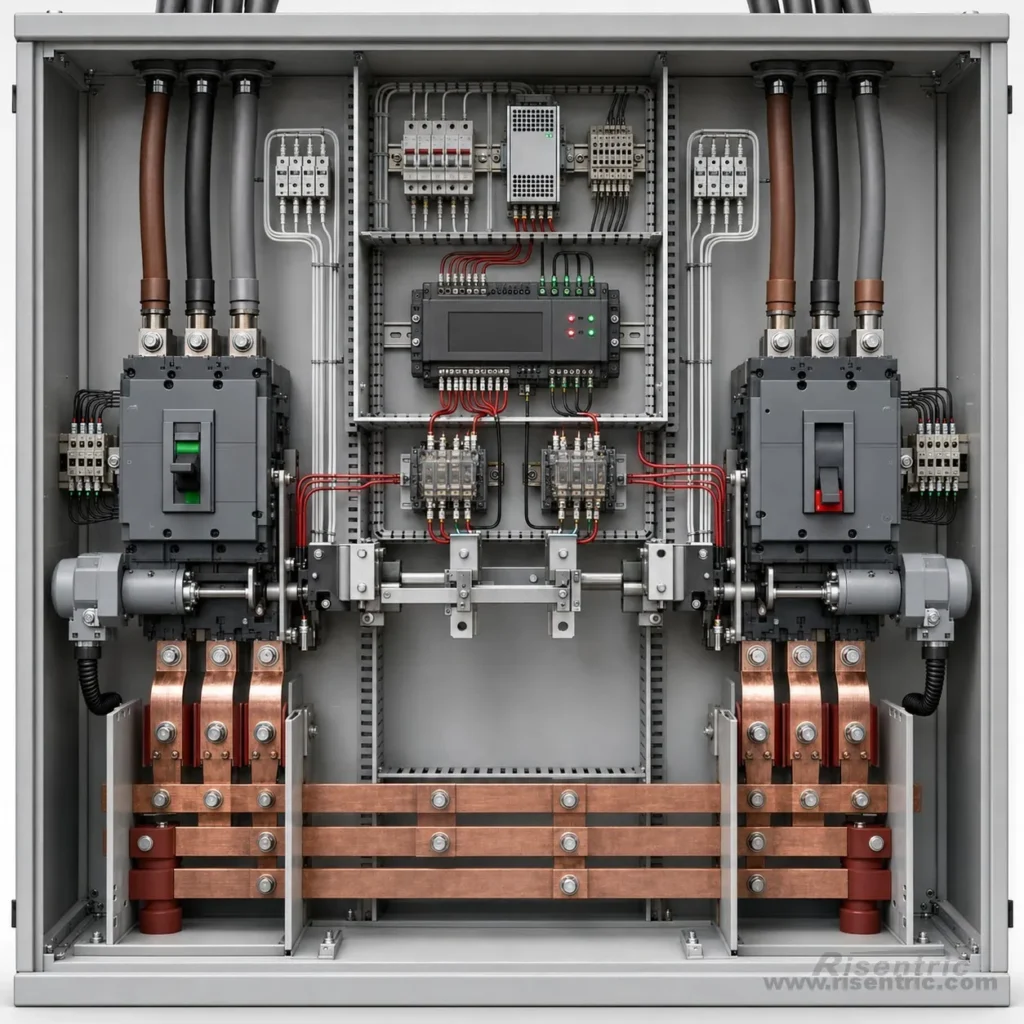
This configuration is normally 20–80% more expensive than an integrated ATS.
Upper Price Limit
A premium system using two withdrawable ACBs, electronic trip units, communication, metering and advanced control may cost two to four times as much as a basic integrated ATS.
The higher price comes from the protection, maintenance and control functions, not from the mechanical interlock itself.
Class PC vs Class CB
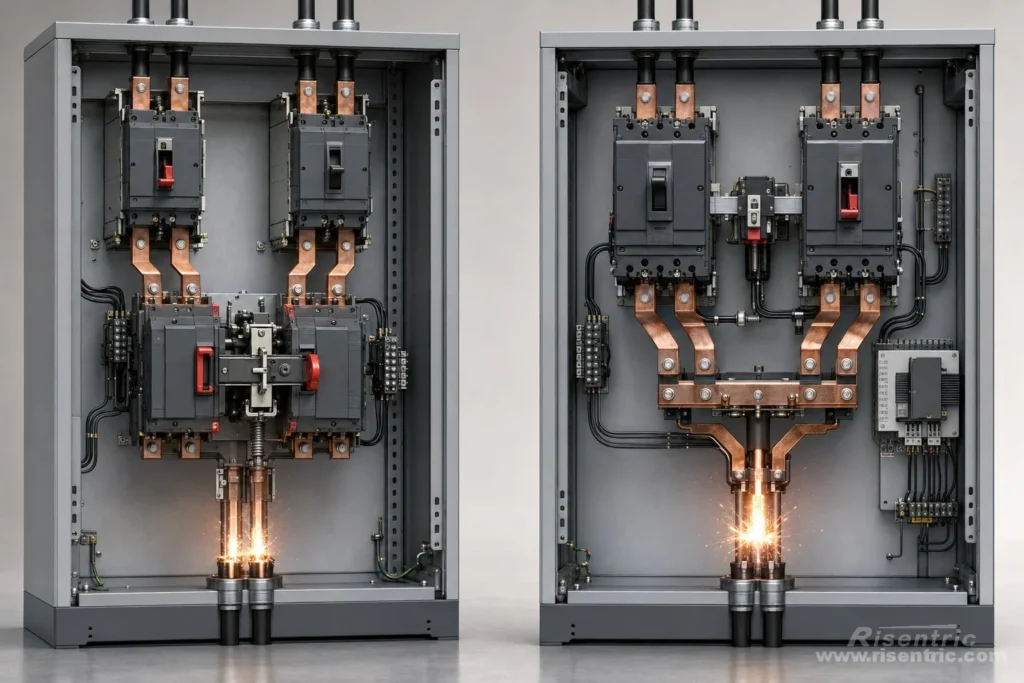
Many integrated ATS products are Class PC devices. They can make, carry and withstand specified fault currents, but normally rely on upstream circuit breakers or fuses to interrupt the fault.
Breaker-based ATS systems may be Class CB, allowing the transfer breakers to also provide overcurrent and short-circuit protection.
This partly explains their higher cost. However, the classification must be confirmed from the tested system under IEC 60947-6-1; it cannot be determined only from the physical structure.
How to Choose Between an Integrated and Breaker-Based ATS
| Selection factor | Integrated ATS | Breaker-based ATS |
|---|---|---|
| Transfer logic | Standard two-source transfer | Complex or customized sequences |
| Protection | Upstream protection available | Breakers also provide protection |
| Switchboard type | Separate compact ATS panel | MDB, MCC or main switchboard |
| Breaker type | Fixed switching device | Withdrawable ACB or MCCB |
| Maintenance | Simpler, fewer components | Easier component replacement |
| Control integration | Basic ATS control | PLC, BMS or PMS integration |
| Installation | Compact and fast to commission | More space and testing required |
| Main priority | Lower cost and simplicity | Flexibility and maintainability |
| Typical use | Standard backup power systems | High-current industrial systems |
Looking for factory-tested ATS Switchgear & Panelboards for your project?
Conclusion
A mechanical interlock is a physical safety mechanism. It prevents two switching devices from closing together.
An integrated ATS is a purpose-built transfer device that coordinates two power sources through one transfer mechanism. The motor operator, source monitoring and ATS controller may also be integrated.
For standard utility-generator and utility-utility applications, an integrated ATS is usually:
- More compact
- Easier to wire
- Faster to commission
- Simpler to test
- Less expensive as a complete panel
A two-breaker ATS is usually:
- More flexible
- Better suited to complex systems
- Easier to combine with breaker protection
- More suitable for some high-current switchboards
- Easier to integrate into customized control systems
Neither structure is automatically better.
The correct selection depends on:
- Rated current
- Short-circuit level
- Protection requirements
- Transfer logic
- Panel space
- Maintenance strategy
- Component availability
- Total installed cost
The price comparison should always include the complete system—not only the visible switching device.
FAQ
Is a mechanical interlock the same as an ATS?
No. A mechanical interlock only prevents two switching devices from closing together. An automatic ATS also requires source monitoring, transfer logic and electrically operated switching devices.
Can two circuit breakers be used as an ATS?
Yes. The breakers normally need mechanical and electrical interlocking, motorized operation, auxiliary contacts and an ATS controller.
Is an integrated ATS cheaper?
For standard low-voltage utility-generator or utility-utility systems, an integrated ATS is often cheaper as a complete panel because it requires fewer accessories, less wiring and less assembly work.
Why can a breaker-based ATS cost more?
It requires two switching devices, operating mechanisms, interlocks, auxiliary contacts, a controller, control wiring and often a larger enclosure.
Does an integrated ATS provide short-circuit protection?
Not always. Many integrated transfer switches require coordinated upstream circuit breakers or fuses.
Which ATS is better for high current?
Breaker-based ATS systems are often suitable for high-current or complex switchboards because they can use ACBs, adjustable protection and customized control logic. The final decision should be based on the project’s current rating, short-circuit level and protection requirements.


