
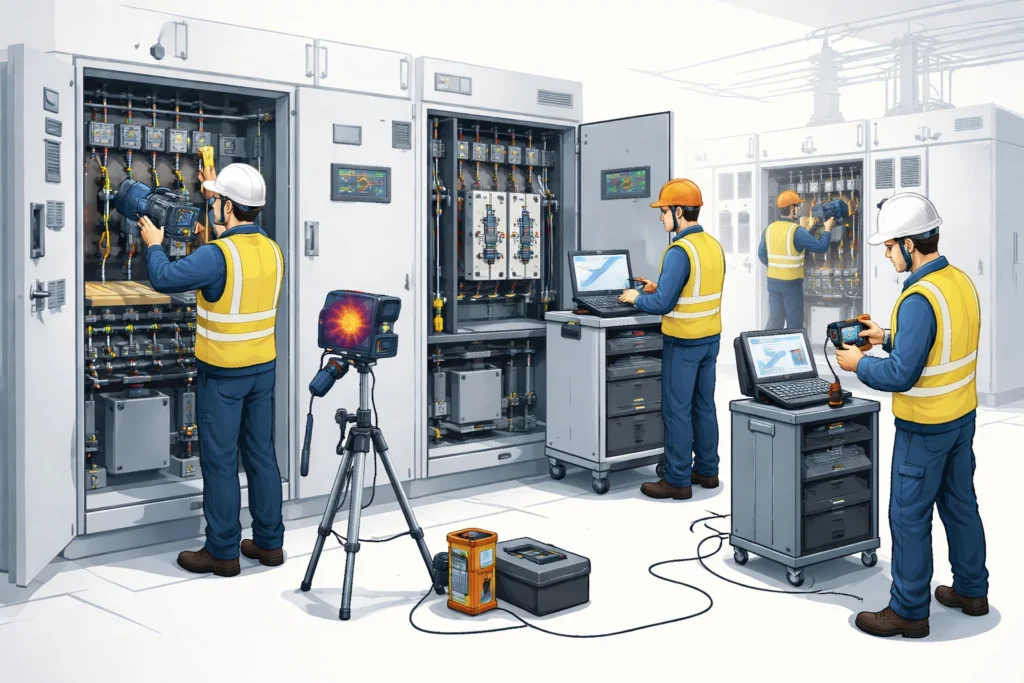
Switchgear maintenance and testing is one of the most important disciplines in power distribution reliability. Whether you operate low-voltage panels, medium-voltage switchgear, or critical industrial feeders, the goal is the same: keep the equipment safe, predictable, and ready to isolate faults when the system needs it most.
In practice, good maintenance is not just cleaning dust from a lineup. It combines inspection, testing, recordkeeping, and follow-up action.
What switchgear maintenance and testing mean
Switchgear maintenance covers inspection, cleaning, adjustment, lubrication where applicable, connection checks, interlock verification, and review of control and protection functions. Switchgear testing adds measured confirmation, such as insulation resistance, contact resistance, functional operation, and trip verification, so you can judge whether the equipment remains fit for service. It is also useful to separate acceptance testing from maintenance testing, E.g. NETA ATS is intended for equipment before initial energization, while NETA MTS applies to equipment already in service.
Looking for factory-tested switchgear for your project?
Why preventive maintenance matters

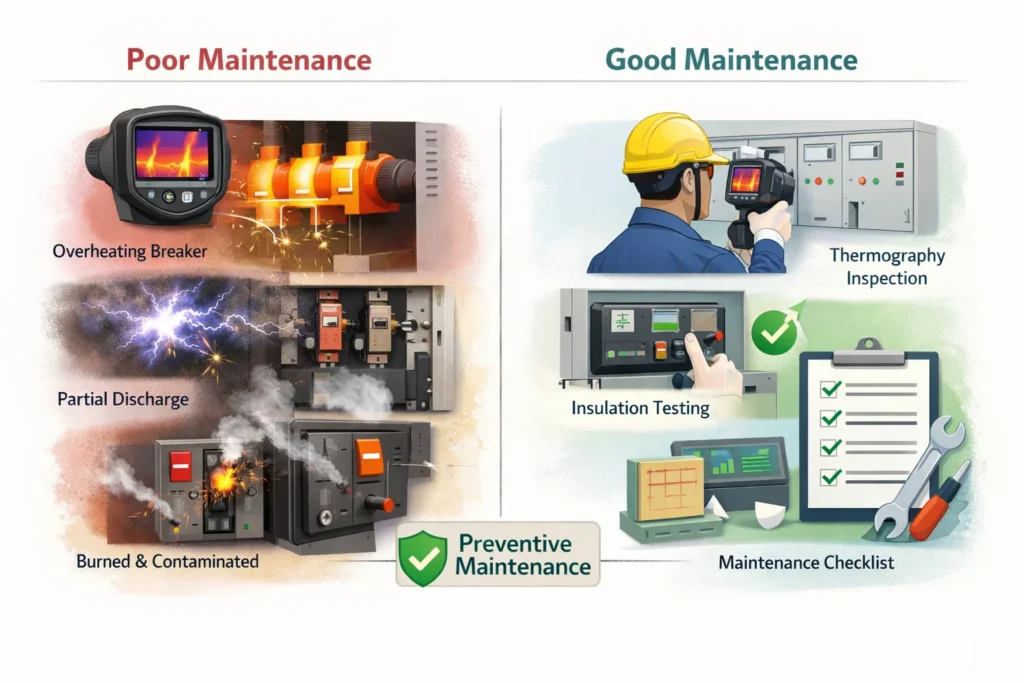
Poor switchgear condition can show up as overheating, contamination, insulation stress, mechanism problems, nuisance trips, or failure to trip under abnormal conditions. OSHA’s electrical standards focus on electrical hazards, and Schneider notes that infrared thermography can help locate potentially dangerous problems before an unplanned interruption occurs. For medium-voltage switchgear, Schneider also describes partial discharge as an insulation-related threat that may not be visible from the outside until it becomes serious.
That is why switchgear maintenance should be treated as a reliability strategy, not only a compliance task. A documented program gives teams baseline results, clearer repair priorities, and fewer surprises during shutdowns.
What a practical maintenance program should include
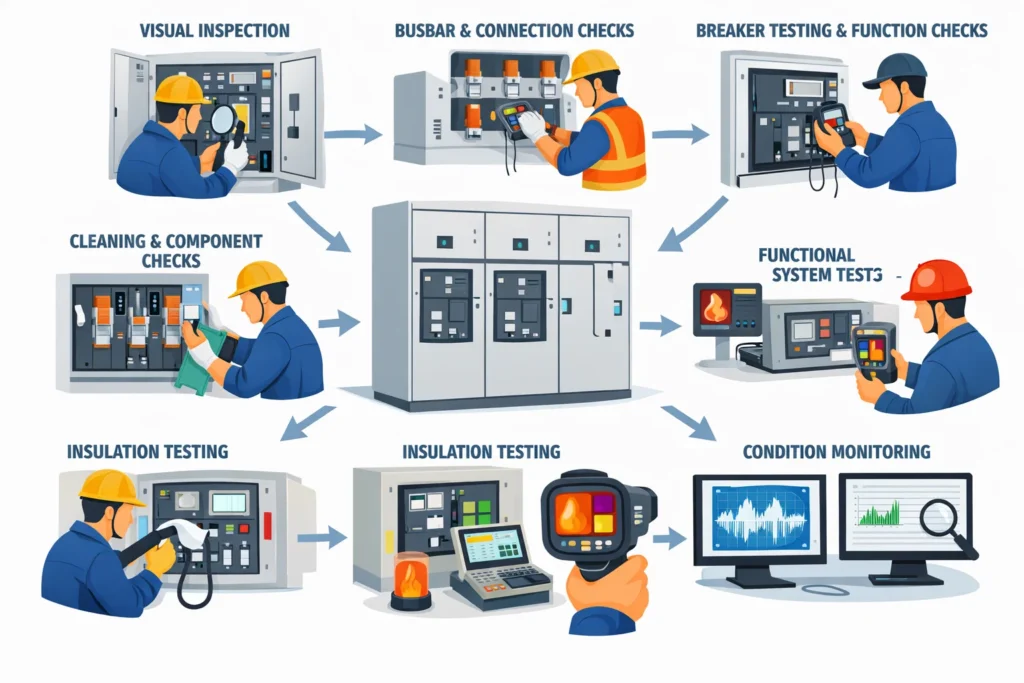
A practical outage-based maintenance scope usually starts with visual inspection of the enclosure and compartments, then moves to busbar and cable connection checks, contact system checks, cleaning, electrical component checks, functional verification, and insulation tests. ABB’s switchgear maintenance guidance lists those items explicitly, and it is a good simple model for building a real maintenance checklist, even though the exact scope will depend on the equipment design and service conditions.
Beyond the physical lineup, include breaker operation, interlocks, closing and tripping functions, indication circuits, alarms, relays, and control power circuits. Switchgear should be evaluated as a working system, not as isolated parts on a checklist. Eaton’s breaker testing guidance and NETA’s maintenance scope both reinforce that functional and electrical verification are essential parts of continued-service evaluation.
Not every useful check requires a shutdown. Schneider says thermography can be used during startup and ongoing operation, and its medium-voltage monitoring guidance describes continuous partial-discharge monitoring as a way to support anomaly detection and maintenance planning. In other words, the most reliable switchgear maintenance programs combine planned outage work with condition-based monitoring, so issues can be detected early and confirmed during scheduled maintenance.
Common switchgear tests
Insulation resistance testing
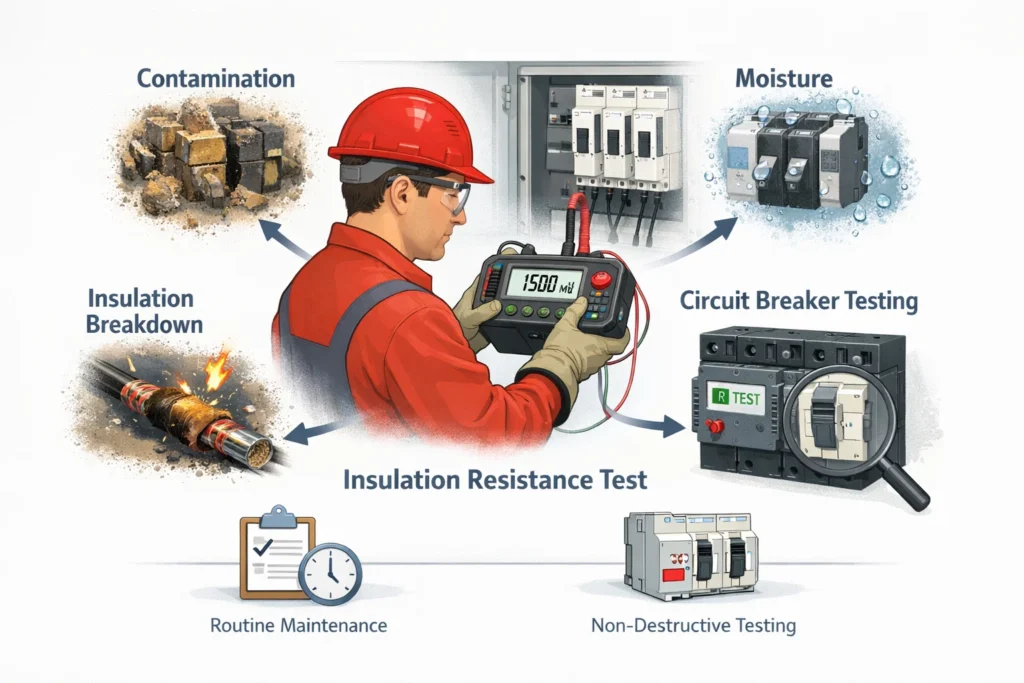
It helps reveal contamination, moisture issues, or insulation weakness trends. ABB lists insulation testing as a periodic maintenance item, and Eaton includes insulation resistance among common non-destructive breaker tests.
Contact resistance testing
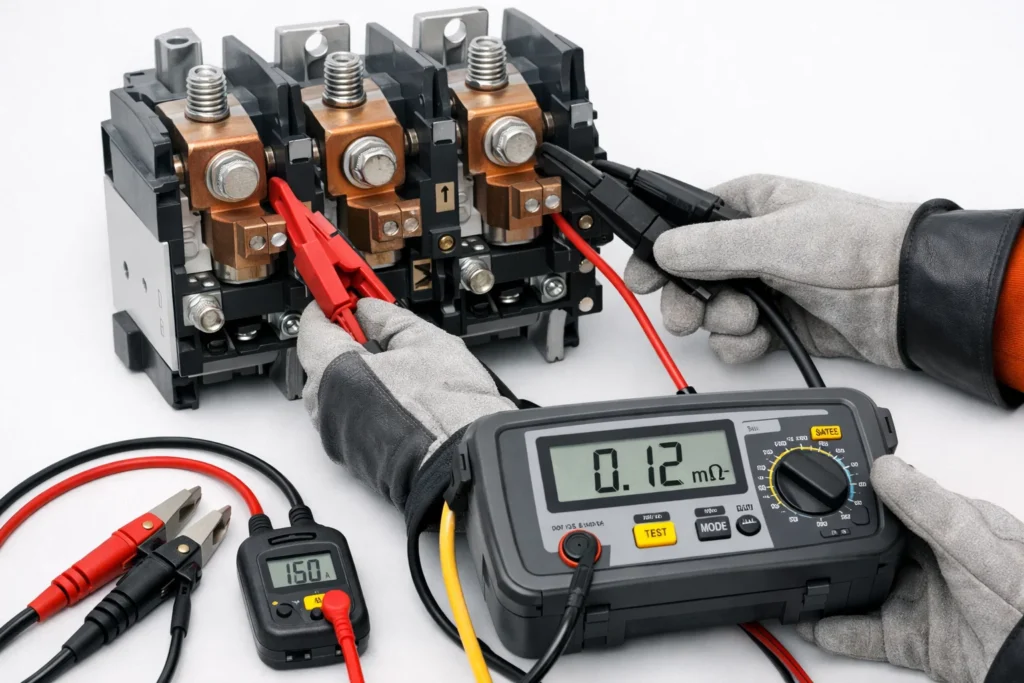
Sometimes called a millivolt drop or primary circuit resistance test—is used to confirm the electrical integrity of breaker contacts and connections. Eaton notes this test is used to verify the electrical integrity of those current-carrying paths before heat buildup becomes a failure point.
Mechanical and functional operation tests
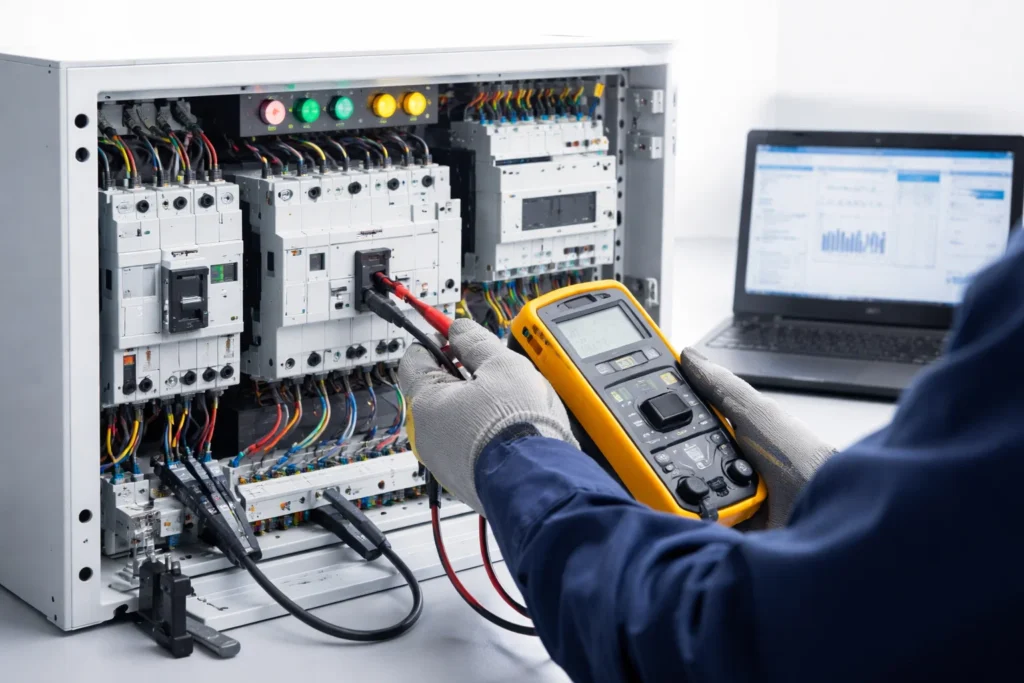
They confirm that breakers and protective devices operate within expected tolerances. Eaton’s MCCB guidance includes mechanical operation testing among the non-destructive tests used to verify breaker characteristics, and the same principle applies to wider switchgear assemblies: mechanisms, interlocks, and control functions must work correctly in real operating sequences.
Trip verification and injection testing
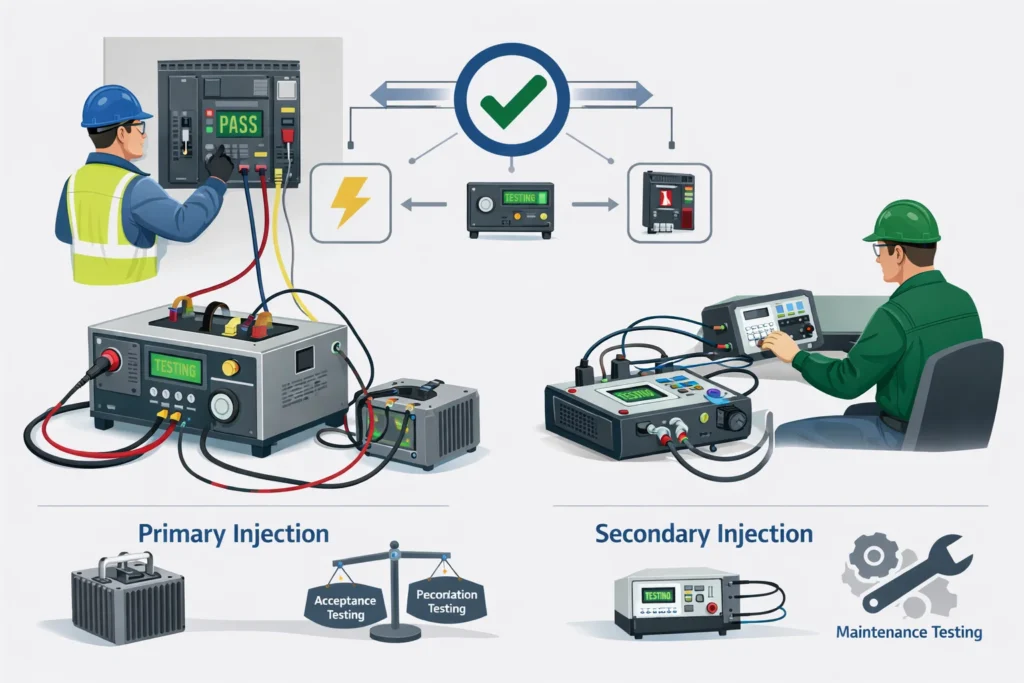
They confirm that protection and trip paths operate as intended. For some breaker families, the choice between primary and secondary injection should follow the applicable standard, device design, and the practical limits of field testing.
Infrared thermography
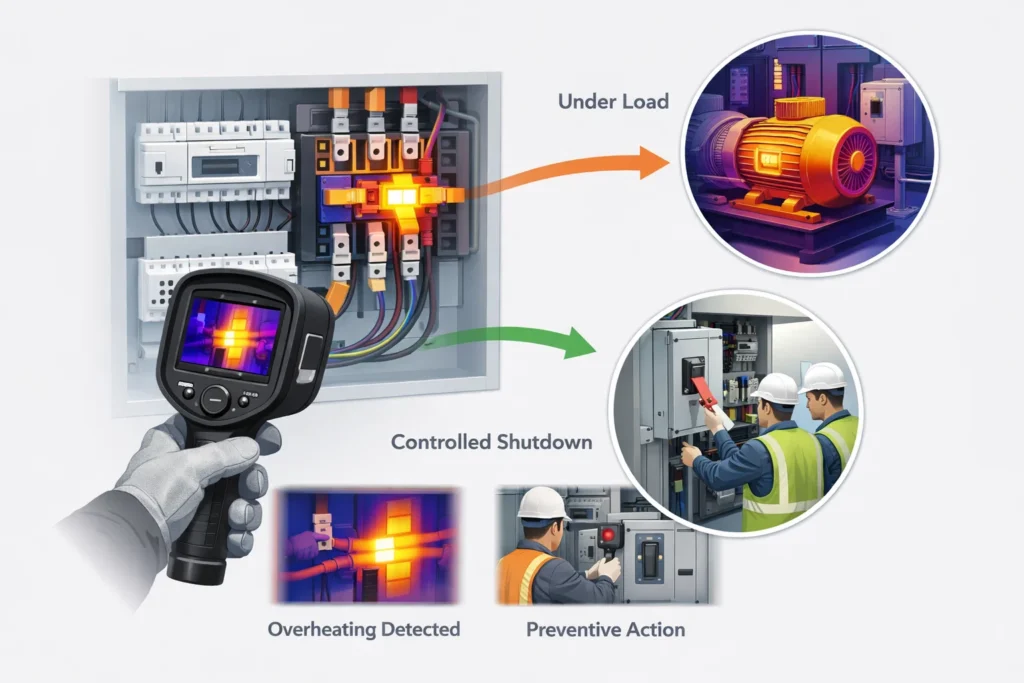
It is valuable because it can be performed under load and during normal operation. Schneider says it can locate potentially dangerous problems quickly and support controlled shutdowns before unplanned interruptions occur.
Looking for factory-tested switchgear for your project?
How often should switchgear be maintained?

There is no universal interval that fits every switchgear lineup. NETA says the ideal maintenance program is reliability-based and unique to each plant and each piece of equipment. In practice, maintenance intervals should be based on switching duty, contamination level, humidity and temperature, load criticality, fault history, equipment age, and OEM recommendations. New equipment should first pass acceptance testing, and those results should then become the baseline for future maintenance trending.
A common mistake is to copy one interval across every board, panel, and breaker. A better approach is to shorten intervals where the environment is harsher, the process is more critical, or the equipment shows abnormal trends, and lengthen them only when records justify it.
A simple maintenance workflow
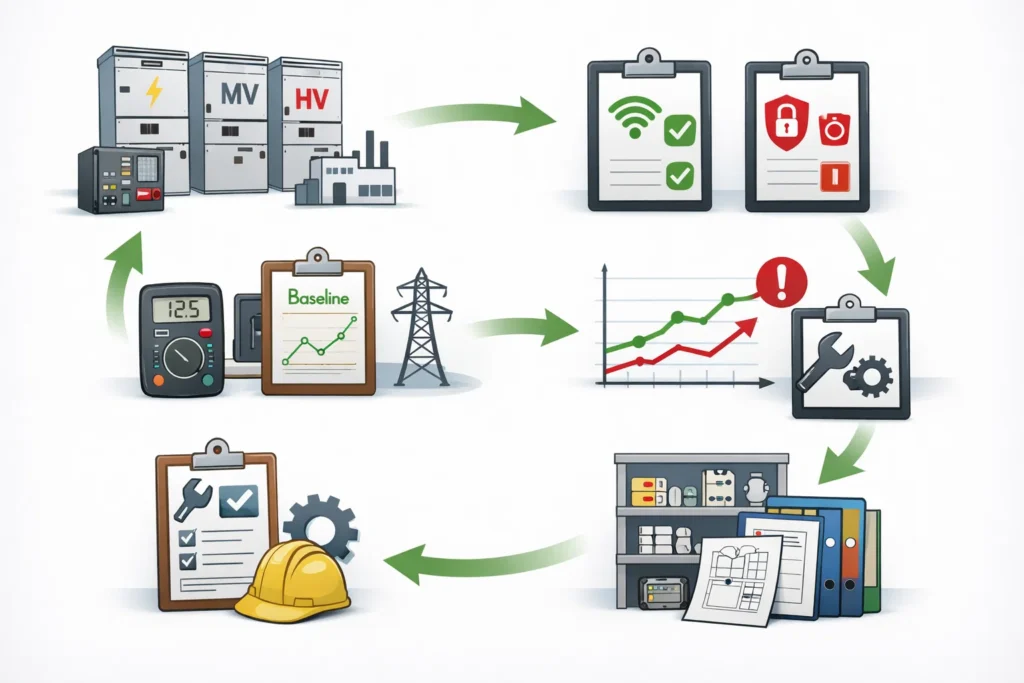
A straightforward way to manage switchgear maintenance and testing is this:
- Classify each lineup by LV/MV/HV, breaker type, and process criticality.
- Separate online checks from shutdown-only tests.
- Record baseline values after commissioning or the first major outage.
- Trend results instead of judging one report in isolation.
- Turn anomalies into corrective work orders with ownership and closeout records.
- Keep spares, drawings, and maintenance logs aligned with the actual equipment in service.
This workflow matches NETA’s reliability-based philosophy and also fits ABB and Schneider’s condition-based direction, where maintenance decisions improve when they are supported by real operating and diagnostic data.
Risentric capability

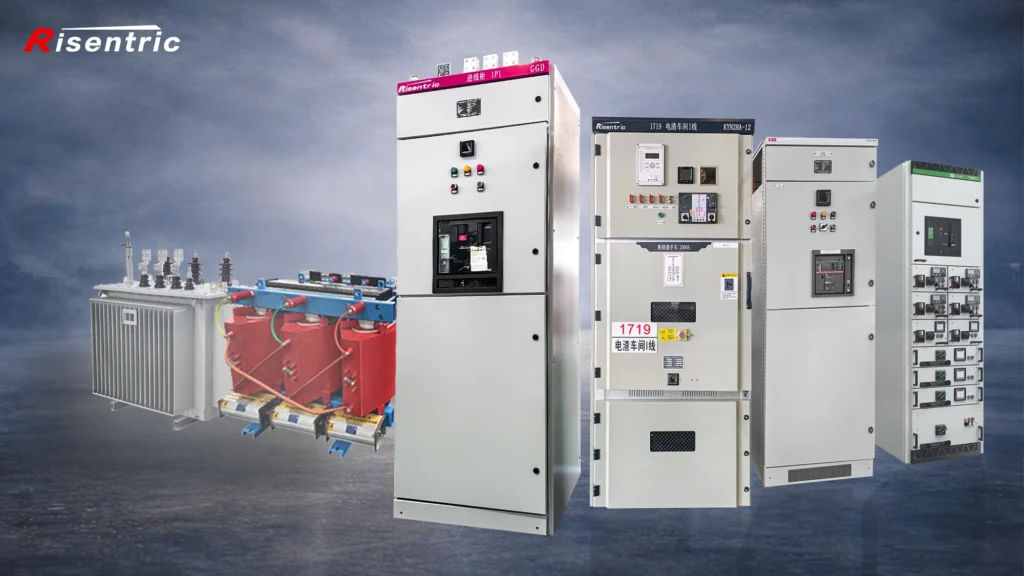
Risentric highlights LV/MV/HV switchgear, ATS, MCC, transformers, and service support, our products are designed and manufactured to applicable IEC standards including IEC 61439, IEC 60947, and IEC 61000. Our Service & Support include FAT documentation, commissioning support, remote troubleshooting, spare parts, and preventive maintenance guidance with recommended intervals and checklists.
Need support for switchgear selection, FAT documentation, commissioning, or preventive maintenance planning? Risentric supports industrial power distribution projects with technical review, documentation support, and after-delivery service coordination for switchgear and related systems.
FAQ
What is included in switchgear maintenance and testing?
A practical scope usually includes visual inspection, cleaning, connection checks, contact system checks, electrical function testing, insulation testing, and breaker or relay verification. The exact scope depends on the equipment design, site conditions, and criticality.
How often should switchgear be tested?
There is no single universal interval. NETA says maintenance should be reliability-based and specific to each item of equipment, which means the right interval depends on duty, environment, age, history, and manufacturer guidance.
Is thermography enough by itself?
No. Thermography is excellent for finding hot spots under load, but it does not replace cleaning, insulation checks, functional verification, or other shutdown-based work. For MV switchgear, insulation-related problems such as partial discharge may need additional monitoring or testing.
What is the difference between acceptance testing and maintenance testing?
Acceptance testing is performed before initial energization to confirm the installation meets design and performance expectations. Maintenance testing is performed later, while the equipment is in service life, to confirm continued suitability, condition, and reliability.
Looking for factory-tested switchgear for your project?
For Risentric’s switchgear maintenance and testing services, please refer to this page.
For further questions about switchgear maintenance and testing, please contact us.
Reference:
https://library.e.abb.com/public/5f1f8f638c14389cc1257b6000291f84/Fact%20File%20-%20Maintenance%20-%20Rev1.pdf
https://www.eaton.com/content/dam/eaton/services/eess/eess-documents/eaton-eess-mccb-primary-vs-secondary-injection-testing-mz027042en.pdf


